OIC wants establishment of international commission to probe 'extrajudicial killings' in Kashmir

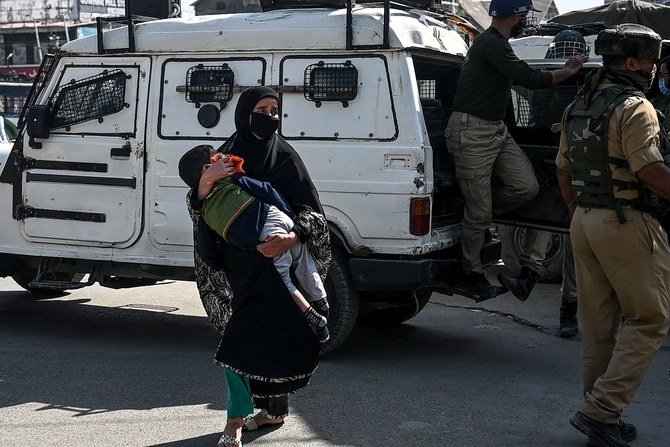
A resident carrying her child walks near Indian security personnel standing guard during clashes between protesters and government forces in Batamaloo area of Srinagar on Sept. 17, 2020. (AFP)
Short Url
Updated 20 September 2020
Follow

OIC wants establishment of international commission to probe 'extrajudicial killings' in Kashmir

  • Indian army on Friday admitted its soldiers exceeded powers in the killing of three civilians in Shopian in July
  • Pakistan says more than 300 people have been killed in fake encounters in India-administered Kashmir since August 2019

ISLAMABAD: The Organization of Islamic Cooperation (OIC) on Saturday called for the establishment of a United Nations commission to investigate extrajudicial killings in Indian-administered Kashmir, after the Indian army admitted to killing three people in a staged encounter in Shopian district earlier this year.
The Indian armed forces on Friday said that their troops had exceeded powers under the controversial Armed Forces Special Powers Act (AFSPA) in the killing of three men in Amshipora village in Shopian, southern part of Kashmir Valley in July.
The OIC’s human right’s body, the Independent Permanent Human Rights Commission (IPHRC), said in a Twitter post that it urges the international community to establish a commission of inquiry under the UN “to investigate these extrajudicial killings and grave human rights violations and urge India to repeal AFSPA.”

The IPHRC said the Indian army’s admission to the killing “reinforces IPHRC’s repeated concerns on intensity and frequency of such crimes committed by Indian forces in #IIOJK (Indian-occupied Kashmir) with impunity under AFSPA supported by the state apparatus under the Hindutva ideology.”
When the Shopian incident took place in July, the Indian forces said they had killed unidentified “rebels.” The army’s spokesman said on Friday that they were now identified as residents of Rajouri district, after an investigation following a complaint by families accusing soldiers of killing the three men in a staged gunbattle.
On Saturday, Pakistan’s Foreign Office called for a transparent judicial inquiry, under international scrutiny, into the July 18 incident.
“The Indian occupation forces had martyred 25-year old Imtiyaz Ahmed, 20-year old Mohammad Ibrar, and 16-year old Abrar Ahmed in so-called ‘cordon and search’ operation in Shopian on 18 July 2020. The young Kashmiri boys had come from Rajouri to work in apple orchard as laborers,” the Foreign Office said in a statement.
It added that since India’s move revoke Kashmir’s special autonomous status on Aug. 5, 2019, “more than 300, mostly young, Kashmiris have been extra-judicially killed by the Indian occupation forces in fake encounters and staged cordon-and-search operations.”




Pakistan issues over $7 billion sukuk in 2025, nears 20 percent Shariah-compliant debt target

Updated 29 December 2025
Follow

Pakistan issues over $7 billion sukuk in 2025, nears 20 percent Shariah-compliant debt target

  • Finance Adviser Khurram Schehzad says this was the highest-ever Sukuk issuance in a single calendar year since 2008
  • Pakistan’s Federal Shariat Court ordered in 2022 the entire banking system to transition to Islamic principles by 2027

ISLAMABAD: Pakistan’s Finance Adviser Khurram Schehzad on Monday said the country achieved a landmark breakthrough in Islamic finance by issuing over Rs2 trillion ($7 billion) sukuk this year, bringing it closer to its 20 percent Shariah-compliant debt target by Fiscal Year 2027-28.

A sukuk is an Islamic financial certificate, similar to a bond, but it complies with Shariah law, which forbids interest. Pakistan’s Federal Shariat Court (FSC) had directed the government in April 2022 to eliminate interest and align the country’s entire banking system with Islamic principles by 2027.

Following the ruling, the government and the State Bank of Pakistan (SBP) have undertaken a series of measures, including legal reforms and the issuance of sukuk to replace interest-based treasury bills and investment bonds.

“In 2025, the Ministry of Finance (MoF) through its Debt Management Office, together with its Joint Financial Advisers (JFAs), successfully issued over PKR 2 trillion in Sukuk,” Schehzad said on X, describing it as “the highest-ever Sukuk issuance in a single calendar year since 2008 by Pakistan.”

Pakistan made a total of 61 issuances across one-, three-, five- and 10-year tenors, according to the finance adviser. The country also successfully launched its first Green Sukuk, a Shariah-compliant bond designed to fund environment-friendly projects.

He said the Green Sukuk was 5.4 times oversubscribed, indicating investor demand was more than five times higher than the amount the government planned to raise, which showed strong market confidence.

“The rising share of Islamic instruments in the government’s domestic securities portfolio (domestic debt) underscores strong momentum, growing from 12.6 percent in June 2025 to around 14.5 percent by December 2025, clearly positioning the MoF to achieve its 20 percent Shariah-compliant debt target by FY28,” Schehzad said.

“This milestone also reflects the structural deepening of Pakistan’s Islamic capital market, sustained investor confidence, and the strengthening of sovereign debt management.”

He said Pakistan was strengthening its government securities market by making it more resilient, diversified, and future-ready, supported by a stabilizing macroeconomic environment, a disciplined debt strategy, and a clear roadmap for Islamic finance.