

Education minister opposes closures as Pakistani schools shut again for flouting coronavirus rules

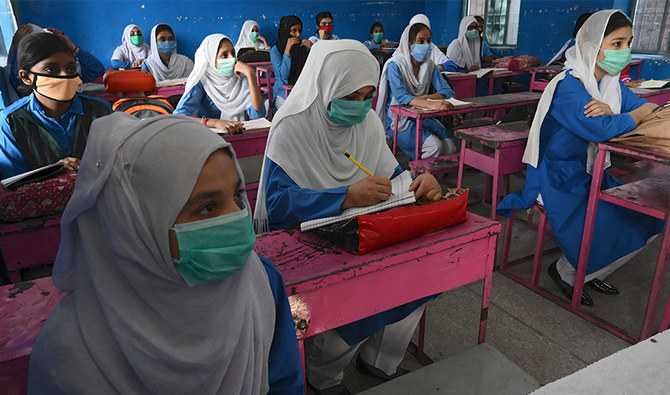
Students wearing facemasks attend a class at a government school in Lahore on September 15, 2020 after the educational institutes were reopened nearly six months after the spread of the Covid-19 coronavirus. (AFP)
Short Url
Updated 20 September 2020
Follow

Education minister opposes closures as Pakistani schools shut again for flouting coronavirus rules

  • Dozens of schools were closed in the past few days due to noncompliance with health protocols
  • Pakistan’s infection figures are increasing again after a steady decline between June and late August

ISLAMABAD: Federal Education Minister Shafqat Mahmood said on Saturday that any hasty decision to close down schools will "destroy education," after dozens of institutes across Pakistan shut down again for failing to follow coronavirus precautions.
The minister's words came a day after authorities in Sindh province decided to delay the reopening of secondary schools over fears of the spread of COVID-19. Educational institutions across the country started to reopen on Sept. 15. All schools were closed in March when the government enforced a nationwide lockdown to contain the pandemic.
The six-month closure "deeply affected the students," Mahmood said in a Twitter post. "Decision to open was taken with great care. Any hasty decision to close will destroy education."


The National Command and Operation Centre (NCOC) announced on Friday that another 13 educational institutions — 10 in Khyber Pakhtunkhwa and three in Sindh — were closed due to “non-compliance with health protocols and disease prevalence.” Also on Friday, Balochistan education department closed two high schools after several students tested positive for COVID-19. On Thursday, 22 schools were sealed in Khyber Pakhtunkhwa, Islamabad and Azad Kashmir.
Pakistan Medical Association (PMA) has warned last week that the government was "taking a huge risk" by reopening schools.
“The government should make antibody tests for school staff compulsory to check the infection before the reopening,” PMA secretary general Dr. Qaiser Sajjad told Arab News on Sept. 12, as he warned that school staff and students could become virus carriers.
Pakistan’s infection figures are increasing again after a steady decline between June and late August.
At least 645 people have tested positive for the coronavirus during the past 24 hours. Over 305,000 people have contracted the virus in Pakistan since the beginning of the outbreak and 6,415 have succumbed to the disease.


Pakistan moves to digitize payments for 10 million women under flagship poverty initiative

Updated 5 sec ago
Follow

Pakistan moves to digitize payments for 10 million women under flagship poverty initiative

  • BISP Official says accounts will be linked to phones to boost financial inclusion and curb payment deductions
  • Over 1.9 million SIMs issued as the nationwide rollout continues across provinces ahead of the March deadline

ISLAMABAD: Pakistan’s flagship poverty alleviation initiative, the Benazir Income Support Program (BISP), plans to equip 10 million women with digital bank accounts linked to their phone numbers within four months in one of the largest such exercises in the world, one of its top officials said on Wednesday.

Launched in 2008, the initiative is named after the late former prime minister Benazir Bhutto and has a budget of Rs716 billion ($2.5 billion) during the current fiscal year. Through its Benazir Kafaalat — or financial assistance — program, BISP provides quarterly stipends of Rs13,500 ($48) to around 10 million women.

In an exclusive interview with Arab News, BISP Secretary Amir Ali Ahmed said the opening of digital bank accounts for the beneficiaries was part of Prime Minister Shehbaz Sharif’s initiative related to a cashless economy and digital transformation of the country.

“I’m glad to share that 10 million bank accounts, wallet accounts were created,” he said. “This is a follow-up of the same exercise whereby now 10 million SIMs are being distributed.

“It is significant to share that the entire beneficiary network that we have is female-centric,” he continued. “So these are 10 million female accounts that have been created.”

Ahmed said the process of issuing mobile phone SIM cards to BISP beneficiaries had started on November 17 and would be completed by March next year.

“Let me share that this is one of the largest such exercises to be conducted in the world which is female-centric, linked with financial inclusion and financial empowerment.”

The BISP official added that out of the more than 10 million beneficiaries, only five to 10 percent had bank accounts, but nearly 90 to 95 percent were excluded from the system.

He said they were being linked to the banking system with cellphone SIMs that are being distributed with the help of the IT ministry, Pakistan Telecommunication Authority, National Database and Registration Authority and telecom companies across the country.

“We feel that this initiative of the government of Pakistan will not only result in financial empowerment of our beneficiaries, it will also result in financial inclusion of a segment which was not part of the banking sector in Pakistan,” he said, adding that the move will also lead to transparency.

In the past, there have been complaints of women not getting their full payment from bank officials in the absence of their own accounts, but Ahmed said this was going to change.

“They will be free from any exploitation at the agent networks, the queues that one would witness, the complaints of corruption or deductions that would emerge,” he continued.

According to official data, more than 1.9 million SIMs have so far been issued for BISP beneficiaries across the country.

The province of Punjab leads the rollout with 810,597 SIMs, followed by Sindh with 523,629 and Khyber Pakhtunkhwa with 371,427 SIMs.

In other regions, Azad Jammu and Kashmir has received 59,617, Balochistan 82,826, Gilgit-Baltistan 45,184, and Islamabad 4,508 SIMs.