


CAIRO: At the Pyramids of Giza, just a handful of tourists walks among the ancient wonders. Only 12 people showed up to admire Luxor’s towering colonnades the day it reopened this month. At Egypt’s Red Sea resorts, visitor numbers are well below previous years.
Even as international flights and tourist spots open up and Egypt’s coronavirus cases remain in check, officials, hotel owners and tour guides concede that the key winter season starting in October is going to be tough.
That could be bad news for the economy. Tourism accounts for up to 15 percent of Egypt’s national output, and officials said it was losing about $1 billion each month after the sector all but shut down from March as the coronavirus pandemic struck.
Egyptian officials say they are making every effort to reassure tourists about their safety and encourage them to visit in the hope that the sector revives gradually.
Egypt is not alone in seeing tourism slump, but it takes a heavy toll on a country that has tapped the International Monetary Fund for $8 billion in new loans this year.
“We used to see about 50 buses here. Now there are none,” said Samir, a souvenir trader who has been working at the pyramids south of Cairo for more than 30 years and has been selling his possessions to pay his son’s school fees.
“We only had one bus, a week ago, full of Russians. They took some photos and left.”
A showpiece museum next to the pyramids is due to open next year, increasing the need for a rapid recovery in 2021.
Westerners typically flock to Egypt’s historic sites and golden sands between October and May to avoid the cold at home and the excessive heat of Egypt’s summer.
FASTFACT
Tourism accounts for about 15 percent of Egyptian GDP.
As the sector gears up, hotel resorts are operating at below half capacity and major sites remain virtually empty, tourist workers and official said.
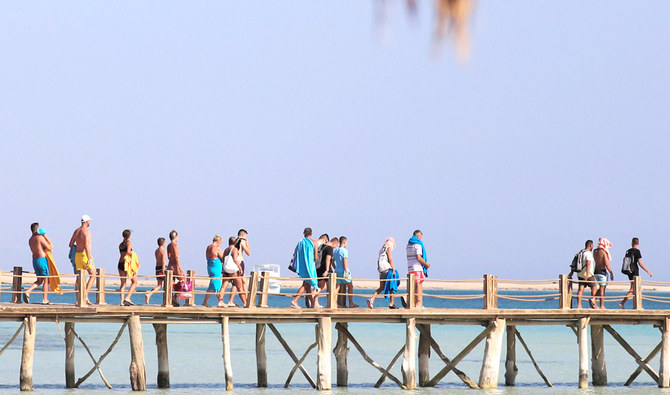
Some 220,000 tourists have visited the Red Sea province and South Sinai — home to the Sharm El-Sheikh resort — since July 1, less than 10 percent of last year’s levels, said Ghada Shalaby, a deputy minister at the Tourism and Antiquities Ministry.
Shalaby said visitors were gradually returning to the coastal resorts, but people’s safety took priority over boosting tourism numbers.
Hotels currently have capacity capped at 50 percent in line with health regulations.
Occupancy at Sharm el-Sheikh is 30 to 35 percent and in Egypt’s Red Sea Governorate and the resort of Hurghada it is 35 to 45 percent, a Tourism Ministry official said.
As sites in Luxor, across the River Nile from the Valley of the Kings, reopened on Sept. 1, a single group of 12 tourists showed up on a visit from Hurghada, said Tharwat Agamy, head of the regional branch of the Egyptian Travel Agents Association. A few more have visited the city daily since then.
Nile cruises are due to restart in October, but there is little expectation that bookings will pick up without a return of charter flights.
“We hope that next year tourism will be working,” said Agamy.
The state has moved to protect the sector with emergency funding, and more than 9,000 registered tour guides will receive 500 Egyptian pounds ($32) monthly until the end of the year. Tourism firms are pleading for exemptions on some fees to be extended.
Mohamed Othman, who owns a Nile cruise boat and a hotel and markets cultural tourism in southern Egypt, said he was hopeful for some bookings in November, and reopening sent an important signal, even if “an influx won’t happen overnight.”
Officially recorded coronavirus cases have fallen to under 200 daily from highs of about 1,500 daily in mid-June. Officials say tourist sites and hotels are subject to strict controls. Those entering the country are required to take PCR tests. But the EU has not added Egypt to its safe travel list.
“We are sparing no effort to ensure that all measures are in place for the return of tourism to the maximum possible capacity and to spread reassurance to the tourists,” said Shalaby.
At Cairo’s Khan Al-Khalili market, a popular tourist shopping spot, many stores are shuttered.
“There is no one,” said Sayed Abel Khaleq, a silver shop owner.


