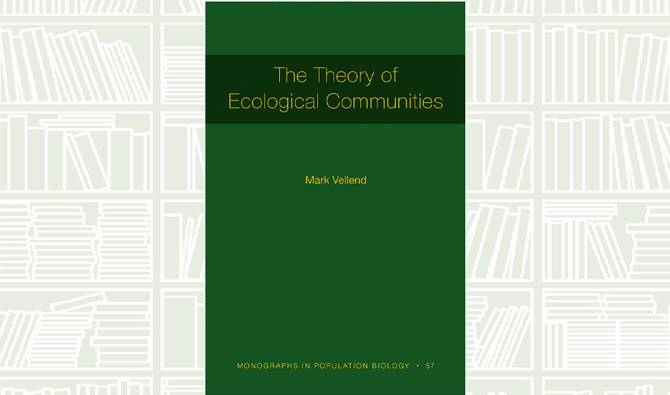
What We Are Reading Today: The Theory of Ecological Communities (MPB-57) by Mark Vellend

Short Url
Updated 17 September 2020
Follow

What We Are Reading Today: The Theory of Ecological Communities (MPB-57) by Mark Vellend

A plethora of different theories, models, and concepts make up the field of community ecology. Amid this vast body of work, is it possible to build one general theory of ecological communities? What other scientific areas might serve as a guiding framework? As it turns out, the core focus of community ecology—understanding patterns of diversity and composition of biological variants across space and time—is shared by evolutionary biology and its very coherent conceptual framework, population genetics theory. The Theory of Ecological Communities takes this as a starting point to pull together community ecology’s various perspectives into a more unified whole.

Mark Vellend builds a theory of ecological communities based on four overarching processes: Selection among species, drift, dispersal, and speciation. These are analogues of the four central processes in population genetics theory—selection within species, drift, gene flow, and mutation—and together they subsume almost all of the many dozens of more specific models built to describe the dynamics of communities of interacting species. 

The result is a theory that allows the effects of many low-level processes, such as competition, facilitation, predation, disturbance, stress, succession, colonization, and local extinction to be understood as the underpinnings of high-level processes with widely applicable consequences for ecological communities.


What We Are Reading Today: ‘Rituals of War’

Photo/Supplied
Updated 29 December 2025
Follow

What We Are Reading Today: ‘Rituals of War’

  • Bahrani brings together and analyzes facets of war and sovereign power that fall under the categories of representation and display, the aesthetic, the ritualistic, and the supernatural

Author: Zainab Bahrani

“Rituals of War” is an investigation into the earliest historical records of violence and biopolitics. In Mesopotamia, ancient Iraq (ca. 3000–500 BC) rituals of war and images of violence constituted part of the magical technologies of warfare that formed the underlying irrational processes of war. In the book, three lines of inquiry are converged into one historical domain of violence, namely, war, the body, and representation.

Building on Foucault’s argument in “Discipline and Punish” that the art of punishing must rest on a whole technology of representation, Zainab Bahrani investigates the ancient Mesopotamian record to reveal how that culture relied on the portrayal of violence and control as part of the mechanics of warfare. Moreover she takes up the more recent arguments of Giorgio Agamben on sovereign power and biopolitic to focus on the relationship of power, the body and violence in Assyro-Babylonian texts and monuments of war.

Bahrani brings together and analyzes facets of war and sovereign power that fall under the categories of representation and display, the aesthetic, the ritualistic, and the supernatural.