

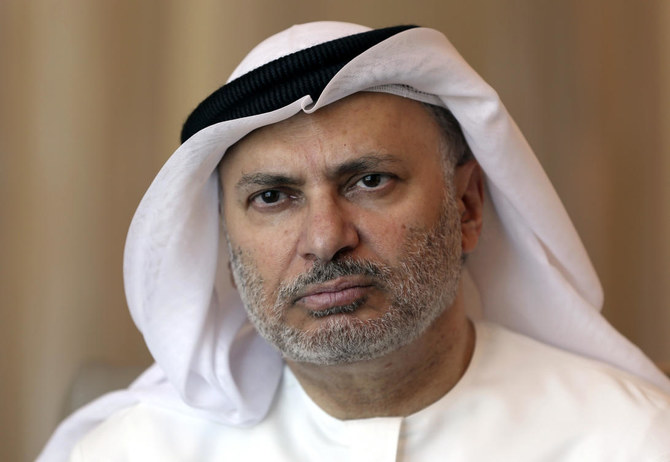

DUBAI: The UAE’s Minister of State for Foreign Affairs has promised that his country’s relationship with Israel will be comprehensive and deep, and will ultimately help the Palestinian cause.
In an online briefing attended by Arab News on Wednesday, Anwar Gargash discussed his country’s commitment to wide-ranging diplomatic, economic and cultural exchanges with Israel, made possible by the Abraham Accords signed on Tuesday.
The Abraham Accords will normalize the relationship between the UAE and Israel, and have been widely hailed as a “historic moment” in the story of the modern Middle East.
On the future relationship, Gargash said: “This will be a very, very warm peace. There will be normal diplomatic relations — our diplomats throughout the world have already been inundated with requests to meet with Israeli diplomats. We have authorized many of these meetings.”
This extensive diplomatic opening, he said, “will be done within days, rather than months.”
In a wide-ranging discussion hosted by the UK’s Emirates Society, Gargash also said that the UAE “is determined that this will be an across-the-board relationship,” incorporating “tourism, banking, trade, investment, health and technology,” into a wide-ranging bilateral relationship.
He said this will “break the taboo of a Gulf state having relations with Israel.”
Gargash also rallied against tribal differences that obstruct regional peace and prosperity.
Fundamental in overcoming this, he said, is the importance of “shattering the psychological barrier” of Muslim and Jewish coexistence.
Once this barrier has been broken, “other tasks will not be easy, but they will be more manageable.”
He said the Palestinian question is one such issue.
The UAE remains committed to a two-state solution to the Israel-Palestine conflict, but Gargash said it is “difficult to have leverage over somebody without communication.
“From our perspective … in the medium-term (the Palestinians) will find out that the UAE, through its new links forged in this relationship, will be able to help them more.”
However, Gargash made clear that it is “extremely important that the Palestinians engage.”
He said their “empty chair approach” has not been helpful thus far, and will not be in the future, and warned that Israeli annexation of up to 30 percent of the West Bank — an initiative suspended as a result of the Abraham accords — could resume within five years if the Palestinians do not re-engage diplomatically.
While the Palestinians are chiefly responsible in this regard, Gargash also pointed to key players in the international community that can assist in the pursuit of this goal.
In particular, British and US recognition of a Palestinian state “would be both admirable and important,” he said.
“Fundamentally, it is the Israelis and Palestinians that must solve this issue,” he added.
This cooperation, he hopes, will lead to the peaceful coexistence of both an Israeli and a Palestinian state.
“I think we are all better off with a two-state solution, and I think we should all work towards that,” Gargash said.


