

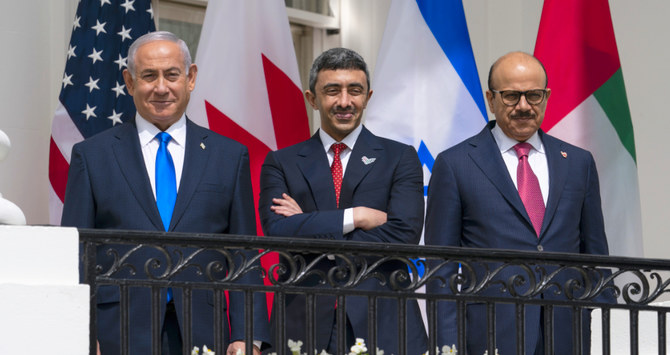

CHICAGO: In what seemed like a re-enactment of ceremonies that have come before, nearly 1,000 people gathered on the South Lawn of the White House on Tuesday to watch Arab and Israeli leaders sign landmark normalization accords. In addition to the promise of a new page in Jewish-Arab relations, the event generated photo-ops that President Donald Trump will find useful as he heads down the final stretch of the 2020 presidential campaign.
Despite the inevitable feeling of deja vu, the signing of the Abraham Accords declaration is different in important respects from the treaties that were signed by Egypt’s Anwar Sadat, Jordan’s King Hussein and Palestine’s Yasser Arafat. For one, the immediate objective is not the cessation of military hostilities or the creation of a Palestinian state, but rather “normalization” of relations between Israel and two Gulf states that have been on the sidelines of the Arab-Israeli conflict.
The White House ceremony was also different in that it took place against the backdrop of a global pandemic that has claimed the lives of almost 200,000 people in the US and hundreds more in the three signatory countries: Israel, the UAE and Bahrain. The mask-wearing attendees visible in photos and videos of the gathering are likely to become markers of a most unusual period in modern world history.
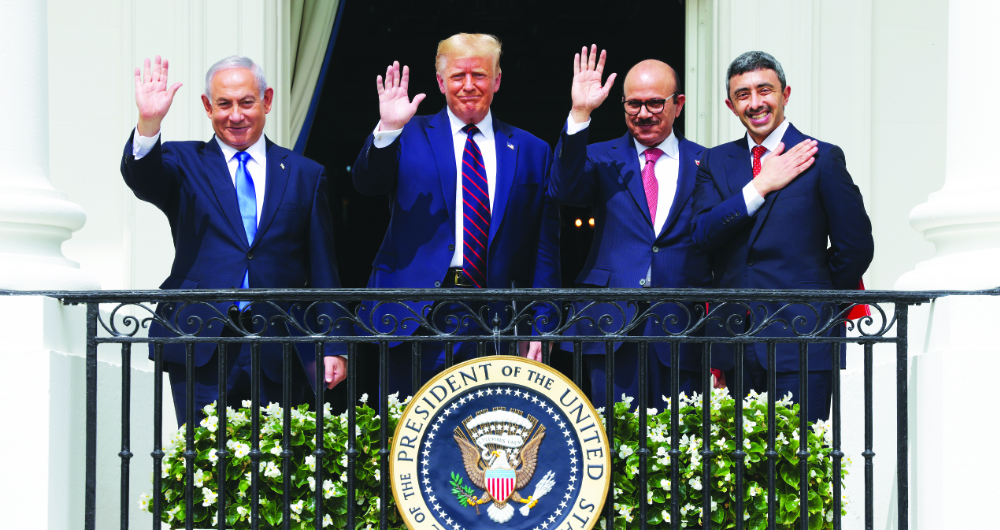
President Donald Trump hosted Israeli Prime Minister Benjamin Netanyahu, far left, and the foreign ministers of Bahrain and the UAE, Abdullatif bin Rashid Al-Zayani and Abdullah bin Zayed Al-Nahyan, at the White House for the signing ceremony on Tuesday. (AFP)
That said, a peace accord with an Arab country has always been critical to Israel’s foreign-policy vision. Sealing deals with two Arab countries at the same time can only be described as a dream come true for an Israeli leader, in this case Prime Minister Benjamin Netanyahu. As for President Trump, who brokered the agreements, he has come in for praise even from liberal American media outlets, who have described the Abraham Accords declaration as a major political achievement.
Most US reports in the run-up to Tuesday’s event listed in detail the Israeli attendees, noting that the agreements would be signed by Netanyahu and witnessed by Trump. By contrast, the representatives of the UAE and Bahrain, who countersigned the documents for their countries, were described as the “foreign ministers of the United Arab Emirates and Bahrain,” not respectively as Abdullah bin Zayed Al-Nahyan and Abdullatif bin Rashid Al-Zayani.
Trump emphasized that his team “wanted this to happen so badly … they doubted it would happen.” That team included several administration officials who have strong personal ties to Israel through their politics and their faiths, including Jared Kushner, Trump’s son-in-law and White House senior adviser; Avi Berkowitz, special representative for international negotiations; and David Friedman, the US ambassador to Israel.
All in all, the agreement was a diplomatic master stroke for Israel and a coup for Trump’s re-election campaign, which has the support of many significant voting blocs, notably Jewish Americans and Evangelical Christians. What cast a shadow, however, was the flat-out rejection of the accords by the Palestinians as well as the continued ill feeling between the Israeli and Palestinian governments.
These aspects of the Abraham Accords are in sharp contrast to the handshakes that took place on Sept. 13, 1993, at the White House South Lawn between Palestinian leader Yasser Arafat and Israeli Prime Minister Yitzhak Rabin, with President Bill Clinton looking on. Tuesday’s ceremony came exactly 27 years to the week from that historic moment, which was also packed with the promise of a new page in Israeli-Arab relations. Rabin was assassinated, two years later, by an Israeli extremist in November 1995.
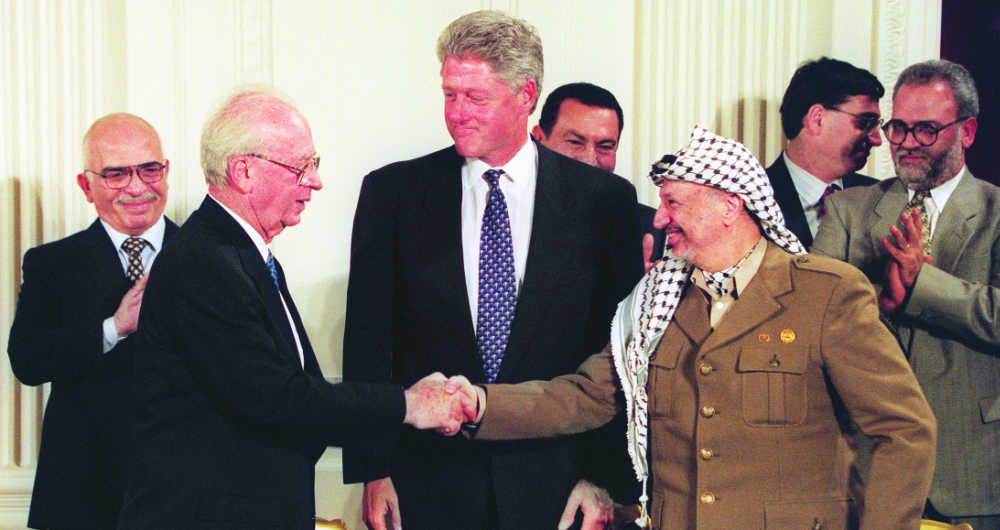
US President Bill Clinton, center, brokered the Oslo Accord between Israeli PM Yitzhak Rabin and PLO Chairman Yasser Arafat, seen shaking hands, on Sept. 13, 1993. (AFP)
Will this time be different? While thanking Trump and officials of the UAE and Bahrain, Netanyahu did not explicitly mention Palestinians when he said the accords would bring peace to “all.” But in an interview with Arab News, Ronald Lauder, a billionaire businessman and chairman of the influential World Jewish Congress, welcomed the Abraham Accords and emphasized that the Palestinian issue was still a priority.
“I think that this is a historic agreement between Israel and the UAE and between Israel and Bahrain. It opens up the entire region; it is a question of starting to believe in each other,” he said.
“This is going to have a ripple effect throughout the Middle East. I believe there will be other countries joining very shortly in this phase. And I believe very, very much that the Palestinians, seeing what is happening, will finally say it is time to come to the peace table and will sit down with Israel and the United States and say let’s talk peace.”
Earlier, Jamal Al-Musharakh, Director of Policy Planning at the UAE Ministry of Foreign Affairs, said the agreement signed by his country will create a “new environment” that will foster and nurture peace not only between Israel and other Arab states but also with Palestinians themselves.
“We have not abandoned the Palestinians,” he told Arab News. “It is a strategic shift. The deal provides a more optimistic view of the future and will result in benefits for all in the region, including for the Palestinians. But the Palestinians need to engage with the peace process themselves.”
The domestic political implications of the normalization agreements will be analyzed deeply by American pundits in the weeks to come. The UAE-Israel agreement was sealed on Aug.13 while the Bahrain-Israel deal materialized just last week.
White House officials, including Berkowitz, told reporters in a recent background briefing that the UAE agreement is much more detailed than the Bahrain deal, which is still being discussed.
Skeptics argue that the objective of the exercise in peace-making is essentially Trump’s re-election. The White House added grist to the mill by issuing a formal press release on Sept. 9 announcing that Trump had again been nominated for a Nobel Peace Prize.
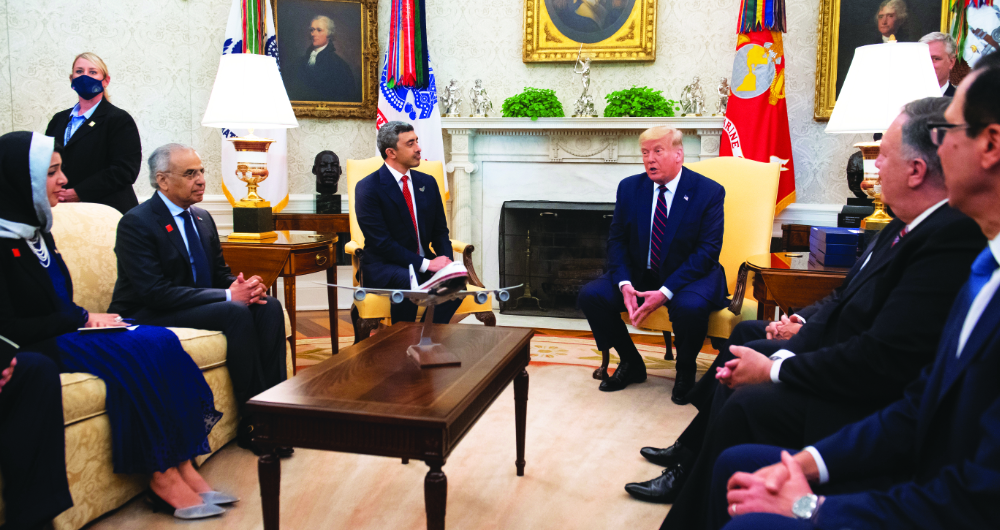
President Trump met with UAE Foreign Minister Abdullah bin Zayed Al-Nahyan in the Oval Office before the signing of the Abraham Accord. (AFP)
As far as Israeli politics is concerned, the recognition by two Arab states has helped bolster the political standing of Netanyahu, who endured three tightly fought elections before he could reach a power-sharing deal with his rival, Benny Gantz.
Many questions remain to be answered. Will more Arab countries sign agreements with Israel and which ones are they? Lauder said he hoped Saudi Arabia and Morocco would be next.
Will the agreements lead to a new wave of negotiations between Israel and the Palestinians? In the fullness of time, how will the hardliners in Iran, Lebanon’s Hezbollah, Gaza’s Hamas rulers and the Qataris react to the Abraham Accords?
Such questions may not have been uppermost in the minds of the attendees of the Sept. 15 White House gathering, but then Washington, D.C. is a world away from the furies of the Middle East. According to media reports, Hamas militants in Gaza fired two rockets into southern Israel, wounding two people, in an attack that was apparently timed to coincide with the signing ceremony.
Twitter: @rayhanania


