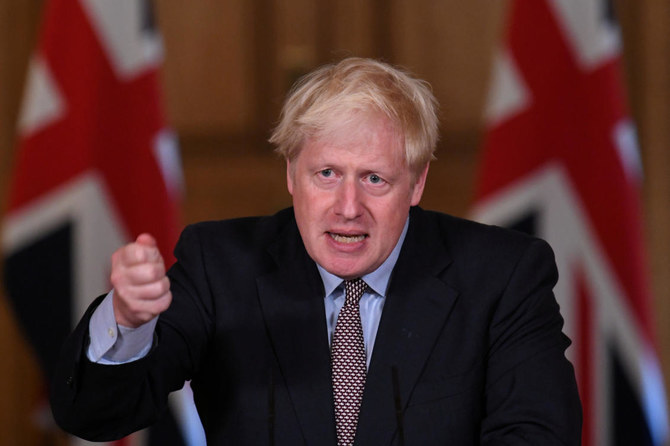
LONDON: British Prime Minister Boris Johnson has strongly defended his government’s plan to override sections of the Brexit deal he negotiated with the European Union, arguing that the EU has an “extreme” interpretation of the treaty that could jeopardize the UK’s future.
In a column published Saturday in The Daily Telegraph, Johnson said the government’s Internal Market Bill is needed to end EU threats to impose a “blockade” in the Irish Sea that the prime minister asserted could “carve up our country.”
The legislation, which the British government has conceded violates international law in places, has prompted a furious outcry within the EU and Johnson’s Conservative Party. British lawmakers are expected to debate it next week.
With the government showing no sign of changing course, there are real concerns that ongoing talks on a future trade deal between the UK and the EU could collapse within weeks. If that happens, tariffs and other impediments to trade will be imposed by both sides at the start of 2021.
The furor is largely based on the fact that the bill would diminish the EU’s previously agreed oversight of trade between mainland Britain and Northern Ireland in the event a trade agreement isn’t secured.
Michael Gove, a senior member of Johnson’s Cabinet, told Sky News on Saturday that the government needs to take out an “insurance policy.”
The UK left the EU on Jan. 31, but it is in a transition period that effectively sees it benefit from the bloc’s tariff-free trade until the end of the year while a future relationship is negotiated. Even before the latest standoff, discussions between the EU’s chief negotiator, Michel Barnier, and his UK counterpart, David Frost, had made very little progress.
One major element of the Brexit withdrawal agreement, which allowed for the UK’s smooth departure from the EU, is the section related to ensuring an open border on the island of Ireland to protect the peace process in Northern Ireland
The issue proved thorny during the more than two years of discussions it took to get a Brexit deal done, as the border between Northern Ireland and Ireland is the only land link between the UK and the EU.
The EU wanted assurances the border would not be used as a back-route for unlicensed goods arriving in Ireland from the rest of the UK — England, Scotland and Wales. As a result, the two sides agreed there would be some kind of regulatory border between mainland Britain and Northern Ireland.
In his newspaper column, Johnson wrote he was “now hearing” that unless his government agrees to the EU’s terms in the trade discussions, then the bloc will use “an extreme interpretation of the Northern Ireland protocol to impose a full-scale trade border down the Irish Sea.”
He said that could mean the EU imposing tariffs on goods moving to Northern Ireland from the rest of the UK or that the bloc stops the transport of food products.
“I have to say that we never seriously believed that the EU would be willing to use a treaty, negotiated in good faith, to blockade one part of the UK, to cut it off; or that they would actually threaten to destroy the economic and territorial integrity of the UK,” the prime minister wrote.
EU leaders have expressed dismay at the U.K’s bill and warned that the trade talks will end if Johnson does not pull the contested proposal. Legal action has also been threatened.
Luis Garicano, a Spanish member of the European Parliament, slammed Johnson’s allegation that the EU is trying to break up the UK as “ridiculous.”
“I think Mr. Johnson insists on having his cake and eating it,” Garicano told BBC radio.
US House Speaker Nancy Pelosi has also said there would be “absolutely no chance” of a trade deal between the United States and the UK if commitments to Northern Ireland are violated. Congress has to ratify all US trade deals.
The EU-UK trade discussions are set to resume on Monday in Brussels.
“It’s now for the UK to reestablish trust toward the European Union,” the EU’s economy commissioner, Paolo Gentiloni, said Saturday at a meeting of European finance ministers in Berlin. “We are prepared to deal also with (an) extraordinary negative outcome of this discussion, but we are still working for finding agreements and solutions.”


Boris Johnson defends Brexit change to avoid UK ‘carve-up’
https://arab.news/6zgr8
Boris Johnson defends Brexit change to avoid UK ‘carve-up’

- Johnson said the government’s Internal Market Bill is needed to end EU threats to impose a “blockade” in the Irish Sea
- The legislation has prompted a furious outcry within the EU and Johnson’s Conservative Party


Left homeless by blaze, Muslims in southernmost Philippines observe Ramadan as month of trial
- Thousands lost their homes when parts of Bongao in Tawi-Tawi were burnt to ashes
- Many trying to fully observe the fasting month say they are grateful to be alive
Manila: As Annalexis Abdulla Dabbang was looking forward to observing the month of Ramadan with her family, just days before it began they lost everything when an enormous fire tore through whole neighborhoods of their city in the southernmost province of the Philippines.
Bongao is the capital of Tawi-Tawi, an island province, forming part of the country’s Muslim minority heartland in the Bangsamoro region. The city experienced its worst fire in years in early February, when flames swept through the coastal community, leaving more than 5,000 people homeless.
“We were swimming for our lives. We had to swim to escape from the fire ... We swam in darkness, and (even) the sea was already hot because of the fire,” Dabbang, a 27-year-old teacher, told Arab News.
“Everything we owned was gone in just a few hours — our home, our memories, the things we worked hard for, everything turned to ashes.”
Trying to save their 2-year-old daughter and themselves, she and her husband left everything behind — as did hundreds of other families that together with them have since taken shelter at the Mindanao State University gymnasium — one of the evacuation centers.
Unable to secure a tent, Dabbang’s family has been sleeping on the bleachers, sharing a single mat as their bed. When Ramadan arrived a few days after they moved to the makeshift shelter, they welcomed it in a different, more solemn way. There is no family privacy for suhoor, no room or means to welcome guests for iftar.
“Ramadan feels different now. It’s painful but at the same time more real. When we lost our home, we began to understand what sacrifice really means. When you sleep in an evacuation center, you understand hunger, discomfort in a deeper way,” Dabbang said.
“We don’t prepare special dishes. We prepare our hearts.”
While she and thousands of others have lost everything they have ever owned, she has not lost her faith.
“Our dreams may have turned to ashes, but our prayers are still alive,” she said.
“This Ramadan my prayers are more emotional than ever. I pray for strength, not just for myself, but for my family and for every neighbor who also lost their family home. I pray for healing from the trauma of fire. I pray that Allah will replace what we lost with something better. I pray for the chance to rebuild not just our house, but our sense of security.”
Juraij Dayan Hussin, a volunteer helping the Bongao fire victims, observed that many of them were traumatized and the need to cleanse the heart and mind during Ramadan was what kept many of them going, because they are “thankful that even though they lost their property, they are still alive.”
But the religious observance related to the fasting month is not easy in a cramped shelter.
“It’s hard for Muslims to perform their prayers when they do not have their proper attire because they usually have specific clothes for prayer,” he said. “Sanitation in the area is also an issue ... when you fast and when you pray, cleanliness is essential.”
For Abdulkail Jani, who is staying at a basketball court with his brother and more than 70 other families, this Ramadan will be spent apart from their parents, whom they managed to move to relatives.
“The month of Ramadan this year is a month of trial ... there will be a huge change from how we observed Ramadan in the past, but we will adjust to it and try to comfort ourselves and our family. The most important thing is that we can perform the fasting,” he told Arab News.
“Despite our situation now, despite everything, as long as we’re alive, we will observe Ramadan. We’ll try to observe it well, without missing anything.”


