

UK woman charged with murder of her 5-year-old daughter in London

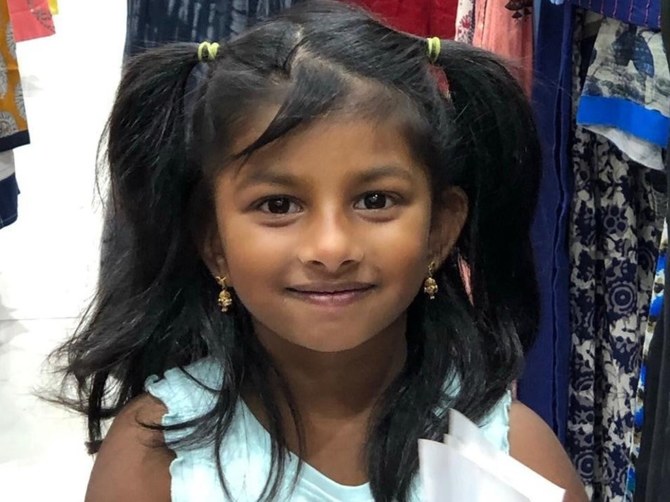
Five-year-old Sayagi Sivanantham was taken to hospital by London Ambulance Service where she was subsequently pronounced dead. (Metropolitan Police)
Short Url
Updated 12 September 2020
Follow

UK woman charged with murder of her 5-year-old daughter in London

  • Sutha Sivanantham, 35, is accused of killing Sayagi at their home in Mitcham on June 30
  • Sayagi Sivanantham was described as a ‘smart kid, always smiling’

LONDON: A British woman charged with murdering her 5-year-old daughter has been remanded in custody after a short court hearing.
Metropolitan Police said that Sutha Sivanantham, 35, appeared via video link at Wimbledon Magistrates’ Court on Friday over the death of Sayagi Sivanantham.
“Police were called to an address on Monarch Parade in Mitcham (south London) at 16:00hrs on Tuesday, 30 June to a report of two people injured,” Met. Police said on their website.

The officers who attended the scene “found a woman and a girl suffering from knife wounds.”
Sayagi was taken to hospital by ambulance but was pronounced dead soon after and a post-mortem examination at Great Ormond Street Children’s Hospital on July 3 gave the cause of death as stab injuries. Her mother was also taken to hospital in a critical condition.
Neighbor Elsa Gonzales, 47, said she heard screaming and crying coming from the flat next door and when she went round she found a woman and child in the bedroom.


Undated handout photo of Sayagi Sivanantham who died in hospital from knife wounds after an attack in a flat in Mitcham, south London, in June. (Metropolitan Police)

“I saw the woman lying on the floor in a pool of blood,” Ms Gonzales told the PA news agency at the time, adding “there was blood everywhere. It’s really breaking my heart, the child was a smart kid, she was always smiling.”
She described Sayagi as a “cheeky little girl, always playing with the neighborhood kids”.
The family are believed to be from Sri Lanka and had lived in the flat for about five years, The Sun newspaper reported.
Siobhain McDonagh, the Labour MP for Mitcham and Morden, tweeted: “Truly tragic events in Mitcham over the last [two] days. My sincere condolences to family and friends.
“My thoughts are also with neighbors & residents who have witnessed such tragedy.”
The case has been sent to the Old Bailey, where a hearing is scheduled to take place on Tuesday.


Only 4% women on ballot as Bangladesh prepares for post-Hasina vote

Updated 5 sec ago
Follow

Only 4% women on ballot as Bangladesh prepares for post-Hasina vote

  • Women PMs have ruled Bangladesh for over half of its independent history
  • For 2026 vote, only 20 out of 51 political parties nominated female candidates

DHAKA: As Bangladesh prepares for the first election since the ouster of its long-serving ex-prime minister Sheikh Hasina, only 4 percent of the registered candidates are women, as more than half of the political parties did not field female candidates.

The vote on Feb. 12 will bring in new leadership after an 18-month rule of the caretaker administration that took control following the student-led uprising that ended 15 years in power of Hasina’s Awami League party.

Nearly 128 million Bangladeshis will head to the polls, but while more than 62 million of them are women, the percentage of female candidates in the race is incomparably lower, despite last year’s consensus reached by political parties to have at least 5 percent women on their lists.

According to the Election Commission, among 1,981 candidates only 81 are women, in a country that in its 54 years of independence had for 32 years been led by women prime ministers — Hasina and her late rival Khaleda Zia.

According to Dr. Rasheda Rawnak Khan from the Department of Anthropology at Dhaka University, women’s political participation was neither reflected by the rule of Hasina nor Zia.

“Bangladesh has had women rulers, not women’s rule,” Khan told Arab News. “The structure of party politics in Bangladesh is deeply patriarchal.”

Only 20 out of 51 political parties nominated female candidates for the 2026 vote. Percentage-wise, the Bangladesh Socialist Party was leading with nine women, or 34 percent of its candidates.

The election’s main contender, the Bangladesh Nationalist Party, whose former leader Zia in 1991 became the second woman prime minister of a predominantly Muslim nation — after Pakistan’s Benazir Bhutto — was the party that last year put forward the 5 percent quota for women.

For the upcoming vote, however, it ended up nominating only 10 women, or 3.5 percent of its 288 candidates.

The second-largest party, Jamaat-e-Islami, has not nominated a single woman.

The 4 percent participation is lower than in the previous election in 2024, when it was slightly above 5 percent, but there was no decreasing trend. In 2019, the rate was 5.9 percent, and 4 percent in 2014.

“We have not seen any independent women’s political movement or institutional activities earlier, from where women could now participate in the election independently,” Khan said.

“Real political participation is different and difficult as well in this patriarchal society, where we need to establish internal party democracy, protection from political violence, ensure direct election, and cultural shifts around female leadership.”

While the 2024 student-led uprising featured a prominent presence of women activists, Election Commission data shows that this has not translated into their political participation, with very few women contesting the upcoming polls.

“In the student movement, women were recruited because they were useful, presentable for rallies and protests both on campus and in the field of political legitimacy. Women were kept at the forefront for exhibiting some sort of ‘inclusive’ images to the media and the people,” Khan said.

“To become a candidate in the general election, one needs to have a powerful mentor, money, muscle power, control over party people, activists, and locals. Within the male-dominated networks, it’s very difficult for women to get all these things.”