US sanctions Lebanese former ministers for corruption, supporting Hezbollah

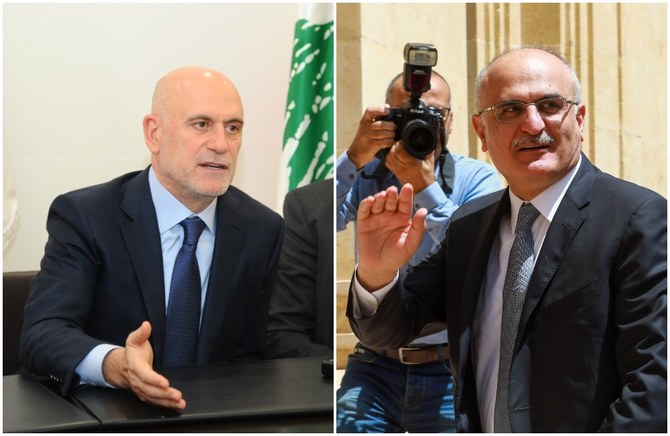
Former Lebanese government ministers Yusuf Finyanus (left) and Ali Hassan Khalil have been sanctioned by the US for helping Hezbollah. (NNA/AFP)
Short Url
Updated 08 September 2020
Follow

US sanctions Lebanese former ministers for corruption, supporting Hezbollah

  • Ali Hassan Khalil and Youssef Fenianos will have assets frozen, financial dealings with them penalized

BEIRUT: The US imposed sanctions on Tuesday on two former Lebanese government ministers for corruption and supporting Hezbollah.
The sanctions targeted former finance minister Ali Hassan Khalil and former transport minister Youssef Fenianos.

Khalil is a senior official in the Amal group headed by parliamentary Speaker Nabih Berri. Fenianos is a member of the Christian Marada group allied with Hezbollah and the Assad regime in Syria. Their assets in the US will be blocked and any financial dealings with them are subject to criminal penalties.
The US said Khalil directed funds to Hezbollah institutions to evade US sanctions, and Fenianos received “hundreds of thousands of dollars” from Hezbollah in return for political favors.

Washington “will use all available authorities to promote accountability for Lebanese leaders who have failed their people,” US Secretary of State Mike Pompeo said.
“Hezbollah depends on Lebanon's corrupt political system for survival. Anyone helping to advance Hezbollah’s political or economic interests is further eroding what remains of effective governance and facilitating financing for terrorism.”

Meanwhile troops were deployed in the Tariq Al-Jadida area of Beirut on Tuesday to prevent further violence at the funeral of a man killed in a shoot-out the night before.

The man died and two others were injured in fighting between rival groups armed with automatic weapons and rocket-propelled grenades.

Interior Minister Mohammed Fahmi and Grand Mufti Sheikh Abdul Latif Derian met on Tuesday to discuss the incident, and both condemned the violence.

“The armed riot is unacceptable,” Fahmi said. “People are fed up with innocent civilians being killed and injured in disputes between individuals who hide behind their weapons.”

Derian described the clashes as “fighting among brothers.”

“Disputes cannot be solved with weapons,” he said. “Enough fighting. We hope our children will return to their senses.” 

Khalil, from the southern town of Khiam, joined Amal when he was a law student in the 1980s and is considered to be Nabih Berri’s right-hand man. He was first elected to parliament in 1996 for a Shiite seat in Marjayoun-Hasbaya, and re-elected in the 2000, 2005 and 2009 elections.

He was agriculture minister in the government of Rafik Hariri, and in later administrations became health minister and finance minister. During the street protests in Lebanon that began last October, information published about Khalil’s personal wealth surprised many who knew him.

Fenianos is part of the Marada movement headed by former minister Suleiman Franjieh, and is said to form a channel of communication and coordination between Hezbollah and the Future Movement. He has previously defended against Hezbollah against accusations of using Beirut airport for illegal purposes. 

Arab News last month reported a surge in smuggling personal weapons from Syria as confidence in the Lebanese state evaporates amid a political vacuum and economic collapse.

Many Lebanese are also taking to flimsy boats and fleeing to Cyprus, 90 km across the Mediterranean. Cyprusrepatriated 90 Lebanese migrants to Tripoli on Tuesday, some of them women and children, after they attempted to enter the island illegally.

“At least five boats carrying more than 150 migrants were stopped,” Cypriot Interior Minister Nicos Nouris said. “Cyprus is on alert.” Cypriot officials will visit Lebanon this week to discuss the problem.



Iran FM tells UN all military bases of ‘hostile forces’ legitimate targets

Updated 28 February 2026
Follow

Iran FM tells UN all military bases of ‘hostile forces’ legitimate targets

  • UN chief condemns escalation, calls for immediate return to negotiating table
  • Emergency session of Security Council set to convene on Saturday in New York

NEW YORK: Iran will use “all necessary defensive capabilities and means” to confront attacks by the US and Israel, and will treat “all bases, facilities, and assets of the hostile forces in the region” as legitimate military targets under its right to self-defense, Foreign Minister Abbas Araghchi said on Saturday.

In a letter to UN Secretary-General Antonio Guterres and the president of the Security Council, Araghchi said US and Israeli airstrikes are “a clear violation” of the UN Charter and amount to “an open armed aggression” against Iran.

Tehran is exercising its “inherent and lawful right of self-defense” under the UN Charter, he added.

The letter, seen by Arab News, accused the US and Israel of launching coordinated, large-scale attacks on Iranian territory, targeting defensive facilities and civilian sites in several cities.

Araghchi said Iran will continue to act “decisively and without hesitation until the aggression ceases fully and unequivocally,” adding that the US and Israel “shall bear full and direct responsibility for all ensuing consequences, including any escalation arising from their unlawful actions.”

He called on the 15-member Security Council to convene an emergency meeting to address a “breach of peace which is a real and serious threat to international peace and security,” and urged UN member states to “unequivocally condemn this act of aggression.”

An emergency session of the council is set to convene in New York on Saturday, requested by France, Bahrain, Colombia, China and Russia.

The Russian mission at the UN said in a statement that during the meeting, Moscow will demand that the US and Israel “immediately cease their illegal and escalatory actions and embark on a path toward a political and diplomatic settlement.” It added that “Russia is willing to provide all necessary assistance in this process.”

Meanwhile, Guterres condemned the military escalation, saying “the use of force by the United States and Israel against Iran, and the subsequent retaliation by Iran across the region, undermine international peace and security.”

The UN Charter clearly prohibits “the threat of the use of force against the territorial integrity or political independence of any state, or in any other manner inconsistent with the Purposes of the United Nations,” Guterres said in a statement.

He called for an immediate cessation of hostilities and de-escalation, and an immediate return to the negotiating table, adding that “failing to do so risks a wider regional conflict with grave consequences for civilians and regional stability.”

UN human rights chief Volker Turk also deplored the escalation and warned that civilians are the ones who end up paying “the ultimate price.”

He said: “Bombs and missiles are not the way to resolve differences but only result in death, destruction and human misery.”

Turk called for restraint and implored the parties “to see reason, to de-escalate, and (return) to the ‘negotiating table’ where they had been actively seeking a solution only hours earlier.”