

Blindness is no barrier for this female Pakistani radio jockey

Rehana Gul behind the radio console at FM 92.2 Pakhtunkhwa in the northwestern Pakistani city of Peshawar on September 2, 2020. (AN Photo)
Short Url
Updated 08 September 2020
Follow

Blindness is no barrier for this female Pakistani radio jockey

  • For Rehana Gul, the road to becoming the first ever blind radio presenter in Khyber Pakhtunkhwa province has been paved with obstacles
  • Her weekly show on FM 92.2 tells stories of people with disabilities, describes their struggles and shares inspirational tales of successes despite odds

PESHAWAR: Four times each month, Rehana Gul positions herself behind the radio console at FM 92.2 Pakhtunkhwa in the northwestern Pakistani city of Peshawar to tell the stories of people with disabilities, describe their struggles and share inspirational tales of their successes despite all odds.
Policy makers, researchers and medical doctors come on the line to provide commentary and answer questions, and this 27-year-old resident of Peshawar handles all this seamlessly, despite the fact that she has been blind from birth.
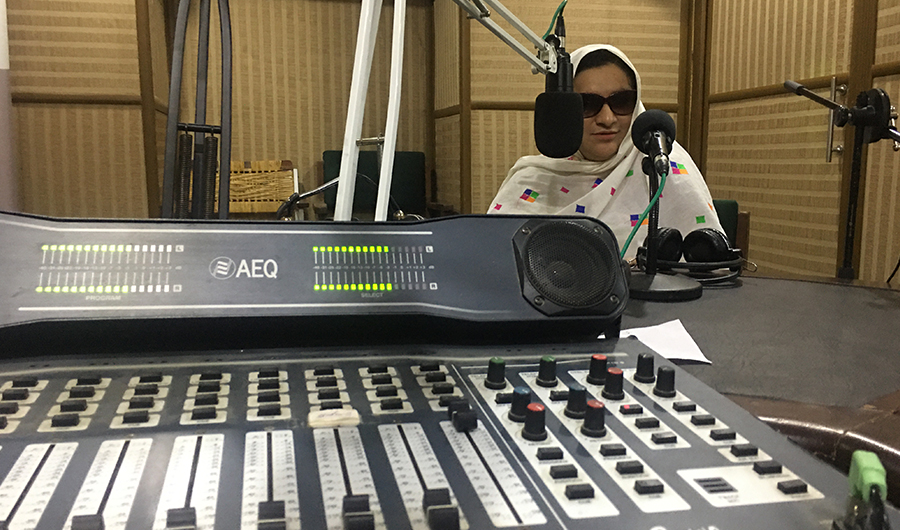


Rehana Gul behind the radio console at FM 92.2 Pakhtunkhwa in the northwestern Pakistani city of Peshawar on September 2, 2020. (AN Photo)

For Gul, the road to becoming the first ever blind radio presenter in Pakistan’s northwestern Khyber Pakhtunkhwa province has been paved with obstacles.
Since she was young, Gul was used to hearing the common refrain: “Rehana Gul is blind and also a woman and she will always need someone to hold her hand,” Gul told Arab News in an interview in her disk jockey’s vibrant voice. “Society is patriarchal and less educated about women and disable persons’ rights but nothing deterred me.”
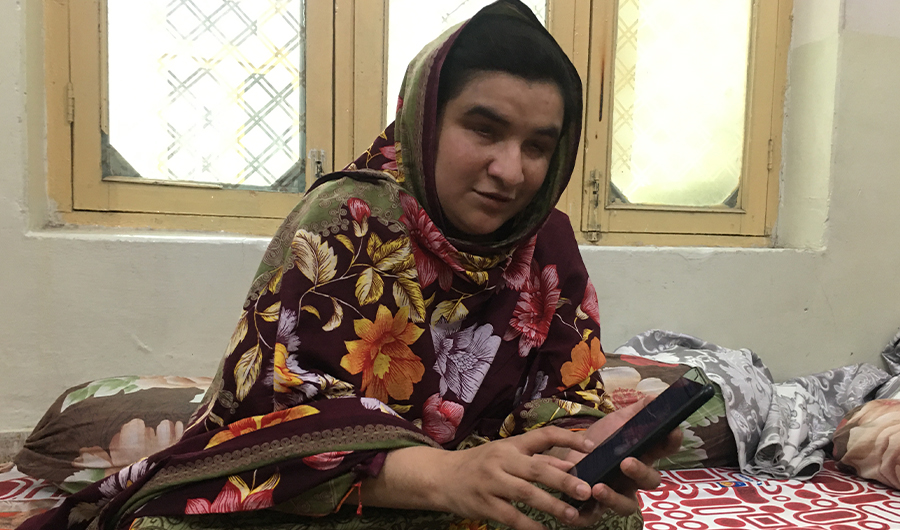


Rehana Gul, the first ever blind radio presenter in Khyber Pakhtunkhwa province, poses at her home in Peshawar, Pakistan, on August 31, 2020 (AN Photo)

Gul was born in Shergarh town of district Mardan and first came to the city of Rawalpindi for treatment when she was six years old. After several checkups, the doctors told her elder brother she would never be able to see and he should enroll her at a school for blind people in the city’s Shamsabad area.
She studied there until the 10th grade, before switching to a regular college and finally enrolled in an educational psychology degree at the University of Peshawar. She then took a job as a voluntary teacher at a school for people with visual impairments in Peshawar, always dreaming of breaking into a career that would help her contribute to her household, especially to help support her illiterate elder brother who she says has always been a pillar of strength, and a cousin in whose house she resides in Peshawar.
About a year ago, a friend referred Gul to try out for a job at FM 92.2. The producer was impressed with her voice, Gul said, and spoke to station director Ansar Khilji about offering her a slot. Soon after, Gul pitched the idea for a program called ‘Mashaloona,’ or ‘Light,’ to highlight the issues of people with disabilities. It was approved.
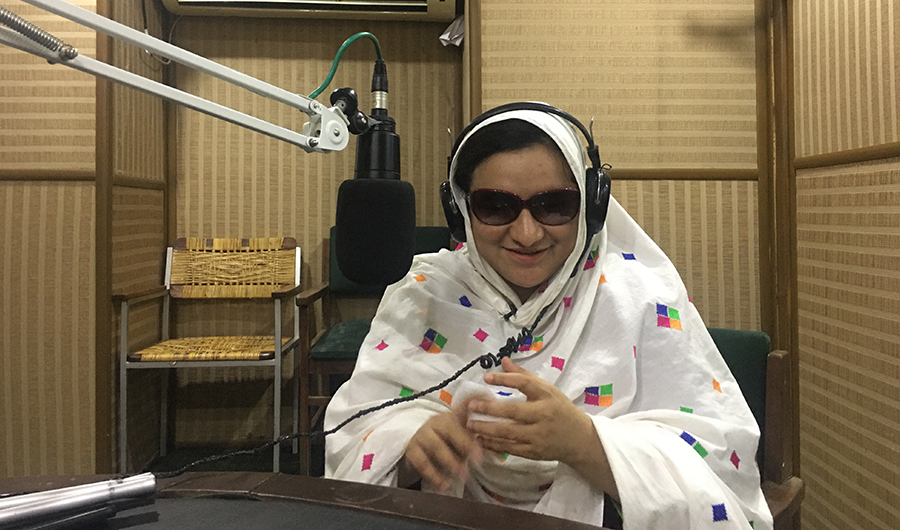


Rehana Gul behind the radio console at FM 92.2 Pakhtunkhwa in the northwestern Pakistani city of Peshawar on September 2, 2020. (AN Photo)

“Introducing Rehana was not an easy task,” Khilji said, speaking about dominant attitudes in the radio industry against people with disabilities. “But Rehana is a prolific presenter … and has perfect voice, delivery and clarity.”
Though Gul says she does not earn enough from her radio show to be self-sufficient or support her family, she said she was glad to finally have a platform to highlight the problems faced by Pakistanis who were not fully sighted or able-bodied.
“Blindness is no more a hurdle for me and that’s why I want to change the minds of those who listen to me, and let them know about the genuine rights of persons with disabilities,” she said. “There is nothing impossible in this world.”


Pakistan’s OGDC ramps up unconventional gas plans

Updated 4 sec ago
Follow

Pakistan’s OGDC ramps up unconventional gas plans

  • Pakistan has long been viewed as having potential in tight and shale gas but commercial output has yet to be proved
  • OGDC says has tripled tight-gas study area to 4,500 square km after new seismic, reservoir analysis indicates potential

ISLAMABAD: Pakistan’s state-run Oil & Gas Development Company is planning a major expansion of unconventional gas developments from early next year, aiming to boost production and reduce reliance on imported liquefied natural gas.

Pakistan has long been viewed as having potential in both tight and shale gas, which are trapped in rock and can only be released with specialized drilling, but commercial output has yet to be proved.

Managing Director Ahmed Lak told Reuters that OGDC had tripled its tight-gas study area to 4,500 square kilometers (1,737 square miles) after new seismic and reservoir analysis indicated larger potential. Phase two of a technical evaluation will finish by end-January, followed by full development plans.

The renewed push comes after US President Donald Trump said Pakistan held “massive” oil reserves in July, a statement analysts said lacked credible geological evidence, but which prompted Islamabad to underscore that it is pursuing its own efforts to unlock unconventional resources.

“We started with 85 wells, but the footprint has expanded massively,” Lak said, adding that OGDC’s next five-year plan would look “drastically different.”

Early results point to a “significant” resource across parts of Sindh and Balochistan, where multiple reservoirs show tight-gas characteristics, he said.

SHALE PILOT RAMPS UP

OGDC is also fast-tracking its shale program, shifting from a single test well to a five- to six-well plan in 2026–27, with expected flows of 3–4 million standard cubic feet per day (mmcfd) per well.

If successful, the development could scale to hundreds or even more than 1,000 wells, Lak said.

He said shale alone could eventually add 600 mmcfd to 1 billion standard cubic feet per day of incremental supply, though partners would be needed if the pilot proves viable.

The company is open to partners “on a reciprocal basis,” potentially exchanging acreage abroad for participation in Pakistan, he said.

A 2015 US Energy Information Administration study estimated Pakistan had 9.1 billion barrels of technically recoverable shale oil, the largest such resource outside China and the United States.

A 2022 assessment found parts of the Indus Basin geologically comparable to North American shale plays, though analysts say commercial viability still hinges on better geomechanical data, expanded fracking capacity and water availability.

OGDC plans to begin drilling a deep-water offshore well in the Indus Basin, known as the Deepal prospect, in the fourth quarter of 2026, Lak said. In October, Turkiye’s TPAO with PPL and its consortium partners, including OGDC, were awarded a block for offshore exploration.

A combination of weak gas demand, rising solar uptake and a rigid LNG import schedule has created a surplus of gas that forced OGDC to curb output and pushed Pakistan to divert cargoes from Italy’s ENI and seek revised terms with Qatar.