

Egypt sends flood aid to Sudan

1 / 2
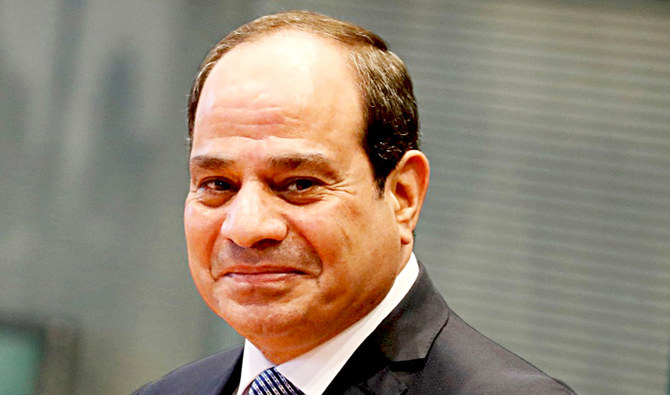
Abdel Fattah El-Sisi, President of Egypt. (Photo/Supplied)
2 / 2
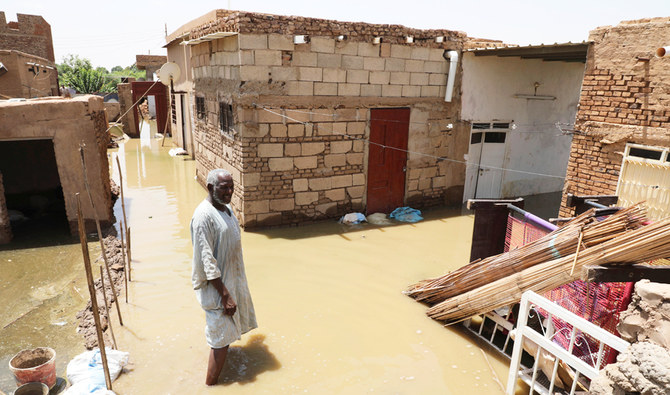
A man passes on the side of a flooded road in the town of Alkadro, about (20 km) north of the capital Khartoum, Sudan, Saturday, Sept. 5, 2020. (AP)
Short Url
Updated 09 September 2020
Follow

Egypt sends flood aid to Sudan

  • Heavy rainfall caused ‘severe damage’ and 100 deaths, says minister

CAIRO: Egypt has sent two military transport aircraft containing food, medicine and rain-resistant tents to Khartoum amid heavy flooding in Sudan.

Egyptian Armed Forces spokesman Tamer Al-Rifai said that preparing the aid came under the direction of Egyptian President Abdel Fattah El-Sisi as part of Egypt’s solidarity with the people of Sudan.

Faisal Mohammed Saleh, Sudanese minister of culture and information, said that there are feelings of sincerity from the people of Egypt toward the Sudanese.

“We have been immersed in the love of the Egyptians since yesterday, and their solidarity on social media,” Saleh said.

“We know the depth of the relations between the two countries and due to political circumstances, the two countries have been affected, but the relationship between them remains strong. We are grateful to the Egyptian government for sending urgent aid to Sudan,” he added.

In the country, 16 states have been affected by flooding, seven of which have been severely hit, resulting in about 100 deaths.

Sudan’s capital Khartoum was most impacted by the floods.

The minister said that damage is worsening due to the amount of buildings and the large population. He added that the flooding is the most extreme in over a century.

“We harnessed all the available resources and everyone is working as a team, but there is severe damage that will take a long time to repair,” Saleh said.

President El-Sisi declared his solidarity with the government and people of Sudan due to the rain and floods.

“My sincere solidarity with our Sudanese brothers, the government and the people, as a result of the rain and floods sweeping through Sudan, which led to tragic losses of individuals and property,” he said in a Facebook post.

I affirm Egypt’s constant readiness to provide all means of support to our Sudanese brothers in this critical period, to deal with the effects of the floods.

Abdel Fattah El-Sisi, President of Egypt

“I affirm Egypt’s constant readiness to provide all means of support to our Sudanese brothers in this critical period, to deal with the effects of the floods,” he added.

After heavy rain fell on southern Upper Egypt, the Red Sea mountain ranges and South Sinai, Egyptians feared that they too would face similar flooding.

“These days we are affected by the seasonal trough of Sudan, which causes torrential flow in the Red Sea, South Sinai and South Sudan. If we are affected by it, then how can we not think about its impact on Sudan,” said Ahmed Abdel-Aal, former head of the Egyptian Meteorological Authority.

He added that Egypt has taken precautions to prevent potential flooding.

A source in the Egyptian Meteorological Authority denied that Egypt was affected by the heavy rainfall.

On Saturday, several roads in the southern Red Sea governorate saw severe rain, including desert valleys in the 85 km area of Safaga-Qena road.

The Egyptian Ministry of Water Resources and Irrigation said it monitored the quantity of rain that fell on some of Upper Egypt’s governorates, and that they are concerned with rainfall at the Nile’s headwaters.

“We are in the beginning of a water year. The floods will reach Egypt over three months in August, September and October,” said Mohammed El Sebaei, the ministry’s spokesman.

He said the High Dam will protect Egypt from flooding, as the dam can discharge surplus water if its storage capacity is reached.

El Sebaei said the situation in Egypt is different from Sudan and that flooding is unlikely.

Russian news agency Sputnik quoted Abdel-Fattah Mutawa, former head of the water resources sector at the Egyptian Irrigation Ministry, who said Egypt should empty part of Lake Nasser’s water to the Toshka spillway and purify the inlets at the end of the Rashid and Damietta branch.

Mutawa added that agricultural drainage stations must be kept in a state of readiness.


Israel’s Netanyahu expected to press Trump over Iran diplomacy

Updated 4 sec ago
Follow

Israel’s Netanyahu expected to press Trump over Iran diplomacy

  • Two leaders will meet for seventh time in nearly 13 months
  • Netanyahu seeks broader US talks with Iran beyond nuclear issues
WASHINGTON/JERUSALEM: President Donald Trump will host Benjamin Netanyahu at the White House on Wednesday where the Israeli prime minister is expected to press him to widen US talks with Iran to include curbs on Tehran’s missile arsenal and other security threats that go beyond its nuclear program.
In his seventh meeting with Trump since the president returned to office nearly 13 months ago, Netanyahu will be looking to influence the next round of US discussions with Iran following nuclear negotiations held in Oman last Friday amid heightened Middle East tensions.
Trump has threatened to carry out strikes on Iran if an agreement is not reached, and Tehran has responded with vows to retaliate, fueling fears of a wider regional war. He has repeatedly voiced support for a secure Israel, long a close US ally in the Middle East and an arch-foe of Iran.
The president repeated his warning in a series of media interviews on Tuesday, saying while he believes Iran wants to make a deal, he would do “something very tough” if they refused.
Trump says no to Iranian nuclear weapons, missiles
Trump told Fox Business that a good deal with Iran would mean “no nuclear weapons, no missiles,” but did not elaborate, and ‌he said in ‌an interview with Axios he was considering sending a second aircraft carrier strike group as part of a massive ‌buildup ⁠of US forces ⁠near Iran.
Israel is concerned that the US might pursue a narrow nuclear deal that does not include limitations on Iran’s ballistic missile program or an end to Iranian support for armed proxy groups such as Hamas and Hezbollah, according to people familiar with the matter.
“I will present to the president our perceptions of the principles in the negotiations,” Netanyahu told reporters before departing for the US
The two men could also discuss potential military action in the event that US-Iran diplomacy fails, according to one of the sources.
After arriving in Washington on Tuesday night, Netanyahu met US special envoy Steve Witkoff and Trump’s son-in-law Jared Kushner, who led the US team at the Iran talks, according to a post on X by Israel’s ambassador to Washington, Michael Leiter.
Gaza also on the agenda
Also on the agenda will be Gaza, with Trump looking to push ahead with a ⁠ceasefire agreement he helped to broker. Progress on his 20-point plan to end the war and rebuild the shattered Palestinian ‌enclave has stalled with wide gaps remaining over complex steps it envisions, including Hamas disarming as ‌Israeli troops withdraw in phases.
“We continue to work closely with our ally Israel to implement President Trump’s historic Gaza peace agreement and to strengthen regional security,” White House spokeswoman Anna Kelly ‌said when asked about US priorities for the meeting.
Netanyahu’s visit, originally scheduled for February 18, was brought forward amid renewed US engagement with Iran. Both sides ‌at last week’s Oman meeting said it was positive and further talks were expected soon.
US Secretary of State Marco Rubio said last week, ahead of the Oman meeting, that the talks would have to include the range of Iran’s missiles, its support for proxy groups and its treatment of its own people.
Iran, which has ruled out restrictions on its missiles, said Friday’s discussions had been limited to nuclear issues.
Trump has been vague about broadening the negotiations. He was quoted as telling Axios on Tuesday that it was a “no-brainer” for ‌any deal to cover Iran’s nuclear program, but that he also thought it possible to address its missile stockpiles.
Iran says its nuclear activities are for peaceful purposes, while the US and Israel have accused it of past ⁠efforts to develop nuclear weapons.
Last June, the US ⁠joined Israel’s strikes on Iranian nuclear facilities during a 12-day war.
Israel also heavily damaged Iran’s air defenses and missile arsenal. But, according to two Israeli officials, there have been signs of a push to restore those capabilities, which Israel sees as a strategic threat.
Trump had threatened last month to intervene militarily during a bloody crackdown on nationwide anti-government protests in Iran, but ultimately held off.
Israel wary of a weakened Iran rebuilding
Tehran’s regional sway has been weakened by Israel’s attack in June as well as blows to Iranian proxies — from Hamas in Gaza to Hezbollah in Lebanon, the Houthis in Yemen and militias in Iraq — and by the ousting of Iran’s close ally, former Syrian President Bashar Assad.
But Israel has been wary of its foes rebuilding after they suffered heavy losses in the multi-front war sparked by Hamas’ October 2023 cross-border attack on southern Israel.
While Trump and Netanyahu have mostly been in sync and the US remains Israel’s main arms supplier, Wednesday’s discussions have the potential for tensions to surface.
Part of Trump’s Gaza plan holds out the prospect for eventual Palestinian statehood — which Netanyahu and his coalition, the most far-right in Israel’s history, have long resisted.
Netanyahu’s security cabinet on Sunday authorized steps that would make it easier for Israeli settlers in the occupied West Bank to buy land while granting Israel broader powers in what the Palestinians see as the heartland of a future state. The Israeli decision drew international condemnation.
“I am against annexation,” Trump was quoted as telling Axios, reiterating his stance on the issue. “We have enough things to think about now.”