BEIRUT: The leader of the Palestinian militant group Hamas on Sunday warned Israel that his organization has missiles capable of striking the city of Tel Aviv, Israel’s commercial and cultural center, and areas beyond it.
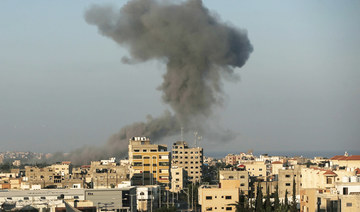
Ismail Haniyeh’s comments during a visit to Lebanon followed an escalation in recent weeks in which Hamas-affiliated groups fired rockets into Israel and Israeli warplanes struck areas in the Gaza Strip, which is ruled by Hamas.
Hamas announced last week that international mediators had brokered a new set of “understandings” with Israel, halting the latest round of fighting for the time being in exchange for an easing of Israeli restrictions on the Gaza Strip.
Haniyeh gave a speech in the Palestinian refugee camp of Ein el-Hilweh near the southern port city of Sidon, where he received a hero’s welcome by armed men who carried him on their shoulders.
Haniyeh and a Hamas delegation met earlier with the leader of the Lebanese militant group Hezbollah, Hassan Nasrallah, during which they discussed the situation in the Middle East and the recent normalization of relations between the United Arab Emirates and Israel, a Hezbollah statement said.
“Our missiles had a range of several kilometers (miles) from the border with Gaza,” Haniyeh said. “Today the resistance in Gaza has missiles that can hit Tel Aviv and beyond Tel Aviv.”
Hamas rockets have reached Tel Aviv and beyond in previous rounds of fighting, but such launches are rare and considered a serious escalation by Israel. The seaside metropolis is located some 70 kilometers (45 miles) north of Gaza.
Israel and Hamas have fought three wars and several smaller battles over the last 13 years. Neither side is believed to be seeking war, but any casualties could ignite a wider conflict.
In recent weeks, groups affiliated with Hamas launched incendiary balloons into Israel, igniting farmland in a bid to pressure Israel to ease the blockade it imposed on Gaza when Hamas seized power in 2007. The group had also fired rockets into Israel in recent weeks, which was seen as a significant escalation.
Haniyeh was criticized during his visit by some in Lebanon on social media. One post sarcastically asked whether it would be better for him to threaten Israel from the West Bank, which is ruled by the Palestinian Authority and with whom Hamas has a longstanding feud. Another post said Lebanon has enough problems at the moment, and doesn’t need Hamas on top of that.
Lebanon is grappling with its worst economic and financial crisis in decades, and the capital Beirut was devastated one month ago by a massive explosion, the result of nearly 3,000 tons of ammonium nitrates igniting at the port. The blast killed more than 190 and injured thousands.

Hamas leader says group has missiles that can hit Tel Aviv
Short Url
https://arab.news/c4t87
Hamas leader says group has missiles that can hit Tel Aviv
- Ismail Haniyeh made his comments at a Palestinian refugee camp near the southern port city of Sidon
- Israel and Hamas have fought three wars and several smaller battles over the last 13 years
Children dying from cold as storm batters Gaza, killing 13
- Three children die from exposure as winter rains flood displacement camps
- Wet weather causes war-damaged buildings and walls to collapse, killing 10
GAZA CITY: Gaza’s civil defense agency on Friday said at least 13 people had died in the last 24 hours, including three children who died from exposure to the cold, as a winter storm batters the territory.
Heavy rain from Storm Byron has flooded tents and temporary shelters across the Gaza Strip since late Wednesday, compounding the suffering of the territory’s residents, nearly all of whom were displaced during more than two years of war.
Gaza’s civil defense agency, which operates as a rescue force under Hamas authority, told AFP three children had died from exposure to the cold — two in Gaza City and one in Khan Yunis in the south.
Al-Shifa Hospital in Gaza City confirmed the deaths of Hadeel Al-Masri, aged nine, and Taim Al-Khawaja, who it said was just several months old.
Nasser Hospital in Khan Yunis on Thursday said eight-month-old Rahaf Abu Jazar had died in the nearby tented encampment of Al-Mawasi due to the cold.
With most of Gaza’s buildings destroyed or damaged, thousands of tents and homemade shelters now line areas cleared of rubble.
Civil defense spokesman Mahmud Bassal said six people died when a house collapsed in the Bir Al-Naja area of the northern Gaza Strip.
Four others died when walls collapsed in multiple separate incidents, he said.
In a statement, the civil defense said its teams had responded to calls from “13 houses that collapsed due to heavy rains and strong winds, mostly in Gaza City and the north.”
No dry clothes
Under gloomy skies in Nuseirat in the central Gaza Strip, Palestinians used bowls, buckets and hoes to try and remove the water that had pooled around their tents made of plastic sheeting.
Young children, some barefoot and others wearing open sandals, trudged and hopped through ponds of muddy water as the rain continued to fall.
“The mattress has been soaked since this morning, and the children slept in wet bedding last night,” Umm Muhammad Joudah told AFP.
“We don’t have any dry clothes to change into.”
Saif Ayman, a 17-year-old who was on crutches due to a leg injury, said his tent had also been submerged.
“In this tent we have no blankets. There are six of us sleeping on one mattress, and we cover ourselves with our clothes,” he said.
The Hamas-run interior and national security ministry gave a preliminary toll of 14 dead due to the effects of the winter rains since Wednesday.
A ceasefire between Israel and militant group Hamas that took effect in October has partially eased restrictions on goods and aid entering into the Gaza Strip.
But supplies have entered in insufficient quantities, according to the United Nations, and the humanitarian needs are still immense.
The UN’s World Health Organization warned on Friday that thousands of families were “sheltering in low-lying or debris-filled coastal areas with no drainage or protective barriers.”
“Winter conditions, combined with poor water and sanitation, are expected to drive a surge in acute respiratory infections,” it added.
Heavy rain from Storm Byron has flooded tents and temporary shelters across the Gaza Strip since late Wednesday, compounding the suffering of the territory’s residents, nearly all of whom were displaced during more than two years of war.
Gaza’s civil defense agency, which operates as a rescue force under Hamas authority, told AFP three children had died from exposure to the cold — two in Gaza City and one in Khan Yunis in the south.
Al-Shifa Hospital in Gaza City confirmed the deaths of Hadeel Al-Masri, aged nine, and Taim Al-Khawaja, who it said was just several months old.
Nasser Hospital in Khan Yunis on Thursday said eight-month-old Rahaf Abu Jazar had died in the nearby tented encampment of Al-Mawasi due to the cold.
With most of Gaza’s buildings destroyed or damaged, thousands of tents and homemade shelters now line areas cleared of rubble.
Civil defense spokesman Mahmud Bassal said six people died when a house collapsed in the Bir Al-Naja area of the northern Gaza Strip.
Four others died when walls collapsed in multiple separate incidents, he said.
In a statement, the civil defense said its teams had responded to calls from “13 houses that collapsed due to heavy rains and strong winds, mostly in Gaza City and the north.”
No dry clothes
Under gloomy skies in Nuseirat in the central Gaza Strip, Palestinians used bowls, buckets and hoes to try and remove the water that had pooled around their tents made of plastic sheeting.
Young children, some barefoot and others wearing open sandals, trudged and hopped through ponds of muddy water as the rain continued to fall.
“The mattress has been soaked since this morning, and the children slept in wet bedding last night,” Umm Muhammad Joudah told AFP.
“We don’t have any dry clothes to change into.”
Saif Ayman, a 17-year-old who was on crutches due to a leg injury, said his tent had also been submerged.
“In this tent we have no blankets. There are six of us sleeping on one mattress, and we cover ourselves with our clothes,” he said.
The Hamas-run interior and national security ministry gave a preliminary toll of 14 dead due to the effects of the winter rains since Wednesday.
A ceasefire between Israel and militant group Hamas that took effect in October has partially eased restrictions on goods and aid entering into the Gaza Strip.
But supplies have entered in insufficient quantities, according to the United Nations, and the humanitarian needs are still immense.
The UN’s World Health Organization warned on Friday that thousands of families were “sheltering in low-lying or debris-filled coastal areas with no drainage or protective barriers.”
“Winter conditions, combined with poor water and sanitation, are expected to drive a surge in acute respiratory infections,” it added.
© 2025 SAUDI RESEARCH & PUBLISHING COMPANY, All Rights Reserved And subject to Terms of Use Agreement.