

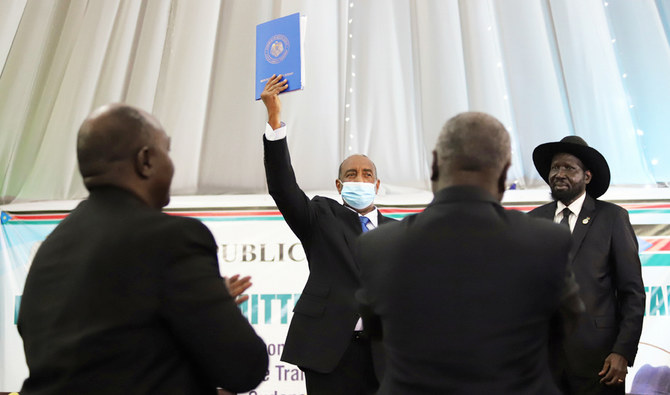

CAIRO: Sudan’s transitional government and a powerful rebel group that controls large swaths of the country’s restive south said on Friday they have agreed to resume peace talks, a development that boosts hopes of ending the country’s decades-long civil wars.
The commitment comes days after the government reached a deal with other rebel groups to quell conflicts stemming from the rule of ousted ruler Omar Bashir.
The Sudan Liberation Movement-North, led by Abdel-Aziz Al-Hilu, and Sudanese Prime Minister Abdalla Hamdok signed a joint letter of intention late Thursday in the Ethiopian capital of Addis Abada, stressing the “necessity” of finding “a comprehensive and just political solution” to the conflicts. It did not specify when the talks would restart.
Negotiating an end to the rebellions in Sudan’s far-flung provinces has been a crucial goal for the transitional government, which took power after the military overthrew Bashir in April last year, following months of pro-democracy protests. Cash-strapped authorities are keen to slash military spending, which takes up 80 percent of the national budget.
Al-Hilu’s faction of the Sudan Liberation Movement-North, also known as SLPM-North, is Sudan’s single largest rebel group. It engaged in previous rounds of peace talks but remained skeptical of the country’s ruling Sovereign Council, comprised of both civilian leaders and military generals, including some from Al-Bashir’s tenure.
SPEEDREAD
Negotiating an end to the rebellions in Sudan’s far-flung provinces has been a crucial goal for the transitional government, which took power after the military overthrew Bashir in April last year.
Along with another major rebel group, the faction skipped the signing of the agreement earlier this week in South Sudan between the government and a rebel alliance known as the Sudan Revolutionary Front, dimming prospects for meaningful change on the ground.
The SLPM-North has also threatened to call for self-determination in the vast areas it controls if its demands are not met. Just days ago, Al-Hilu accused the transitional government of adopting the “evasive” tactics of Bashir’s administration throughout tortuous peace negotiations that have dragged on for nearly a year.
To lay the groundwork for a future deal, Al-Hilu and Hamdok agreed in principle on a range of political issues that have frustrated efforts to reach a deal in the past.
Sudan’s constitution “should be based on the principle of separation of religion and state,” the statement said, acknowledging a long-held demand of the ardently secularist SLPM-North. The sides also agreed to let the rebel group retain its weapons until they ink an accord calling for new security arrangements.
Al-Hilu’s movement controls large chunks of territory in the war-scarred Blue Nile and South Kordofan provinces, home to a significant Christian minority that long complained of discrimination under Bashir.
During Bashir’s 30 years in power, the Khartoum government extended Islamic rule in Sudan and fanned tensions between the Muslim majority north and mainly Christian and animizt south, precipitating brutal wars and ultimately, the secession of South Sudan in 2011.


