COLOMBO: A Panamanian-registered oil tanker burned out of control for a second day off Sri Lanka on Friday, raising fears of a major new oil spill in the Indian Ocean.
Sri Lankan navy and India coast guard fired water cannon while an air force helicopter dropped water on the drifting New Diamond.
More Indian navy vessels were heading to the scene to help fight the blaze on the tanker which was carrying 270,000 tons of crude and 1,700 tons of diesel.
One Filipino crew member was confirmed to have died in an engine room explosion on Thursday which sparked the alert, the Sri Lankan navy said.
The other 22 crew — five Greek and 17 Filipino — were taken off the 330-meter (1,080-foot) vessel and the fire had not spread to the cargo by mid-morning Friday, officials said.
The ship was on its way from Kuwait to the eastern Indian port of Paradip when it issued a distress signal 60 kilometers (38 miles) from Sri Lanka’s east coast.
As the fire grew, the stricken vessel drifted about 10 kilometers closer to the shore, Sri Lankan officials said.
India’s coast guard said there was a two-meter crack in the New Diamond’s hull about 10 meters above the water line.
Both India and Sri Lanka have deployed reconnaissance planes to track the ship, officials said. However, Sri Lanka’s Disaster Management Center said there was no immediate danger of a spill.
“It is not as bad as it seems,” DMC head Sudantha Ranasinghe told AFP. “The fire has not spread to the cargo. Once the fire is put out, the vessel will be towed further away into deeper waters.”
He said authorities were considering a ship-to-ship transfer of the crude before salvaging the tanker.
The vessel is larger than the Japanese bulk carrier MV Wakashio, which crashed into a reef in Mauritius in July leaking more than 1,000 tons of oil into the island nation’s pristine waters.
Sri Lanka’s neighbor Maldives has raised concerns that a possible oil spill from the New Diamond could cause serious environmental damage.
The Maldives depends on fisheries and tourism and the country has one of the world’s best coral eco systems.
Maldivian minister at the president’s office, Ahmed Naseem, called for precautionary measures in the Indian Ocean archipelago of 1,192 coral islands.
The Maldives is located about 1,000 kilometers (625 miles) southwest of Sri Lanka.
“Maldives needs to watch this oil spill carefully and take all precautions to prevent it from reaching her shores,” Naseem said on Twitter. “This could be a major disaster.”

Raging tanker fire sparks fears of a new Indian Ocean disaster
https://arab.news/p7z54
Raging tanker fire sparks fears of a new Indian Ocean disaster
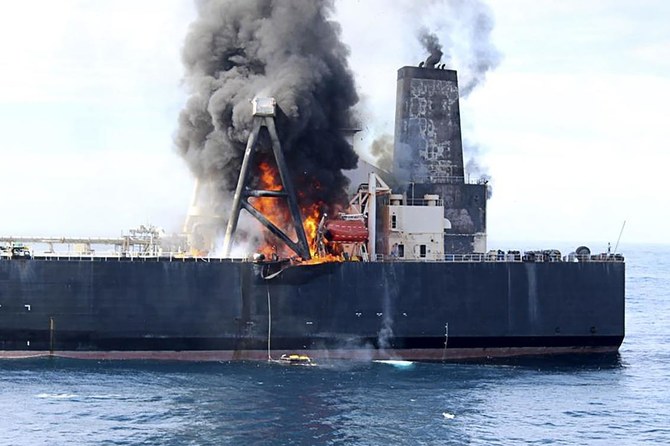
- Sri Lankan navy and India coast guard fired water cannon while an air force helicopter dropped water on the drifting New Diamond
- The ship was on its way from Kuwait to the eastern Indian port of Paradip when it issued a distress signal 60 kilometers (38 miles) from Sri Lanka’s east coast
India’s space industry gears up for human spaceflight tests, commercial expansion in 2026
- ISRO plans to complete 7 space missions by March, including Gaganyaan mission test
- In 2025, India’s space sector had over 300 startups operating in rocket launches, satellites, analysis
NEW DELHI: After sending its first astronaut to the International Space Station, autonomously docking two satellites, and launching the heaviest payload this year, India’s space industry is preparing for the first uncrewed test of its human spaceflight program in 2026.
In 2025, India’s space program spearheaded by the Indian Space Research Organisation marked several milestones, starting in January, when it became the fourth country to perform space docking — connecting two spacecraft in orbit, which is a capability crucial for future space stations and deep-space missions.
In June, Shubhanshu Shukla, an Indian Air Force pilot, flew to the ISS as part of the Axiom 4 mission. He became the second Indian national in space, after Rakesh Sharma in 1984.
A month later, ISRO, in collaboration with NASA, launched a joint observation satellite to provide high-resolution radar imagery of the Earth, and in December capped the year by deploying the BlueBird Block 2, the heaviest payload ever launched from Indian soil.
It “marked a decisive year for India’s space sector as policy reforms translated into tangible execution across launch, satellite manufacturing, Earth observation, space data, and satellite communications,” said Lt. Gen. AK Bhatt (retd.), director general of the Indian Space Association.
The year also saw new contracts, production lines, launch vehicles moving closer to operational readiness, and growth in India’s $9 billion space economy driven largely by the private industry and public–private partnerships, which Bhatt expected to expand in the coming year.
“The Indian space sector is poised for a transformative 2026, with ISRO’s rigorous seven-mission schedule by March,” he told Arab News.
ISRO last month announced plans to complete seven space missions by March 2026, including the first uncrewed test flight of India’s Gaganyaan human spaceflight program.
Another mission will be EOS‑N1, where ISRO and India’s Defence Research and Development Organisation will launch an Earth observation satellite for strategic and surveillance applications.
The private industry will also have its debut by HAL-L&T launching the first fully indigenously manufactured Polar Satellite Launch Vehicle early next year, which will carry OceanSat-3A, an Earth observation satellite for oceanography and environmental monitoring.
“Complementing this, private innovators like Skyroot Aerospace with its Vikram-I orbital launch in January-February, GalaxEye’s pioneering multi-sensor Drishti satellite in Q1 and Dhruva Space’s LEAP-2 on the HAL-L&T PSLV and Agnibaan rocket by Agnikul in Q3 will further confirm the vitality of our ecosystem,” Bhatt said.
Over the past few years, India has been establishing its position in the global space industry.
In August 2023, ISRO’s Chandrayaan-3 moon rover made history by landing on the lunar surface, making India the first country to land near the lunar south pole and the fourth to land on the moon — after the US, the Soviet Union, and China.
A month later, it launched Aditya-L1 in 2023 — the country’s first solar observation mission, and the world’s second after the US Parker Solar Probe in 2021.
India currently accounts for about 2 percent of the $450 billion global space economy, with its share expected to rise to nearly 8 percent by 2033, driven largely by private companies.
In 2025, the country’s space sector had more than 300 active startups operating in rocket launches, satellites, Earth observation, satellite communications, propulsion, electronics, space monitoring, and data analytics, according to Indian Space Association data.
“As launch capacity improves and satellite constellations scale up, the real value creation is now shifting closer to applications, analytics and decision-making. From agriculture and climate monitoring to infrastructure planning and national security, satellite data is steadily moving from being a niche input to a mainstream business and governance tool,” said Amit Kumar, co-founder and chief operating officer of Suhora Technologies, a space data company that turns satellite imagery and artificial intelligence‑driven analytics into actionable intelligence.
“As we move into 2026, the opportunity lies in translating India’s space capabilities into everyday insights that solve real-world problems at scale.”


