Waqar backs young generation to uphold Pakistan fast bowling tradition

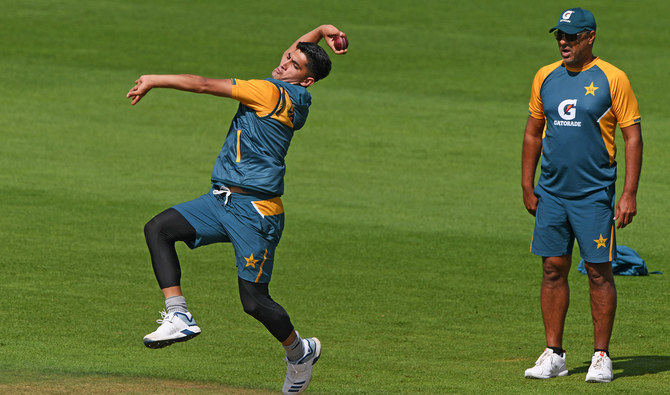
Pakistan bowling coach Waqar Younis, right, watches Naseem Shah, left, warm up ahead of the start of play on the fifth day of the second Test cricket match between England and Pakistan at the Ageas Bowl in Southampton, southwest England on Aug. 17, 2020. (AFP/File)
Short Url
Updated 03 September 2020
Follow

Waqar backs young generation to uphold Pakistan fast bowling tradition

  • Fast bowling is the trademark of Pakistan cricket, says Waqar
  • Waqar called on the International Cricket Council to designate just one brand of ball for all Test cricket

LONDON: Waqar Younis is confident that the future of Pakistan’s “trademark” fast bowling is in safe hands after overseeing the latest generation of quicks during their recent tour of England.
Teenage paceman Naseem Shah and 20-year-old left-arm fast bowler Shaheen Afridi both impressed as Pakistan lost the three-match Test series 1-0 but drew the Twenty20 campaign 1-1.
“Fast bowling is the trademark of Pakistan cricket,” said the 48-year-old Waqar, an outstanding fast bowler, in a Pakistan Cricket Board website column published on Thursday.
“There have been so many great ones over the years and I am confident that the future will be bright again,” added Waqar, who formed a celebrated partnership with left-arm quick Wasim Akram and is now Pakistan’s bowling coach.
“We have seen already that Naseem Shah and Shaheen Shah Afridi are wonderful bowlers. Muhammad Musa, who was part of the squad in England, is another, and there are a couple in the under-19s also. Of course, Mohammad Abbas is very seasoned and experienced.”
Abbas, like Waqar and Wasim before him, has played in English county cricket and the coach would like to see the emerging quicks do the same.
“I know from personal experience how much you can learn from playing in England, getting used to different weather and ground conditions, the pitches, and life off the field also,” Waqar said.
“Both Mohammad Amir (Essex) and Mohammad Abbas (Leicestershire) have been really successful for English counties and it has benefited their careers so much as well.”
One consequence of the coronavirus is that players have been banned from using saliva to shine the ball.
But Waqar said the Dukes ball used in England stayed harder for longer than other brands and “made the saliva issue less of a problem.”
Waqar, however, called on the International Cricket Council to designate just one brand of ball for all Test cricket.
“It doesn’t matter which brand but the ICC should make that decision,” he said. “It’s hard for bowlers to adjust to using different types of ball when they play around the world.”


Pakistan, ADB sign $730 loan agreements to boost SOE reforms, energy infrastructure

Updated 25 December 2025
Follow

Pakistan, ADB sign $730 loan agreements to boost SOE reforms, energy infrastructure

  • Both sign $330 million Power Transmission Strengthening Project and $400 million SOE Transformation Program loan agreements
  • Economic Affairs Division official says Transmission Project will secure Pakistan’s energy future by strengthening national grid’s backbone

KARACHI: Pakistan and the Asian Development Bank (ADB) on Thursday signed two loan agreements totaling $730 million to boost reforms in state-owned enterprises (SOEs) and energy infrastructure in the country, the bank said.

The first of the two agreements pertains to the SOE Transformation Program worth $400 million while the second loan, worth $330 million, is for a Power Transmission Strengthening Project, the lender said. 

The agreements were signed by ADB Country Director for Pakistan Emma Fan and Pakistan’s Secretary of Economic Affairs Division Humair Karim. 

“The agreements demonstrate ADB’s enduring commitment to supporting sustainable and inclusive economic growth in Pakistan,” the ADB said. 

Pakistan’s SOEs have incurred losses worth billions of dollars over the years due to financial mismanagement and corruption. These entities, including the country’s national airline Pakistan International Airlines, which was sold to a private group this week, have relied on subsequent government bailouts over the years to operate.

The ADB approved the $400 million loan for SOE reforms on Dec. 12. It said the program seeks to improve governance and optimize the performance of Pakistan’s commercial SOEs. 

Karim highlighted that the Power Transmission Strengthening Project will enable reliable evacuation of 2,300 MW from Pakistan’s upcoming hydropower projects, relieve overloading of existing transmission lines and enhance resilience under contingency conditions, the Press Information Department (PID) said. 

“The Secretary emphasized that both initiatives are transformative in nature as the Transmission Project will secure Pakistan’s energy future by strengthening the backbone of the national grid whereas the SOE Program will enhance transparency, efficiency and sustainability of state-owned enterprises nationwide,” the PID said. 

The ADB has supported reforms by Pakistan to strengthen its public finance and social protection systems. It has also undertaken programs in the country to help with post-flood reconstruction, improve food security and social and human capital. 

To date, ADB says it has committed 764 public sector loans, grants and technical assistance totaling $43.4 billion to Pakistan.