DUBAI: The government of Dubai started marketing a dual-tranche bond on Wednesday, its first sale in public debt markets in six years, as the Middle East trade and tourism hub seeks to boost finances hit by the coronavirus crisis.
Dubai offered investors about 250 basis points over mid-swaps for 10-year sukuk, or Islamic bonds, and about 4.375 percent for 30-year conventional bonds, according to a document issued by one of the banks leading the deal and seen by Reuters.
The emirate’s first public debt issuance since 2014 comes amid a sharp economic downturn that has revived concern over Dubai’s finances and revived memories of the 2009 debt crisis that wobbled its economy. Dubai has budgeted a $3.2 billion deficit this year, a bond prospectus showed.
It also showed that while the government’s direct debt amounted to nearly $34 billion at the end of June, Dubai had no consolidated estimates for the outstanding total debt of government-related entities.
Dubai is unrated, which may exclude a pool of investors from the debt offering, said advisory and research firm Azure Strategy.
“A rating process would require a more granular disclosure of Dubai’s credit profile,” it said in a report on Tuesday.
In July, ratings agency S&P said Dubai’s economy could shrink 11 percent, as it cut the credit ratings of two of the emirate’s biggest property firms to “junk” status.


Dubai set to raise $1.5 billion on return to public debt markets

https://arab.news/j4gy6
Dubai set to raise $1.5 billion on return to public debt markets

- It received over $7.5 billion in orders for the debt sale


Global Markets: Stocks set for tough week, oil eyes strong gains as Middle East war rages
- Oil prices set for largest weekly rise since Russia’s invasion of Ukraine
- Stocks take a beat, but Asia shares set for 6 percent weekly fall
- Yields jump as global rate expectations turn hawkish
SINGAPORE: A slight pullback in oil prices on Friday offered some reprieve to battered global stocks, though share markets in Asia remained on track for their sharpest weekly drop in six years as the conflict in the Middle East showed few signs of easing.
Oil prices, headed for their largest weekly gain since Russia launched its full-scale invasion of Ukraine in February 2022, slipped on news that the US government is weighing potentially intervening in the futures market to blunt rising prices.
Still, they remained up close to 20 percent for the week.
Brent crude futures last traded at $84.73 per barrel, on track for a 17 percent weekly rise. US crude retreated from a 20-month high and was last at $80 a barrel, taking its weekly gain to more than 19 percent.
“What we see is ... markets (consolidating) for a time, chopping around current levels, as a ‘wait and see’ approach takes (precedence) for the time being,” said Michael Brown, senior research strategist at Pepperstone.
The US-Israel war on Iran convulsed global markets this week and left investors seeking the safety of cash, as they sobered up to the fact that the conflict could drag on longer than initially anticipated.
Traders also moved to price in more hawkish rate expectations from major central banks, spooked by the prospect of a resurgence in inflation if the spike in energy prices persists.
Yields on US Treasuries have shot up some 18 basis points this week, their most in nearly a year, while the dollar was set for its largest weekly gain in 16 months.
“The range of plausible outcomes (of the war) has expanded to include both the possibility of an exceptionally constructive resolution and a highly destructive one,” said Daleep Singh, chief global economist at PGIM Fixed Income.
“Markets are being asked to price a much fatter set of tails with very little reliable information about the likelihood of each, or the path in between.”
EUROSTOXX 50 futures were up 0.95 percent in Asia on Friday, while FTSE futures and DAX futures rose 0.5 percent and 0.8 percent, respectively.
Nasdaq futures added 0.27 percent, while S&P 500 futures rose 0.16 percent.
High-flying stocks tumble
MSCI’s broadest index of Asia-Pacific shares outside Japan last traded 0.2 percent higher, though it was set to fall 6 percent for the week, which would mark its steepest weekly drop since March 2020.
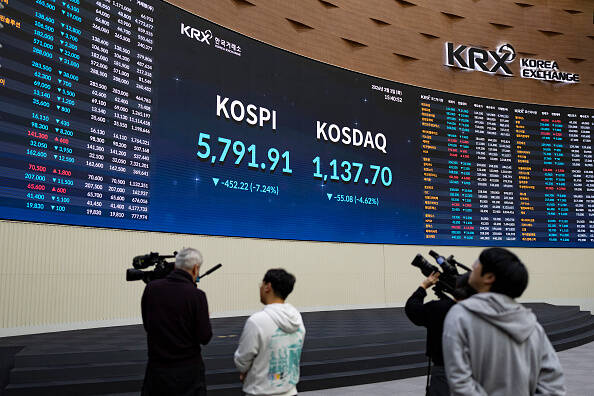
Japan’s Nikkei was up 0.6 percent but on track for a 5.5 percent weekly loss, while South Korea’s Kospi was headed for its largest weekly fall in six years with a 10.5 percent slide.
The market rout this week sent even high-flying technology stocks and indexes such as the Kospi tumbling, as investors scrambled to book profits to cover losses elsewhere.
“When the dollar rallies and US yields rise, funding conditions are tightening, which will often exacerbate broader moves particularly if there’s leverage involved,” said Ben Bennett, head of Asia investment strategy at L&G Asset Management.
Dollar is king
The dollar has emerged as one of few winners this week in volatile sessions that have dragged stocks, bonds and, at times, even safe-haven precious metals lower.
The rally in the dollar hit pause on Friday, but it was still on track for a weekly gain of close to 1.5 percent, bolstered by safe-haven demand and reduced US rate-easing expectations.
The euro, which remains vulnerable to a spike in energy prices, was set to fall 1.8 percent for the week, while sterling was headed for a 1 percent weekly drop.
Investors are now pricing in about 40 basis points of easing from the Federal Reserve this year, down from 56 bps a week ago , while odds for a rate cut from the Bank of England this month have fallen to 22 percent from a near certainty just last week.
The European Central Bank is seen hiking rates by year-end.
The shifting rate expectations have, in turn, pushed up global bond yields, and in Asia on Friday, the yield on the benchmark 10-year US Treasury was steady at 4.1421 percent, having risen some 18 bps this week.
The two-year yield has jumped 20 bps for the week.
Elsewhere, spot gold was steady at $5,118.79 an ounce, though it was headed for a 3 percent weekly fall as rising yields and a stronger dollar eclipsed the yellow metal’s safe-haven appeal.


