Saudi Arabia’s Future Investment Initiative postponed until January
Organizers of Future Investment Initiative in Riyadh opt to reschedule event rather than move it online
Updated 27 January 2021
Frank Kane
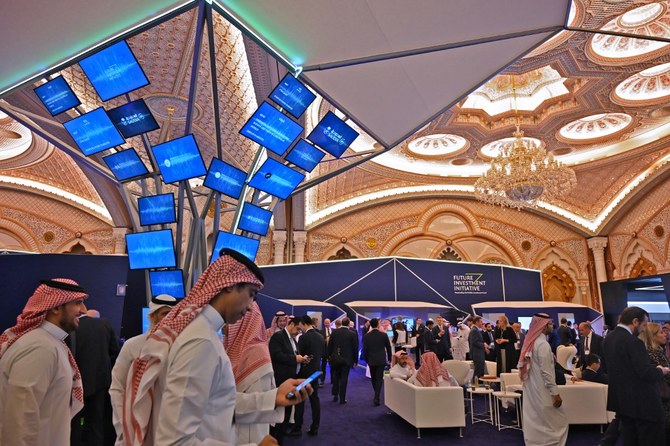
DUBAI: The Future Investment Initiative (FII), Saudi Arabia’s flagship financial forum, has been postponed until early next year because of the COVID-19 pandemic, the organizers said.
The event, which has become a fixture in the global investment calendar in the short time since its launch in 2017, was scheduled for late next month but has been put back until the end of January.
The organizers, the FII Institute, said: “After careful consideration and assessment of the global travel and airline outlook, as well as the regulations imposed by a significant number of countries, and in the context of the efforts deployed to overcome the impact of COVID-19, we have decided to postpone the fourth edition of the FII, initially scheduled to take place from Oct. 28-29, 2020 in Riyadh, to Jan. 26-28 under the theme ‘The Neo-Renaissance.’”
One executive involved in the event said that consideration had been given to staging a “virtual” FII but it was decided that an in-person event was preferable, even if it had to be delayed.
“The challenge was not guaranteeing safety once in Saudi Arabia, but the difficulties of getting there and back for a three-day event,” he added.
The forum is likely to stick to the schedule already drawn up under the neo-renaissance theme, focusing on healthcare, sustainability, artificial intelligence and robotics, the executive said.
Richard Attias, a member of the FII Institute’s board of directors, last month said he was still aiming to stage an in-person event.
“I think virtual events are OK but it’s not, to be honest, the best way to definitely do business together,” he said. “It is not the best way to talk about big investments. You cannot make deals of billions of dollars and investment of billions of dollars just through virtual conversation.”
With the global pandemic continuing to affect many parts of the world, some countries have re-imposed travel restrictions and curfew regulations on air travelers. Flights to and from the Kingdom are still heavily restricted, with international airports closed to passenger traffic.
FII — dubbed “Davos in the desert” but held in the luxury of the Ritz-Carlton hotel and conference center in Riyadh for the past three years — attracts thousands of participants from the biggest corporations and investment institutions in the world. Business deals worth billions of dollars have been signed during the event.
The end of January is normally a busy time on the international forums circuit, with the World Economic Forum’s annual meeting traditionally taking place at that time in Davos, Switzerland. For 2021, however, that event has been moved to the summer, again because of pandemic-related travel concerns.
Middle East CEOs among the most confident globally, driven by investment momentum
Updated 5 sec ago
Nirmal Narayanan
RIYADH: CEOs in the Middle East remain among the most confident globally, with 88 percent expecting economic growth in their territories to strengthen, compared with a global average of 55 percent, according to a survey by PwC.
In its latest report, the professional services firm underlined that business chiefs in the Middle East continue to deploy capital, scale artificial intelligence and expand selectively into new sectors, supported by a strong investment momentum and long-term national transformation agendas.
Confidence in economic growth is even higher among CEOs in the Gulf Cooperation Council, with 93 percent of business leaders expressing an optimistic outlook for the future.
The findings by PwC align with a report released by KPMG in November, which said that CEOs in the Middle East are entering 2026 with stronger confidence levels and a higher readiness to deploy AI responsibly than many of their international peers.
Commenting on the latest analysis, Hani Ashkar, territory senior partner at PwC Middle East, said: “These findings reflect the strong underlying confidence we are seeing across the Middle East. CEOs in the region are resilient and are ready to deploy capital for long-term growth.”
He added: “Supported by national transformation agendas and sustained investment in artificial intelligence, the Middle East is well positioned to compete, adapt and grow.”
Speaking to Arab News, Thomas Kuruvilla, managing partner at Arthur D. Little Middle East and India, said that Gulf CEOs’ optimism is driven by a combination that is genuinely hard to replicate elsewhere, driven by large-scale fiscal capacity, political decisiveness, and national vision programs that are actually being executed, not just announced.
Kuruvilla also highlighted the growing prominence of Saudi Arabia in the GCC business landscape and added that “the Kingdom’s giga-projects, including Neom, Diriyah and Red Sea, are not just construction plays but are demand engines pulling entire ecosystems forward.”
Sarah El-Tarzi, co-founder and managing partner at Konnexions Communications, shared similar views, highlighting that CEOs in the region are clearer about what they stand for and more willing to engage openly with markets, employees, and the public.
“From my perspective, the optimism going into 2026 is coming from a shift in how the Gulf operates, not just how fast it grows. What has changed is execution. Strategies are no longer abstract. They are visible, measurable, and moving,” added El-Tarzi.
Sarah El-Tarzi, co-founder and managing partner at Konnexions Communications. Supplied
Capital strengthening in Middle East
According to PwC, GCC continues to consolidate its position as a global investment hub, with Saudi Arabia and the UAE named among the top 10 global investment destinations, reinforcing their role as anchor markets for international and intra-regional capital.
Commenting on the survey results, Munir Al-Daraawi, founder and CEO of Orla Properties, told Arab News that the overwhelming optimism among 93 percent of Gulf CEOs is a testament to the region’s successful economic diversification.
“Beyond oil, we are seeing massive capital inflows driven by regulatory reforms and the rapid maturation of the real estate and tourism sectors. This confidence is underpinned by a stable macroeconomic environment that encourages long-term infrastructure investment,” said Al-Daraawi.
The PwC report added that Middle East businesses are also the most active globally when it comes to investing beyond their home markets, with 88 percent of CEOs planning to invest outside their domestic territories.
Almost three-quarters of these investments will stay within the Middle East, signalling deeper regional integration and growing confidence in local value creation.
“The Gulf has proven it can mobilize capital quickly; the real competitive advantage now is speed of execution at scale,” said Kurivilla.
Thomas Kuruvilla, managing partner at Arthur D. Little Middle East and India. Supplied
Riad Gohar, CEO of BlackOak Real Estate, told Arab News that population growth, real end-user absorption, and a predictable policy environment are increasing confidence among business leaders in the region, resulting in the mobilization of capital.
“Capital in 2026 is also different. It is not speculative. It is coming from residents, repeat investors, and institutions reinvesting locally because they understand the fundamentals and are building for the long term,” said Gohar.
AI adoption
According to the report, CEOs in the Middle East region, particularly in the GCC, report significantly higher application of AI than the global average.
More than a third of Middle East and GCC leaders report integrating the technology directly into their offerings, compared with fewer than one in five globally.
Adoption is strongest in demand generation functions such as sales, marketing, and customer service, where 39 percent of Middle East CEOs and 43 percent of GCC CEOs report extensive AI use.
Uptake is also strong across support services, with nearly 40 percent of Middle East CEOs deploying AI, well above global averages.
Mona Abou Hana, chief corporate and network officer at PwC Middle East, said: “Leaders across the region are investing with intention in AI, cybersecurity and new capabilities because they understand that resilience today is built through action.”
Some 80 percent of business leaders in the Middle East revealed that their culture enables AI adoption, while 70 percent have a clearly defined AI roadmap, well ahead of global benchmarks.
“For CEOs, AI serves as a powerful lever for scalability; it allows us to process vast market data in real-time, enabling faster, more accurate decision-making that is essential for cross-border expansion. By automating routine complexities, leadership can focus on high-level strategy and innovation,” Al-Daraawi told Arab News.
Kuruvilla said that AI is becoming a strategic differentiator in the Middle East, while the real opportunity is not in adopting this advanced technology faster, but the way in which it can be used more boldly.
“In sectors such as financial services, energy, and logistics, companies in Saudi Arabia and the UAE are already deploying AI for predictive analytics, fraud detection, and operational optimization. Saudi Aramco’s use of AI in upstream operations is a clear example of how scale and data density can create global leadership,” added the Arthur D. Little official.
Managing Director at A.A. Al Moosa Enterprises, Mobility Division, Rahul Singh, told Arab News that AI is helping leaders take smarter, faster decisions, while accelerating growth without sacrificing quality or reliability.
“By using AI to forecast demand and improve customer experiences, companies can confidently expand services into new markets,” added Singh.
Dealmaking shifts toward capability-led growth
PwC said that mergers and acquisitions demand remains strong in the GCC region, with 72 percent of Middle East CEOs planning a major acquisition over the next three years.
The report added that deal activity reflects a growing emphasis on capability-building, as CEOs look to strengthen skills, talent and data to support long-term growth.
“M&A activity in the Gulf is set to remain strong, but the nature of deals is changing. CEOs are increasingly using acquisitions to buy time rather than just scale, acquiring digital, AI, and sustainability capabilities that would take years to build internally,” said Kuruvilla.
Chief Investment Officer at Century Financial, Vijay Valecha, told Arab News that the PwC survey findings point to the region’s growing attractiveness for dealmakers as ambitious national visions and robust economic growth underpin this momentum.
“Companies are already expanding into new regions, competing more aggressively for skilled talent, and acquiring advanced technologies to stay ahead. Sovereign wealth funds are playing a central role in this shift, actively supporting diversification into renewables, digital infrastructure, and advanced manufacturing,” added Valecha.
Amit Dua, president of SunTec Business Solutions, shared similar insights, highlighting that Saudi Arabia and the wider GCC region are likely to see continued deal activity, especially in technology-driven sectors, consumer markets, and industrial services, aligned to national diversification agendas.
“In many cases, M&A is becoming the tool leaders use to enter adjacencies, build strategic depth, and future-proof business models in a more complex global environment,” said Dua.
Amit Dua, president of SunTec Business Solutions. Supplied
Near-term caution
According to the PwC report, geopolitical conflict remains the region’s most significant concern, directly shaping boardroom decision-making, with near-term caution weighing on CEO sentiment across the Middle East.
Despite heightened geopolitical, cyber and climate risks, CEOs are choosing to invest through uncertainty rather than wait for stability, with 60 percent saying they can lead effectively through disruption and 42 percent indicating they can create new business opportunities that arise from such disruptions.
As a strategic response to geopolitical risk, nearly 30 percent of Middle East CEOs and 32 percent of GCC CEOs expect to reconfigure supply chains.
Nearly one in five indicated they would restructure tax obligations to manage geopolitical exposure, while 17 percent were prepared to exit markets that become too risky.
“Middle East CEOs are not deterred by global risk; they are planning through it. What stands out is the discipline behind their confidence,” added Hana.