

Renovation launched for UNESCO heritage site in Yemen

1 / 2
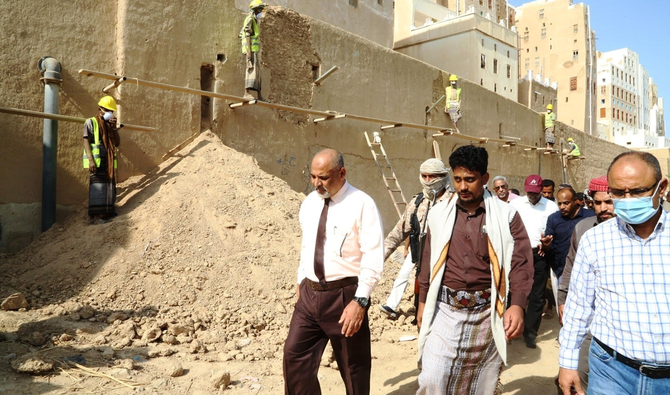
Local government officials in Hadramout inspect renovation of Shibam wall that has been hit hard by rains. (Supplied)
2 / 2
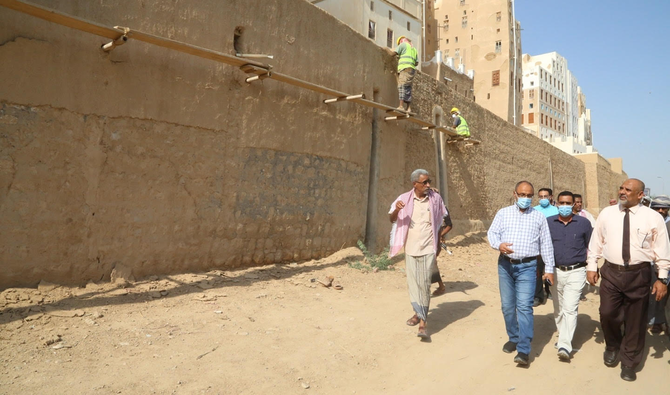
Local government officials in Hadramout inspect renovation of Shibam wall that has been hit hard by rains. (Supplied)
Short Url
Updated 30 August 2020
Follow

Renovation launched for UNESCO heritage site in Yemen

  • UNESCO has been mobilizing resources and expertise to safeguard Yemen’s cultural heritage by implementing a number of projects

AL-MUKALLA, Yemen: Local authorities in Yemen’s southeastern province of Hadramout have announced the start of a program to renovate dozens of decaying houses in the historic city of Shibam, a UNESCO World Heritage site since 1982.

The program is funded by the EU through UNESCO and the Yemeni Social Fund for Development.

The first phase costs $509,000, and targets mud houses that have not undergone renovation for the last five years, said Hasan Ayded, director of Shibam’s office of the General Organization for the Preservation of Historic Cities in Yemen, a government body.

“The priority is for houses that have been hit hard by rains and explosions, and those overlooking the city’s main square,” Ayded told Arab News. 

Known for its ancient towering adobe houses, Shibam has been deprived of vital maintenance since late 2014, when international perseveration experts fled the city following the Houthis’ takeover of Yemen’s capital Sanaa and their subsequent military expansion.

To make things worse, heavy downpours lashed Shibam in July this year, putting dozens of mud houses at risk of collapse.

Ayded said a government committee assigned by local authorities to assess the scale of damage in Shibam found out that almost half its 500 houses are in need of urgent attention.

“If we don’t intervene now, the problem will be bigger and will require more funds,” he said, adding that his office is in urgent need of $100,000 to renovate 40 crumbling houses in the second phase of the program. He urged local authorities, aid organizations and UNESCO to mobilize funds.

“Humanitarian assistance shouldn’t be restricted to food baskets. Saving a house in Shibam and keeping a family inside it is also humanitarian assistance,” he said.

Local officials are also calling for studies on how to help UNESCO World Heritage sites in Yemen adapt to climate change and unprecedented extreme weather.

In Houthi-held Sanaa, houses in the Old City, another UNESCO World Heritage site, have been crumbling since early August due to heavy rains and torrential floods.

UNESCO said in a statement: “Along with its international partners, UNESCO has been mobilizing resources and expertise to safeguard Yemen’s cultural heritage by implementing a number of projects with a focus on urban rehabilitation of private houses and capacity building for the local authorities.”


‘No good actors’ in Sudan war, says Trump’s Middle East adviser

Updated 5 sec ago
Follow

‘No good actors’ in Sudan war, says Trump’s Middle East adviser

  • Resolving conflict a ‘deeply felt concern’ of US president, Massad Boulos tells UN Security Council
  • ‘Today, Sudan faces the biggest and gravest humanitarian catastrophe in the world’

LONDON: A senior adviser to US President Donald Trump on Thursday criticized Sudan’s warring factions as he warned that no military solution could resolve the civil war.

Massad Boulos, Trump’s senior adviser on African, Arab and Middle Eastern affairs, was speaking at a ministerial-level UN Security Council briefing on Sudan.

A UN fact-finding mission has determined that the paramilitary Rapid Support Forces’ siege of the city of El-Fasher likely constituted genocide.

Resolving the almost three-year-long war in Sudan is a “deeply felt concern” of Trump, Boulos told the briefing, which was chaired by UK Foreign Secretary Yvette Cooper.

“Under President Trump and Secretary (of State Marco) Rubio’s leadership and close direction, I am helping to spearhead US efforts to achieve peace in Sudan,” he said.

“Today, Sudan faces the biggest and gravest humanitarian catastrophe in the world. After more than 1,000 days of needless conflict between the Sudanese Armed Forces and the Rapid Support Forces, the toll is staggering.”

In the eyes of the US, “there are no good actors in this conflict,” Boulos said, criticizing both factions for carrying out “serious human rights violations and abuses.”

He highlighted apparent efforts by coordinated Islamist networks to regain political influence in the fractured Sudanese state.

“Let me be clear: Efforts by Islamist networks or any extremist political movement to manipulate this conflict, derail a civilian transition, or reassert authoritarian control will not be tolerated by the US,” Boulos said.

“We will use the tools at our disposal — including sanctions and other measures — to hold accountable those who enable violence, undermine democratic governance, or threaten regional stability.”

His remarks came as the US announced fresh sanctions on RSF commanders, citing their record of “human rights violations, including ethnic killings, torture, starvation tactics and sexual violence.”

The paramilitary figures are now “subject to asset freezes, arms embargoes and travel bans,” Boulos said, adding: “We are working closely with partners in this room — including the United Kingdom, Egypt, Saudi Arabia and the UAE, and several others — to press for an immediate humanitarian truce, and without preconditions.

“Such a truce must guarantee sustained, unhindered humanitarian access across conflict lines and borders.”

He urged the international community to support five pillars of engagement to resolve the crisis: achieving an immediate humanitarian truce; coordinated efforts to ensure sustained humanitarian access; a phased approach for negotiating a permanent ceasefire; a structured political process that leads to a civilian-led transitional government and democratic elections; and a robust reconstruction and recovery effort.

“The US remains committed to working with all of you to end this tragic conflict and to support a peaceful, civilian future for Sudan,” Boulos said.