

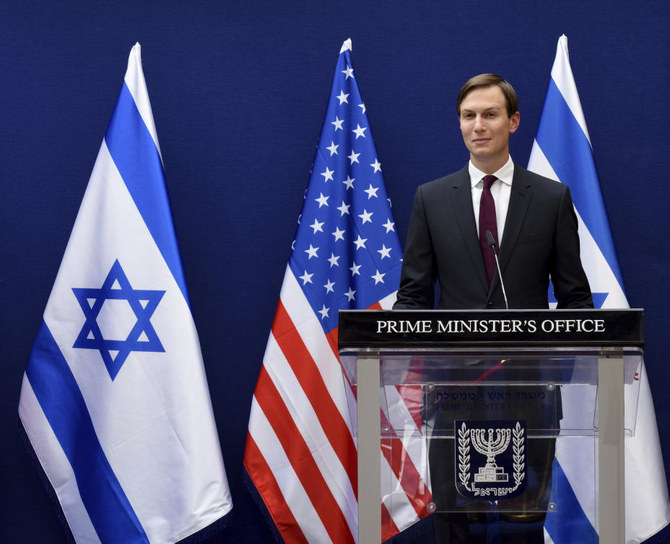
Kushner hopes for more Arab, Muslim partners for Israel ahead of UAE visit

White House adviser Jared Kushner and Israeli Prime Minister Benjamin Netanyahu make joint statements to the press about the Israeli-UAE peace accords. (AP)
Short Url
Updated 31 August 2020
Follow

Kushner hopes for more Arab, Muslim partners for Israel ahead of UAE visit

  • Trump adviser Jared Kushner met Prime Minister Benjamin Netanyahu in Jerusalem on the eve of talks in Abu Dhabi

JERUSALEM: US President Donald Trump’s national security adviser said on Sunday more Arab and Muslim countries were likely to follow the United Arab Emirates in normalizing relations with Israel.
The White House official, Robert O’Brien, and Trump’s son-in-law and senior adviser Jared Kushner met Prime Minister Benjamin Netanyahu in Jerusalem on the eve of talks in Abu Dhabi on Monday on finalizing formal Israel-UAE ties.
Israel and the UAE announced on Aug. 13 that they would forge official ties under a deal brokered by Washington. The diplomatic move reshapes the Middle East order, from the Palestinian issue to relations with Iran.


“We believe that other Arab and Muslim countries will soon follow the United Arab Emirates’ lead and normalize relations with Israel,” O’Brien told reporters after talks at Netanyahu’s residence.
He did not name the states, but Israeli officials have publicly mentioned Oman, Bahrain and Sudan.
Palestinians have condemned the UAE’s move as abandonment of a policy of linking official relations with Israel to achievement of Palestinian statehood in territory captured by Israel in a 1967 war.
The Trump administration has been trying to coax other Sunni Arab countries that share Israel’s concerns about Iran to join in a regional peace push.
Kushner, speaking alongside Netanyahu and O’Brien, said the UAE deal was a “giant step forward” in the direction.
“To have played a role in its creation, and I say this as the grandson of two Holocaust survivors, it means more to me and to my family that I can ever express,” Kushner said.
Kushner, O’Brien and other US officials will join an Israeli delegation on Monday in the first flight by an Israeli commercial airline — El Al — to the UAE.
Speaking on Israel’s Kan public radio on Sunday, Israeli Regional Cooperation Minister Ofir Akunis said Israel hopes to hold a signing ceremony in Washington for the UAE deal by mid-September.
In the Israeli-occupied West Bank, Hanan Ashrawi, a member of the Palestine Liberation Organization’s executive committee, said Kushner and his team were “scrambling to convince as many Arab and Muslim leaders as possible” to attend a White House signing event and give Trump a boost ahead of the Nov. 3 US presidential election.
“They will be a prop at the backdrop of a meaningless spectacle for a ridiculous agreement that will not bring peace to the region,” Ashrawi said.
On Saturday, the UAE announced it was scrapping its economic boycott against Israel. Officials from the two countries have said they are looking at cooperation in defense, medicine, agriculture, tourism and technology.
Netanyahu told reporters that abolishing “the anachronistic boycott” opened the door for “unbridled” trade, tourism and investment.
Statements issued by the UAE and Israel on Sunday said the UAE minister of state and Israel’s agriculture minister spoke by phone on Friday and “pledged to collaborate on projects that address food and water security.”
The UAE, a desert state, relies on imports for around 80 percent to 90 percent of its food, and has heavily encouraged investments in recent years in agricultural technology and farmland investments abroad.


Deaths mount in Gaza as ceasefire frays and key agreements stall

Updated 9 sec ago
Follow

Deaths mount in Gaza as ceasefire frays and key agreements stall

JERUSALEM: As the bodies of two dozen Palestinians killed in Israeli strikes arrived at hospitals in Gaza on Wednesday, the director of one asked a question that has echoed across the war-ravaged territory for months.
“Where is the ceasefire? Where are the mediators?” Shifa Hospital’s Mohamed Abu Selmiya wrote on Facebook.
At least 556 Palestinians have been killed in Israeli strikes since a US-brokered truce came into effect in October, including 24 on Wednesday and 30 on Saturday, according to Gaza’s Health Ministry. Four Israeli soldiers have been killed in Gaza in the same period, with more injured, including a soldier whom the military said was severely wounded when militants opened fire near the ceasefire line in northern Gaza overnight.
Other aspects of the agreement have stalled, including the deployment of an international security force, Hamas’ disarmament and the start of Gaza’s reconstruction. The opening of the Rafah border crossing between Gaza and Egypt raised hope of further progress, but fewer than 50 people were allowed to cross on Monday.
Hostages freed as other issues languish
In October, after months of stalled negotiations, Israel and Hamas accepted a 20-point plan proposed by US President Donald Trump aimed at ending the war unleashed by Hamas’ Oct. 7, 2023, attack into Israel.
At the time, Trump said it would lead to a “Strong, Durable, and Everlasting Peace.”
Hamas freed all the living hostages it still held at the outset of the deal in exchange for thousands of Palestinian prisoners held by Israel and the remains of others.
But the larger issues the agreement sought to address, including the future governance of the strip, were met with reservations, and the US offered no firm timeline.
The return of the remains of hostages meanwhile stretched far beyond the 72-hour timeline outlined in the agreement. Israel recovered the body of the last hostage only last week, after accusing Hamas and other militant groups of violating the ceasefire by failing to return all of the bodies. The militants said they were unable to immediately locate all the remains because of the massive destruction caused by the war — a claim Israel rejected.
The ceasefire also called for an immediate influx of humanitarian aid, including equipment to clear rubble and rehabilitate infrastructure. The United Nations and humanitarian groups say aid deliveries to Gaza’s 2 million Palestinians have fallen short due to customs clearance problems and other delays. COGAT, the Israeli military body overseeing aid to Gaza, has called the UN’s claims “simply a lie.”
Ceasefire holds despite accusations
Violence has sharply declined since the ceasefire paused a war in which more than 71,800 Palestinians have been killed, according to the Gaza Health Ministry. The ministry is part of the Hamas-led government and maintains detailed records seen as generally reliable by UN agencies and independent experts.
Hamas-led militants killed some 1,200 people in the initial October 2023 attack and took around 250 hostage.
Both sides say the agreement is still in effect and use the word “ceasefire” in their communications. But Israel accuses Hamas fighters of operating beyond the truce line splitting Gaza in half, threatening its troops and occasionally opening fire, while Hamas accuses Israeli forces of gunfire and strikes on residential areas far from the line.
Palestinians have called on US and Arab mediators to get Israel to stop carrying out deadly strikes, which often kill civilians. Among those killed on Wednesday were five children, including two babies. Hamas, which accuses Israel of hundreds of violations, called it a “grave circumvention of the ceasefire agreement.”
In a joint statement on Sunday, eight Arab and Muslim countries condemned Israel’s actions since the agreement took effect and urged restraint from all sides “to preserve and sustain the ceasefire.”
Israel says it is responding to daily violations committed by Hamas and acting to protect its troops. “While Hamas’ actions undermine the ceasefire, Israel remains fully committed to upholding it,” the military said in a statement on Wednesday.
“One of the scenarios the (military) has to be ready for is Hamas is using a deception tactic like they did before October 7 and rearming and preparing for an attack when it’s comfortable for them,” said Lt. Col. Nadav Shoshani, a military spokesperson.
Some signs of progress
The return of the remains of the last hostage, the limited opening of the Rafah crossing, and the naming of a Palestinian committee to govern Gaza and oversee its reconstruction showed a willingness to advance the agreement despite the violence.
Last month, US envoy Steve Witkoff, who played a key role in brokering the truce, said it was time for “transitioning from ceasefire to demilitarization, technocratic governance, and reconstruction.”
That will require Israel and Hamas to grapple with major issues on which they have been sharply divided, including whether Israel will fully withdraw from Gaza and Hamas will lay down its arms.
Though political leaders are holding onto the term “ceasefire” and have yet to withdraw from the process, there is growing despair in Gaza.
On Saturday, Atallah Abu Hadaiyed heard explosions in Gaza City during his morning prayers and ran outside to find his cousins lying on the ground as flames curled around them.
“We don’t know if we’re at war or at peace,” he said from a displacement camp, as tarpaulin strips blew off the tent behind him.