

Woman with polio drowns in her home, becomes symbol of Karachi floods' devastation

Residents sit over the debris of their collapsed houses at a flooded residential area after heavy monsoon rains in Pakistan's port city of Karachi on Aug. 26, 2020. (AFP)
Short Url
Updated 31 August 2020
Follow

Woman with polio drowns in her home, becomes symbol of Karachi floods' devastation

  • Nearly 50 people have died, according to official figures, but many remain missing as search efforts continue
  • Parts of Karachi remain submerged after thunderstorms started to lash Sindh province on Tuesday

KARACHI: When floodwaters started to enter homes in eastern Karachi on Thursday afternoon, Nusrat Aashiq was alone. Disability made it difficult for her to struggle to the surface. Nobody could hear her cries for help.
Nearly 50 people have died, according to official figures, since the worst thunderstorms hit the coastal city of 15 million on Tuesday. As search and rescue efforts are still underway, many more people remain missing, feared to have lost their struggle against the flood, like Aashiq.
“Suffering from the poliovirus, which had crippled her body, the woman might have made efforts and called for help. But no one was there to help,” Bilal Siddiqui, Aashiq’s neighbor in the Karachi Administration Employees Housing Society (KAEHS), one of the city’s most affected, told Arab News.
Police say the 42-year-old woman could not move as both her legs were paralyzed. Her husband was reportedly away when she drowned, but the case will be investigated, local police Inspector Shoaib-ur-Rehman said.
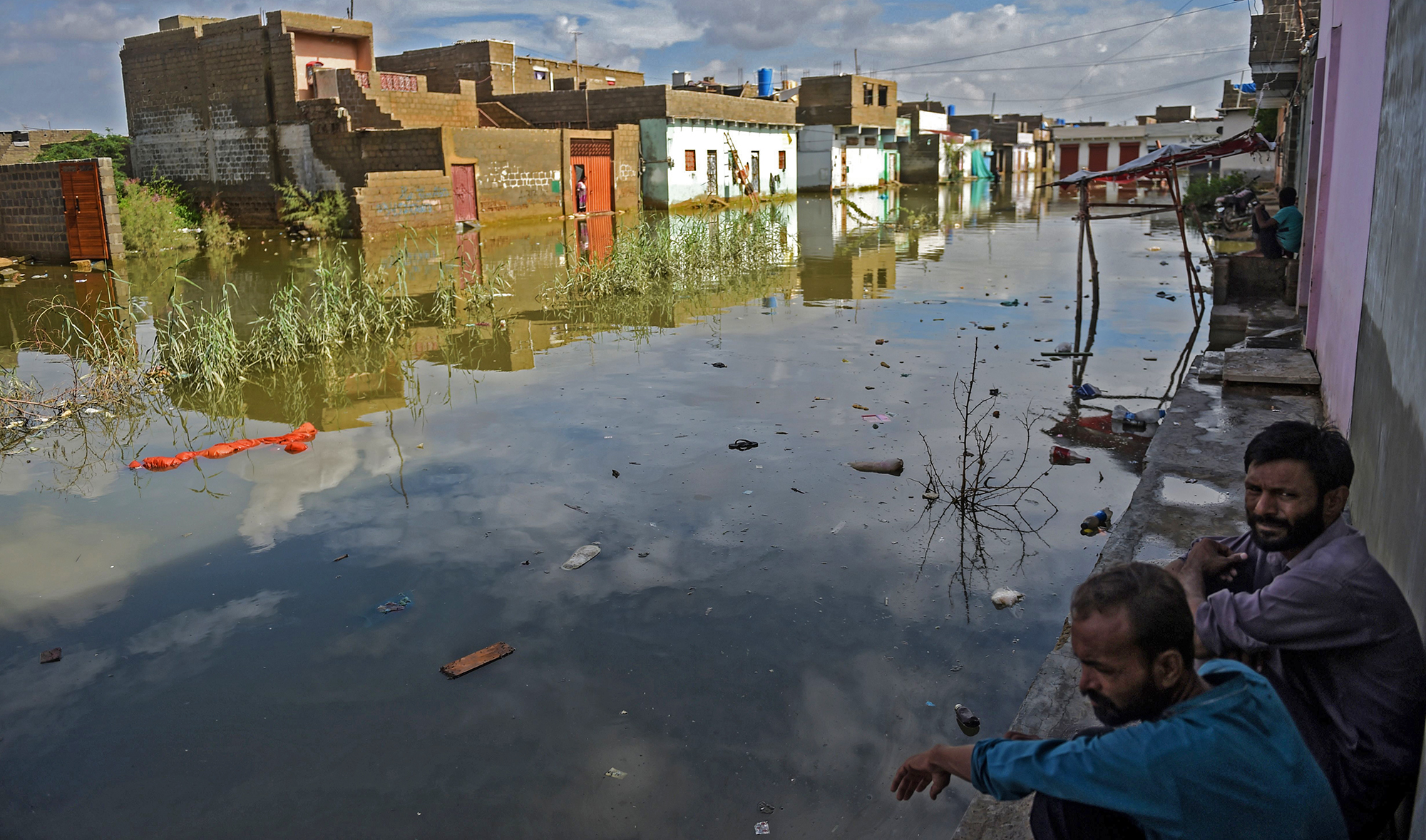


Residents sit alongside their houses at a flooded area after heavy monsoon rains in Pakistan's port city of Karachi on Aug. 26, 2020. (AFP)

Many others still remain unaccounted for and families of the missing are in anguish while footage circulated on social media fuels their fear. On Saturday evening, a widely shared video showed the body of a young man being recovered from a clogged sewage drain.
Hina Waseem, a resident of Karachi’s Jamshed town whose family was also torn apart by the flood, is still waiting for her husband who went missing when he was accompanying his mother. The mother’s body was found on Saturday. 
“Till yesterday Hina would ask about her husband and complain that we are not doing enough to find him, but since the body of her mother-in-law has been recovered, she is only crying,” Waseem’s cousin, Owais Ali, told Arab News.
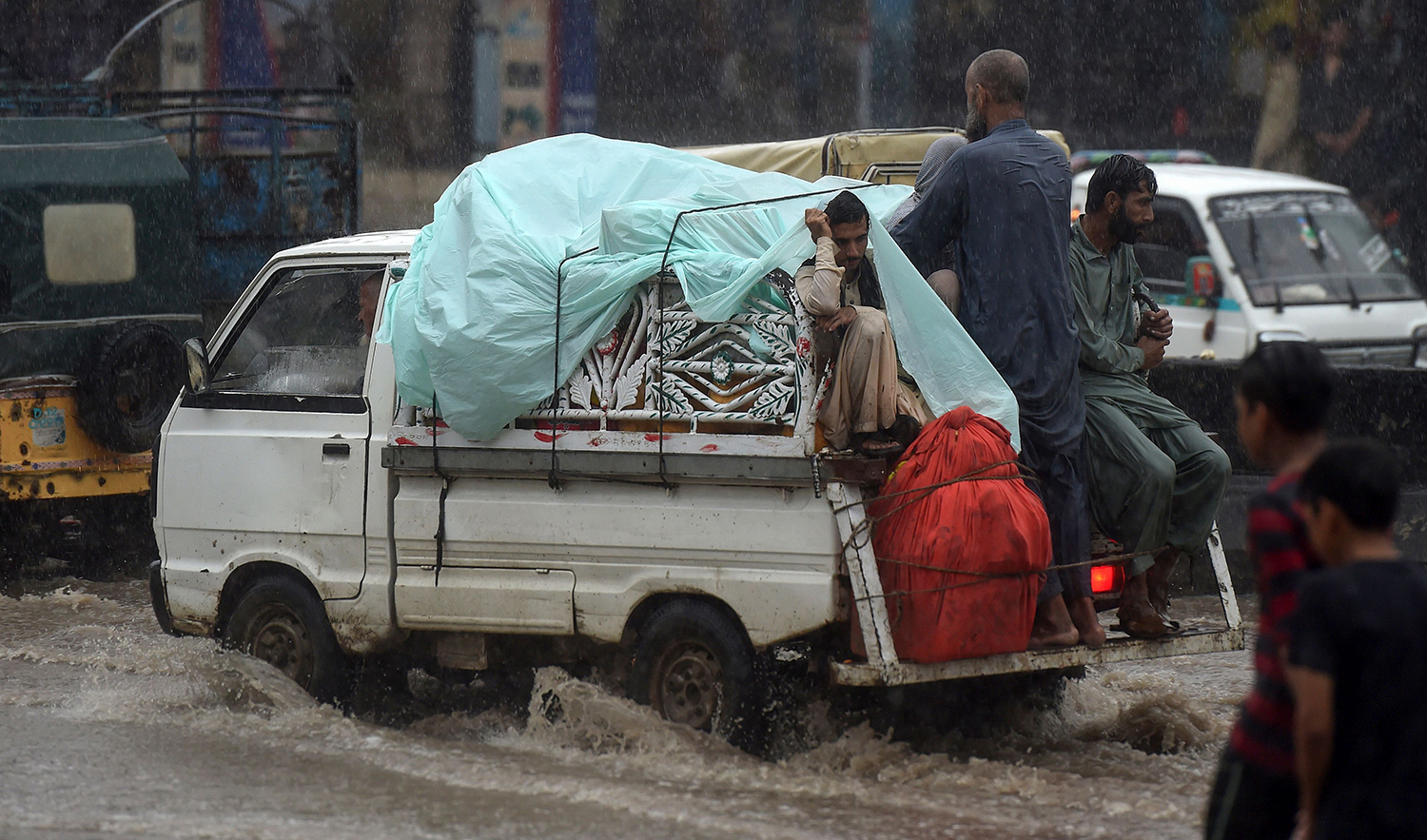


People ride in a vehicle during heavy monsoon rains in Pakistan's port city of Karachi on August 27, 2020. (AFP)

As the provincial government has ordered a survey to determine the economic losses caused by the floods, after the business community claimed that Karachi alone had suffered damages of about Rs12 billion ($71.7 million) in the past few days, many ordinary people have lost their future and dreams.
Nusrat Jehan, a resident of Manzoor colony, said the items she had bought for her daughter’s dowry were all washed away by the flood. Years of saving for her child’s wedding vanished in no time. “I don’t know if I will be able to manage it again,” she said.
Shahid Rasam, a famous artist from the DHA area of the city, shared with Arab News a video showing all his paintings, books and furniture submerged in murky floodwaters. “This is DHA phase 4, a so-called posh area, with highest tax payers, and look at their suffering. In fact, the whole city has become a river of filth,” he said.
“See the condition of my studio, the canvases, the books, everything has been destroyed. The water has completely destroyed my work.”


Pakistan opposition to hold protest today over jailed ex-PM Khan’s deteriorating eye condition

Updated 6 sec ago
Follow

Pakistan opposition to hold protest today over jailed ex-PM Khan’s deteriorating eye condition

  • A court-appointed lawyer this week visited Imran Khan at prison and recommended independent ophthalmology review of his right eye
  • Information Minister Attaullah Tarar said Khan party’s narrative has ‘fallen flat on its face’ after ex-PM voiced ‘satisfaction’ with facilities

ISLAMABAD: Pakistan’s opposition alliance has announced a sit-in outside the Parliament House in Islamabad today, Friday, over jailed former prime minister Imran Khan’s deteriorating eye condition, following a rare prison visit by a Supreme Court-appointed lawyer this week.

Barrister Salman Safdar, who was appointed ‘amicus curiae,’ or friend of the court, visited Khan at Rawalpindi’s Adiala jail on Feb. 10 and filed a detailed report on his living conditions and health, which was made public on Thursday.

The report stated that in view of the seriousness of Khan’s ocular condition, “it is imperative that the seriousness of the condition be independently ascertained without delay.” There was no immediate response from prison authorities on the findings.

The Tehreek-e-Tahafuz-e-Ayin-e-Pakistan opposition alliance late Thursday demanded that Khan be transferred to Al-Shifa Hospital and announced a sit-in outside parliament until the former prime minister is allowed treatment in the presence of his personal physicians.

“The sit-in will be held tomorrow,” Mahmood Khan Achakzai, the head of the opposition alliance, told reporters in Islamabad, adding that they will peacefully lay down all demands at the sit-in. “If, God forbids, something happens, then the government will be responsible for that.”

Khan, 73, has been in custody since August 2023 in connection with multiple cases that he and his party describe as politically motivated. The government denies the allegation.

Concerns about Khan’s health have resurfaced in recent weeks after authorities confirmed he had been briefly taken from prison to a hospital in Islamabad for an eye procedure. The government said at the time his condition was stable, while Khan’s family and his Pakistan Tehreek-e-Insaf (PTI) political party complained they had not been informed in advance and alleged he was being denied timely and independent medical access.

The issue was then taken up by the Supreme Court earlier this week, which tasked Safdar, who has represented Khan in the past, with visiting the ex-premier and submitting a written report.

According to a medical condition report from the Pakistan Institute of Medical Sciences (PIMS), dated Feb. 6, 2026 and referenced in Safdar’s court filing, Khan was diagnosed with “right central retinal vein occlusion” after reporting reduced vision in his right eye.

The report states that he underwent anti-VEGF intravitreal injection treatment at PIMS and was discharged with follow-up advice.

However, in his interaction with Safdar, Khan said he had experienced “rapid and substantial loss of vision over the preceding three months” and claimed his complaints had not been addressed promptly while in custody. He further stated that despite treatment, he had been left with “only 15 percent vision in his right eye.”

Safdar’s report notes that the former premier appeared “visibly perturbed and deeply distressed by the loss of vision and the absence of timely and specialized medical intervention.” The amicus also recommended that the Supreme Court consider directing involvement of Khan’s personal physicians or other specialists of his choice, warning that “any further delay poses a serious risk to the Petitioner’s well-being.”

Beyond medical concerns, the report addressed Khan’s confinement conditions, noting that he expressed “satisfaction regarding his safety and security within the cell-block,” as well as contentment with basic amenities and food provisions.

Responding to the report, Information Minister Attaullah Tarar rejected claims of mistreatment, saying the “narrative being propagated to international media” by Khan’s family had “fallen flat on its face.”

He said the prison report on Khan’s daily routine and diet had removed any ambiguity and maintained that all facilities were available to the former premier, who he said enjoyed privileges “more than any other prisoner.” His X post did not address the allegations on Khan’s health issues.