

Brussels set to discuss sanctions against Turkey

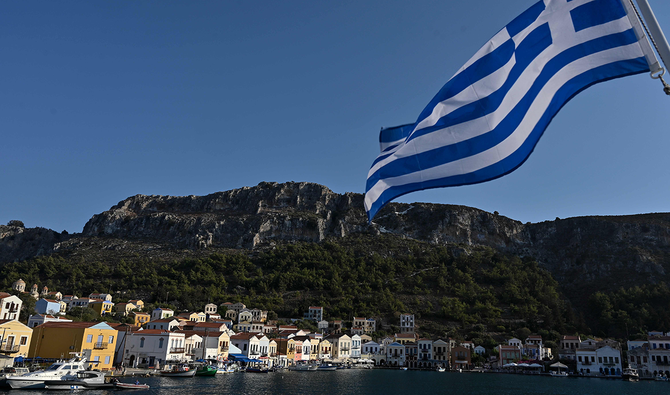
A view of the tiny Greek island of Kastellorizo (Megisti) with a Greek flag, in the Dodecanese, the furthest south eastern Greek Island, two kilometers from the Turkish mainland, on August 28, 2020. (AFP)
Short Url
Updated 29 August 2020
Follow

Brussels set to discuss sanctions against Turkey

  • EU states upset over maritime boundaries, energy exploration

ANKARA: Brussels is set to discuss sanctions against Turkey at a meeting of EU leaders next month, as the country began firing exercises in contested waters of the eastern Mediterranean on Saturday.

Turkey and Greece are in a bitter dispute over maritime boundaries and energy exploration rights. 

German Chancellor Angela Merkel has said that all EU countries are obliged to back Athens in its longtime dispute with Ankara over claims to hydrocarbon resources in the area. Turkey is also prospecting in waters that Cyprus, another EU member, claims rights to. 

On Friday the bloc’s foreign policy chief, Josep Borell, said sanctions were likely to be discussed on Sept. 24 and that they could include individuals, vessels or access to European ports and European technology in a bid to restrict Turkey’s ability to explore for natural gas in contested waters.

German Foreign Minister Heiko Maas and Borrell both said the EU would try to boost dialogue between Greece and Turkey to calm the situation.

Any scaling back from Turkey of its energy drilling in the disputed area may also be rewarded with trade opportunities between the Turkish and EU markets, according to some insights. 

But EU sanctions are unlikely to deter Turkey, according to one expert.

“The kind of sanctions the EU can put in place at this stage will likely be an extension of previous ones, related to persons and institutions involved in research and drilling activities,” Marc Pierini, a former EU ambassador to Turkey and now a visiting scholar at the Carnegie Europe foundation, told Arab News. “In my view, they are unlikely to deter Turkey.”

However he warned that there were other kinds of sanctions that Turkey could face, calling them “self-inflicted” ones.

“Turkey’s military activities, fierce anti-EU statements, unilateral creation of legal situations, and the repeated irreversible nature of these policy decisions have created an unpredictable political, security, and legal image of Turkey. This is likely to profoundly deter the international business and financial circles previously interested in Turkey.”

A new survey by Turkey’s MetroPoll company showed that around 60 percent of the Turks interviewed wanted the east Mediterranean crisis to be resolved diplomatically, while around 32 percent supported military action, if required. Supporters of the ruling party and its allies are divided between diplomatic and military options, while the opposition parties favor a diplomatic resolution. 

Karol Wasilewski, an analyst at the Warsaw-based Polish Institute of International Affairs, said that Turkey should pay close attention to the message the EU was sending rather than focusing on sanctions. 

“The EU has to defend its members,” he told Arab News. “The EU prioritizes diplomacy and dialogue to create a mutually beneficial formula of relations. There is a growing frustration among member states when it comes to Turkey, and there may be changes in the EU's approach toward Turkey.”

Wasilewski said that the bloc’s approach to Turkey was of particular importance especially in light of Maas’ statement during his visit to Ankara that the future of the relationship would be determined until the end of the year.

“This may be a veiled suggestion from a German diplomat that if Turkey won’t engage in dialogue the Germans won't be able to still be a moderating force when it comes to the EU's policy toward Turkey,” Wasilewski added.

He urged decision-makers in Ankara to read the EU’s latest messages about the maritime dispute to find common ground and prevent further escalation and destabilization.

“They should also try to make use of the opportunity the EU still offers because if Germany joins France's stance on Turkey and, as a result, the whole EU takes a decision to have a more assertive policy toward Turkey, the country will have difficulties in facing the consequences.”

Turkey’s shooting exercises will continue until Sept. 11. Ankara has made it clear that it will retaliate to any sanctions from the West.


Trump has ‘productive’ talks with Putin before Zelensky meet

Updated 4 sec ago
Follow

Trump has ‘productive’ talks with Putin before Zelensky meet

  • Trump’s upbeat tone on peace deal comes after Russia carried out another massive bombardment of Kyiv
  • US president due to meet Zelensky at his Mar-a-Lago estate today
PALM BEACH: Donald Trump said Sunday he had “productive” talks with Russian leader Vladimir Putin hours before the US president meets Ukraine’s Volodymyr Zelensky, in a year-end sprint to seal a deal to end the war.
Trump’s renewed upbeat tone comes despite wide skepticism in Europe about Putin’s intentions after Russia carried out another massive bombardment of the Ukrainian capital Kyiv just as Zelensky was heading to Trump’s Florida estate.
“I just had a very good and productive telephone call with President Putin of Russia,” Trump announced on his Truth Social platform.
The Kremlin gave a more pointed readout, saying that Trump agreed that a mere ceasefire “would only prolong the conflict” as it demanded Ukraine compromise on territory.
Trump is meeting Zelensky in the dining room of his Mar-a-Lago estate, where he frequently brings both foreign guests and domestic supporters.
Trump has made ending the Ukraine war a centerpiece of his second term as a self-proclaimed “president of peace,” and he has repeatedly blamed both Kyiv and Moscow for the failure to secure a ceasefire.
Zelensky, who has faced verbal attacks from Trump, has sought to show willingness to work with the contours of the US leader’s plans, but Putin has offered no sign that he will accept it.
Sunday’s meeting will be Trump’s first in-person encounter with Zelensky since October, when the US president refused to grant his request for long-range Tomahawk missiles.
And the Ukrainian leader could face another hard sell this time around, with Trump insisting that he “doesn’t have anything until I approve it.”

- European allies -

The talks are expected to last an hour, after which the two presidents are scheduled to hold a joint call with the leaders of key European allies.
Polish Prime Minister Donald Tusk, who will join the call, wrote on X that the Russian attacks on Kyiv were “contrary to President Trump’s expectations and despite the readiness to make compromises” by Zelensky.
The revised peace plan, which emerged from weeks of intense US-Ukraine negotiations, would stop the war along its current front lines and could require Ukraine to pull troops back from the east, allowing the creation of demilitarized buffer zones.
As such, it contains Kyiv’s most explicit acknowledgement yet of possible territorial concessions.
It does not, however, envisage Ukraine withdrawing from the 20 percent of the eastern Donetsk region that it still controls — Russia’s main territorial demand.
The Ukrainian leader said he hoped the talks in Florida would be “very constructive” but stressed that Putin had shown his hand with a deadly drone and missile assault on Kyiv that temporarily knocked out power and heating to hundreds of thousands of residents during freezing temperatures.
“This attack is again Russia’s answer on our peace efforts. And this really showed that Putin doesn’t want peace,” he said as he visited Canada.
He also told reporters that he would press Trump on the importance of providing security guarantees that would prevent any renewed Russian aggression if a ceasefire were secured.
“We need strong security guarantees. We will discuss this and we will discuss the terms,” he said.
Ukraine insists it needs more European and US funding and weapons — especially drones.

- Russian opposition -

Russia has accused Ukraine and its European backers of trying to “torpedo” a previous US-brokered plan to stop the fighting, and recent battlefield gains — Russia announced on Saturday it had captured two more towns in eastern Ukraine — are seen as strengthening Moscow’s hand when it comes to peace talks.
“If the authorities in Kyiv don’t want to settle this business peacefully, we’ll resolve all the problems before us by military means,” Putin said on Saturday.
Russian Foreign Minister Sergei Lavrov told state news agency TASS that Moscow would continue its engagement with US negotiators but criticized European governments as the “main obstacle” to peace.
“They are making no secret of their plans to prepare for war with Russia,” Lavrov said, adding that the ambitions of European politicians are “literally blinding them.”