Greece wants emergency EU ministers’ meeting on Turkey tensions

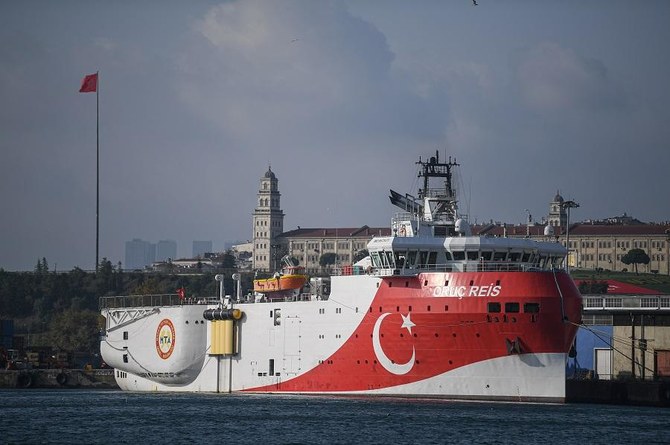
Tensions escalated on Monday after Turkey’s navy issued an advisory known as a Navtex saying that the Oruc Reis vessel would operate in an area of sea south of Turkey’s Antalya and west of Cyprus between Aug. 10-23. (File/AFP)
Short Url
Updated 11 August 2020
Follow

Greece wants emergency EU ministers’ meeting on Turkey tensions

  • The two NATO allies are at odds over overlapping claims for hydrocarbon resources in the region
  • Greece’s Foreign Affairs Ministry urged Turkey to “immediately cease its illegal activities which undermine peace and security in the region”

ATHENS: Greece will request an emergency meeting of EU foreign affairs ministers over Turkey’s decision to dispatch a seismic research vessel in a disputed area in the eastern Mediterranean, the prime minister’s office said on Tuesday.
The two NATO allies, who hold fundamentally different views on where their continental shelves begin and end, are at odds over overlapping claims for hydrocarbon resources in the region.
Tensions escalated on Monday after Turkey’s navy issued an advisory known as a Navtex saying that the Oruc Reis vessel would operate in an area of sea south of Turkey’s Antalya and west of Cyprus between Aug. 10-23. Seismic surveys are part of preparatory work for potential hydrocarbon exploration.
Greece’s Foreign Affairs Ministry urged Turkey to “immediately cease its illegal activities which undermine peace and security in the region.” Turkey has dismissed the Greek objections, saying they had no legal basis, and vowed to continue operations.
The latest advisory came after Egypt and Greece signed an accord last Thursday designating an exclusive economic zone between the two nations in the east Mediterranean, increasing friction with Turkey over the area.
Prime Minister Kyriakos Mitsotakis met Foreign Minister Nikos Dendias on Tuesday and called for the emergency meeting of EU foreign affairs ministers.
An EU spokesman said consultations among member states would take place before a decision on the request is made. EU foreign ministers are scheduled to meet in Berlin on Aug. 27-28.
“We agree that the situation in the eastern Mediterranean is extremely worrying and needs to be solved in a dialogue, not in a series and sequence of steps that are increasing the escalation and the tensions,” said European Commission spokesman Peter Stano.
“The EU stands in full solidarity with Cyprus and Greece.”
A similar Turkish advisory was issued last month prompting another dispute that was calmed after the intervention of German Chancellor Angela Merkel, leading Turkey to agree to a pause in operations.


Al-Shabab extremists are greatest threat to peace in Somalia and the region, UN experts say

Updated 5 sec ago
Follow

Al-Shabab extremists are greatest threat to peace in Somalia and the region, UN experts say

  • The UN Security Council on Tuesday voted unanimously to extend authorization for the African Union’s “support and stabilization” force in Somalia until Dec. 31, 2026

UNITED NATIONS: The Al-Shabab extremist group remains the greatest immediate threat to peace and stability in Somalia and the region, especially Kenya, UN experts said in a report released Wednesday.
Despite ongoing efforts by Somali and international forces to curb operations by Al-Qaeda-linked Al-Shabab, “the group’s ability to carry out complex, asymmetric attacks in Somalia remains undiminished,” the experts said.
They said the threat comes not only from Al-Shabab’s ability to strike — including within the capital, Mogadishu, where it attempted to assassinate the president on March 18 — but from its sophisticated extortion operations, forced recruitment and effective propaganda machine.
The UN Security Council on Tuesday voted unanimously to extend authorization for the African Union’s “support and stabilization” force in Somalia until Dec. 31, 2026. The force includes 11,826 uniformed personnel, including 680 police.
The extremist group poses a significant threat to neighboring Kenya “by conducting attacks that vary from attacks with improvised explosive devices, which predominantly target security personnel, to attacks on infrastructure, kidnappings, home raids and stealing of livestock,” the experts said.
This year, Al-Shabab averaged around six attacks a month in Kenya, mostly in Mandera and Lamu counties, which border Somalia in the northeast, the panel said.
The experts said Al-Shabab’s goal remains to remove Somalia’s government, “rid the country of foreign forces and establish a Greater Somalia, joining all ethnic Somalis across east Africa under strict Islamic rule.”
The panel of experts also investigated the Islamic State’s operations in Somalia and reported that fighters were recruited from around the world to join the extremist group, the majority from east Africa. At the end of 2024, they said the group known as ISIL-Somalia had a fighting force of over 1,000, at least 60 percent of them foreign fighters.
“Although small in terms of numbers and financial resources compared with Al-Shabab, the group’s expansion constituted a significant threat to peace and security in Somalia and the broader region,” the panel said.