

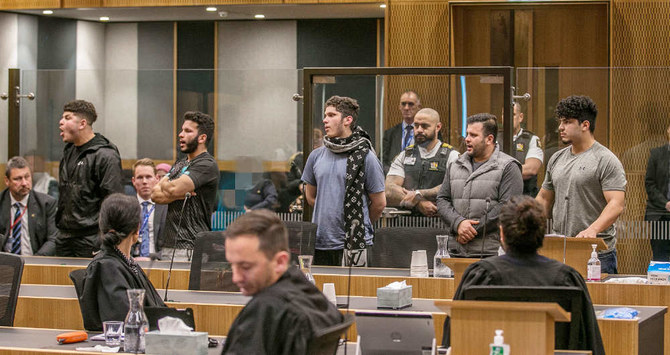

CHRISTCHURCH, NEW ZEALAND: The white supremacist responsible for an anti-Muslim shooting spree that left dozens dead, traumatising New Zealand and capturing the world’s attention was today sentenced to life imprisonment without the possibility of parole.
Brenton Harrison Tarrant, 29, had pleaded guilty to 51 counts of murder, 40 counts of attempted murder and one charge of engaging in a terrorist act in relation to the massacre on March 15 last year that he livestreamed on Facebook.
“The trauma of March 15 is not easily healed but today I hope is the last where we have any cause to hear or utter the name of the terrorist behind it. His deserves to be a lifetime of complete and utter silence,” New Zealand Prime Minister Jacinda Ardern said after the sentencing.
The Muslim community in New Zealand reacts to the sentence, Prime Minister Jacinda Ardern comments. (AFP video)
The killings took place during Friday prayers at the city’s Linwood Islamic Centre and Al Noor Mosque, not far from the courthouse where this week’s four-day sentencing hearing took place.
Among the arsenal of weapons Tarrant brought with him to execute his meticulously planned attacks was a pump-action rifle he daubed with a Nazi-style SS symbol.
In his livestream, he described what was happening as a “firefight” as if the men, women and children he methodically picked off had somehow been in a position to defend themselves.
The prosecution had called for a whole-of-life sentence to reflect what it called the “calculated sadism and depravity” of the crimes.
Justice Cameron Mander agreed, describing Tarrant himself as “unusually racist” in his views and bereft of any remorse for his actions.
The moment the judge read out Tarrant's sentence. (AFP video)
“If not here, when?” he said of the whole-of-life sanction.
The judge said the penalty was required in order to fully denounce Tarrant’s actions and to fully hold an “entirely self-centred” offender accountable. The penalty also had a deterrent value and would protect the wider community.
Earlier, he asked Tarrant if he wished to say anything before the final sentencing. “No, thank you,” Tarrant replied, looking sallow and diminished in baggy prison overalls.
Today’s sentence is a first for New Zealand, which last executed a convict in 1961, before abolishing the death penalty in the late 1980s.
But the case itself has been a judicial novelty, too. The scale of the crime was without local precedent. So had been this week’s avalanche of victim-impact statements — chosen from among 200 submissions — and the wrenching effect on the wider culture.

Brenton Tarrant will spend the rest of his life behind bars. (AFP)
Justice Mander spoke of the grandparents who would never again see their grandchildren, wives who would never again hold hands with their husbands, the children who still ask when they would be seeing their vanished parents. In one of the cases, he noted with evident distaste, three of the family members of what had been a four-person household had perished at his hand.
Raf Manji, a former city councillor in Christchurch who has spent much of the past 17 months working with survivors and was in the court this week, told Arab News that the whole-of-life sentence was the only welcome outcome in such a horrendous case.
Speaking outside the courthouse, Manji said it was “really important for the families of the terrorized that this sentence has been without parole,” said Manji.
“This man will never be able to leave prison, and he will have to spend the rest of his life in a cell. As a punishment. And that is really important. Sometimes the punishment side of things can be a difficult thing, especially in more liberal societies, but it’s really important.”
Members of New Zealand's Muslim community spoke outside the court after sentencing was served. (AFP video)
The 90 victim-impact testimonies given to the court during the sentencing had laid bare the terror that was caused by the defendant. Clearly, they also left their trace on the final deliberations.
This week the defendant looked like “a shell of a man, and recalled Eichmann’s trial [in Jerusalem], you know in that ‘banality of evil’ sense,” when the appearance of the individual usually reminds us only that they are “ordinary people who have done terrible things,” Manji said.
The unprecedented sentence was also welcomed in religious circles beyond the local Muslim community, including a statement issued immediately by the New Zealand Jewish Council saying no other minimum term would have reflected the gravity of the offence.
“The hearing has highlighted the stark contrast between the victims of this atrocity, who have shown the greatest strength and dignity, and the shooter, utterly lacking those qualities and indeed any semblance of contrition and humanity,” Juliet Moses, the council’s spokeswoman, said.


