

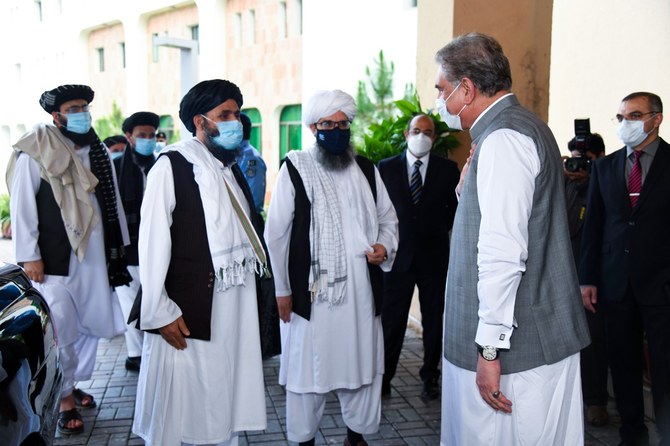

ISLAMABAD: Foreign Minister Makhdoom Shah Mahmood Qureshi on Tuesday warned against ‘spoilers’ who did not want to see peace in Afghanistan, as he met a high-level team from the Afghan Taliban’s political office that is visiting Islamabad on the invitation of the foreign office.
The head of the Afghan Taliban has finalized a 20-member negotiating team for upcoming talks between the Kabul government and the insurgent group, thirteen of whom are from the group’s existing leadership council, the group’s chief negotiator told Arab News on Tuesday.
Afghanistan’s government and the Taliban have agreed that Doha will be the venue for the peace talks, known as the intra-Afghan dialogue — the first high-level meeting between the two sides after nearly two decades of fighting.
A Taliban team, led by Mullah Abdul Ghani Baradar arrived in Pakistan on Monday for talks with Pakistani leaders that both sides hope will help kickstart the intra-Afghan talks.
In a statement released on Tuesday evening, the foreign office said Qureshi emphasized the implementation in “entirety” of a historic peace deal signed between the Taliban and Washington in Doha earlier this year, which outlined a roadmap for withdrawing foreign forces from Afghanistan and peace talks between Kabul and the Taliban to end the 19-year war.
“The Foreign Minister also cautioned against ‘spoilers’ who did not wish to see return of peace in the region,” the statement said. “For its part, the Foreign Minister stressed, Pakistan will continue to support an Afghan-led and Afghan-owned peace process for durable peace, stability and prosperity in the region and beyond.”
“Foreign Minister Shah Mahmood Qureshi underscored Prime Minister Imran Khan’s consistent stance that there was no military solution to the conflict in Afghanistan and that a political settlement was the only way forward,” the statement added.
Qureshi also urged the international community to step up its efforts for the reconstruction and economic development of Afghanistan and highlighted the need for “creating economic opportunities and an environment conducive for return of Afghan refugees to their homeland with dignity and honor.”
Taliban’s Baradar thanked Qureshi for the invitation and affirmed support for efforts for peace, security and development in Afghanistan.
A Taliban political delegation last visited Pakistan in October 2019 for wide-ranging consultations on the Afghan peace and reconciliation process.
Earlier in the day, Taliban chief negotiator Sher Abbas Stanekzai announced a 20-member negotiating team for upcoming talks between the Kabul government and the insurgent group.
“All decision-making powers are with the negotiations team, which has 65 percent representation from the ‘Rehbari Shoura’ [Taliban leadership council],” Stanekzai told Arab News via audio message from Doha, Qatar, where the insurgent group has had a political office since 2013. “They will take the process forward... and are now involved in internal consultation to chalk out a strategy.”
Stanekzai said Sheikh Hibatullah Akhunzada, the leader of the Afghan Taliban, would have the authority to devise the council’s strategy and sign agreements with President Ashraf Ghani’s government in Kabul.
The 20-member negotiation council includes several of Akhunzada’s close aides such as Sheikh Abdul Hakeem, Maulvi Abdul Kabeer, Maulvi Noor Mohammad Saqib, Mullah Shireen Noorzai, Sheikh Qasim Turkmen, and Abdul Manan Omari, who is the brother of Taliban founder Mullah Omar.
Intra-Afghan peace talks are set to begin following the release of 5,000 Taliban prisoners by the Afghan government, a condition of the Doha deal. There was deadlock earlier over the release of 400 ‘hardcore’ Taliban prisoners, but Ghani announced on August 9 that he would free them “soon.”
“Kabul had agreed to release prisoners but later deviated from its commitment,” Stanekzai said. “We will not start intra-Afghan dialogue even if our one prisoner stays in jail. Every prisoner is a hero.”


