

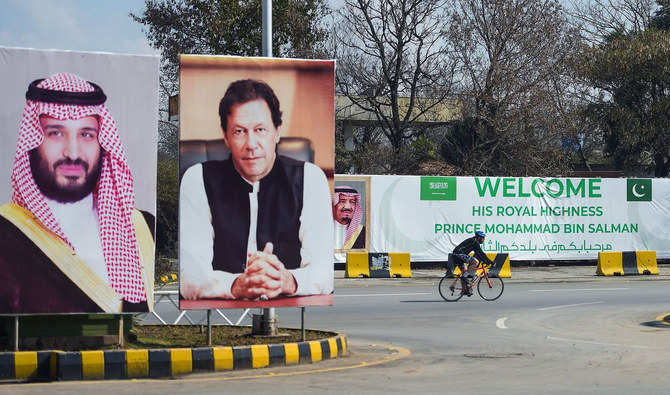

KARACHI: The political, economic and diplomatic relations between Pakistan and Saudi Arabia are stronger than ever, Pakistan officials and experts said on Tuesday, dispelling the impression that the Saudi deferred oil payment facility and loans were becoming an issue between the two countries.
Speculation was rife in Pakistan that Saudi Arabia had suspended the deferred oil payment facility and was demanding back the money deposited with the Pakistani central bank after the August 5 statement of Foreign Minister Shah Mahmood Qureshi about the Organization of Islamic Cooperation’s stance over Kashmir that sparked some discomfort among the diplomatic circles.
However, Qureshi on Monday dismissed the notion that the diplomatic relations between the two allies had hit a rough patch, adding that Riyadh had neither asked Islamabad to return the loan nor suspended the oil facility for Pakistan.
“The prime minister and foreign minister have repeatedly said that the relations between the two countries are normal and we stand together in difficult situations,” Malik Muhammad Ehsan Ullah Tiwana, who heads the National Assembly Standing Committee on Foreign Affairs, told Arab News on Tuesday.
“The oil facility was not utilized and the Saudis did not ask us to return the loan,” he continued. “None of this is an issue and the government of Pakistan has clearly expressed its stance. It is business as usual between the two countries.”
Pakistan returned $1 billion to Saudi Arabia earlier this month. The money was part of a $3 billion loan Riyadh had given to Pakistan in November 2018 and its return was widely viewed by local and foreign media as the consequence of the foreign minister’s statement.
However, the government has strongly dispelled the impression, calling it a mere “assumption.”
“One billion dollar is like peanuts for a country like Saudi Arabia that supported Pakistan with more than $6 billion when Islamabad was in dire need,” Ali Pervaiz, a member of the National Assembly Standing Committee on Finance, Revenue and Economic Affairs, told Arab News. “Saudi Arabia is our time-tested friend and has stood by Pakistan through thick and thin.”
Analysts familiar with the matter noted that Pakistan had not only repaid a portion of the Saudi debt but also retired some other debts ahead of schedule to get better ratings in the international market.
“We need improved rating since the government is planning to launch Euro Bond and Sukuk in the international market,” Dr. Vaqar Ahmed, Joint Executive Director of the Sustainable Development Policy Institute (SDPI), told Arab News. “You launch Euro Bond and Sukuk in international market only when you have good ratings. The government wanted to show that there is enough liquidity in the economy,” he added.
The agreement between Pakistan and Saudi Arabia for $3.2 billion worth of oil on deferred payments expired in May this year, though Pakistan did not utilize the whole amount due to its domestic economic situation.
“The oil on deferred payment is a small issue,” Ahmed explained. “In fact, it is not an issue at all. You will get it when you seek its renewal. The issue was that Pakistan could not utilize the previous facility because there was no growth in the economy and COVID-19 contracted it further. Not even 50 percent of the facility was utilized.”
Dr. @vaqarahmed, Joint Executive Director of SDPI told #ArabNewsPK that #SaudiArabia's #oil on deferred payment is "not an issue at all" as #Pakistan couldn't fully utilize previous facility amid #COVID19 shutdown || #economy
-
Read special by @Khurshid72https://t.co/gXz8GYg1Ne pic.twitter.com/G3XCWS6NfI— Arab News Pakistan (@arabnewspk) August 26, 2020
In 2018, Pakistan had secured $7.7 billion through bilateral arrangements, including $3 billion from Saudi Arabia (apart from the $3.2 billion oil facility that it got from the Kingdom), to ease its external sector woes. The Inflows had provided the much-needed balance-of-payments support to Islamabad.
On Tuesday, Brent crude touched 6-month high at $46 per barrel in the international market. Analysts say the external financial position of the country could once again come under pressure in the absence of the Saudi oil facility.
“The oil is the single most macro-influencing factor since it contributes more than 25 percent to the country’s imports. Now that the Saudi oil facility is absent, the external financial position of the country may be impacted again if oil prices continue to surge,” Khurram Schehzad, chief executive officer of a Karachi-based advisory, Alpha Beta Core Solutions, said.
Asked about the renewal of the deferred oil payment facility, a senior official said that the Pakistani government was already working on that.
“We wrote to them [the Saudi government] in May and are waiting [for their response],” Mohsin Mushtaq Chandna, a finance ministry spokesperson, told Arab News.




