SRINAGAR: A prominent rights group in Indian-administered Kashmir on Tuesday described a communications blackout imposed by India following its scrapping of the disputed region’s semi-autonomy last year “collective punishment” and urged the international community to question New Delhi over what it called “digital apartheid.”
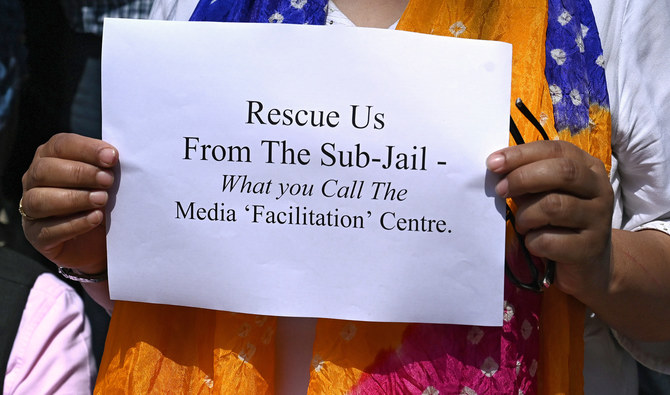
In a report, the Jammu-Kashmir Coalition of Civil Society described “harms, costs and consequences of the digital siege in Jammu-Kashmir from August 2019,” when New Delhi stripped the region of its statehood and the semi-autonomy that gave its natives special rights in land ownership and jobs.
The move, which set off widespread anger, was accompanied by a security clampdown and communications blackout in the region that left hundreds of thousands jobless, impaired the already feeble health care system and paused the school and college education of millions.
“The multi-faceted and targeted denial of digital rights is a systemic form of discrimination, digital repression and collective punishment of the region’s residents, particularly in light of India’s long history of political repression and atrocities,” said the report, titled “Kashmir’s Internet Siege.”
Several officials, including the region’s home secretary, Shaleen Kabra, who issues Internet regulatory orders, did not respond to requests for comment.
Indian officials have said the Internet ban was aimed at heading off anti-India protests and attacks by rebels who have fought for decades for the region’s independence or unification with Pakistan, which administers another portion of Kashmir. Both countries claim the landlocked Himalayan region in its entirety.
Officials have also argued that such security measures were necessary to better integrate the region with India, foster greater economic development and stop threats from “anti-national elements” and Pakistan.
Many Kashmiris, however, view the move as the beginning of settler colonialism aimed at engineering a demographic change in India’s only Muslim-majority region, a development that could increase the possibility of heightened conflict.
Although some of the communications restrictions have been removed and the Internet has been restored over fixed lines, mobile Internet speeds in most of the region remain painfully slow.
Digital rights activists have consistently denounced the Internet restrictions and some have called them ” far worse censorship than anywhere in the world.” The report said India leads the world in ordering Internet shutdowns and Kashmir “accounts for more than two-thirds of shutdowns ordered in the country.”
The conflict in Kashmir has existed since the late 1940s, when India and Pakistan won independence from the British empire and began fighting over their rival claims to the territory. The two rivals have fought two wars over Kashmir.
The Jammu-Kashmir Coalition of Civil Society said its report was based on field work, government documents, court files and media reports. It describes the consequences of the longest ever lockdown in the region’s turbulent history and its severe impact on livelihoods, education, health and media freedoms.
It said the digital siege led to “chilling effects of online surveillance, profiling and criminal sanctions, with police complaints registered” against some working journalists and over 200 social media users.
Some business in the region resumed following the partial lifting of the clampdown earlier this year. However, Indian authorities enforced another harsh lockdown in March to combat the coronavirus pandemic.
The Kashmir Chamber of Commerce and Industries pegged the economic losses in the region at $5.3 billion and job losses at half a million since August last year.
During the service blackouts, critically ill patients couldn’t access government health care or seek insurance reimbursements online, students couldn’t apply for fellowships or scholarships and distraught families couldn’t connect to relatives outside the region. Local tech companies had to close or relocate to other areas of India.
“While the Government of India may have succeeded in gagging the voices of people of Jammu and Kashmir with its longstanding communication blockade,” the report said, “it should not prevent the international community from speaking and calling out the Government of India for suppressing the fundamental rights of people.”


![]()

Kashmir group calls India’s Internet ban 'digital apartheid'
Short Url
https://arab.news/6hq6d
Kashmir group calls India’s Internet ban 'digital apartheid'
- Kashmiris view this as the beginning of settler colonialism aimed at engineering a demographic change in the dispute region
- Digital rights activists call the Internet restrictions ‘far worse censorship than anywhere in the world’
Latest updates


Recommended


© 2026 SAUDI RESEARCH & PUBLISHING COMPANY, All Rights Reserved And subject to Terms of Use Agreement.