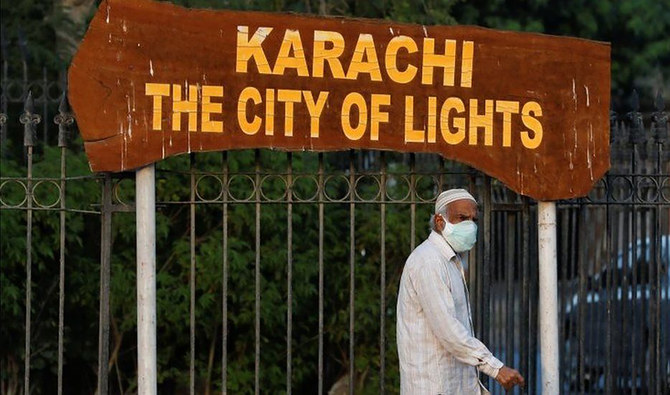
KARACHI: Chief Minister of Pakistan’s southern Sindh province, Syed Murad Ali Shah, said on Monday at least $10 billion is required to modernize the infrastructure of Karachi, a sprawling Pakistani metropolis where the management of infrastructure and services has been hamstrung by disputes between different levels of government for decades.
In the 1960s, Karachi had the tallest building in South Asia, an inner-city rail service, vibrant nightlife, and booming tourism.
But more than five decades later, the city’s infrastructure has failed to keep pace with a population that has risen more than 300 percent, leaving public services such as health, transport, and water either provided by the private sector or controlled by organized crime.
The city nevertheless remains key to Pakistan’s shaky economy.
Last month and this month, rains wreaked havoc on Karachi, with main roads submerged, sewage spewing from manholes and into homes, and power cuts lasting for hours, prompting Prime Minister Imran Khan to ask the National Disaster Management Authority (NDMA) and the army to step in the sort out the city’s drains and larger clean up drive.
“[The requirement of $10 billion has been established by the World Bank when it conducted [the] Karachi diagnostic study,” the chief minister said in a written reply to questions from Arab News, asking about plans to modernize Karachi. “The funds would be arranged from donor agencies and some projects would be launched on public private partnership mode.”
“In the past four years, we have worked a lot on cleaning the storm drains in the city,” he said, adding that his government, run by the Pakistan People’s Party, was also dispensing funds for that purpose to the Karachi Metropolitan Corporation, run by the Karachi mayor who belonged to an opponent political party, the Muttahida Qaumi Movement Pakistan (MQM-P).
Karachi, a city of over 15 million people, has for years faced various municipal problems, which experts say have roots in its complicated governance system, with power shared by different political parties.
Earlier, this month representatives of the ruling Pakistan Tehreek-e-Insaf (PTI) and the opposition PPP and MQMP met to resolve some of the issues of Karachi but the PPP and MQM-P later backtracked from a decision to run the city through a consensus liaison committee.
There is also controversy over the modernization of Karachi’s old downtown, one of a string of projects aimed at revitalizing Pakistan’s largest city. Experts say the politicking by local parties and wrangling between different levels of government that have stalled Karachi’s growth for decades continue to hold back development. Public transit programs, including a shiny new bus service and the revival of a long-closed inner city rail service, are among the projects stuck in the gridlock.


![]()

Chief minister says $10 bln needed to modernize Karachi, key to Pakistan’s shaky economy
Short Url
https://arab.news/ws84j
Chief minister says $10 bln needed to modernize Karachi, key to Pakistan’s shaky economy
- Funds to be arranged from donors and projects to be launched on public private partnership basis, Murad Ali Shah says
- Management of infrastructure and services in the sprawling port city blocked for decades by disputes between different levels of government
Latest updates


© 2026 SAUDI RESEARCH & PUBLISHING COMPANY, All Rights Reserved And subject to Terms of Use Agreement.