

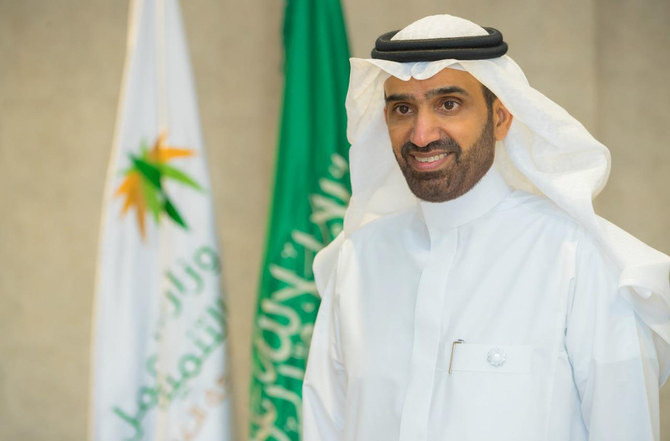
The 20 percent localization measure is intended to help graduates seek job opportunities in Saudi Arabia that best suit their degrees
Updated 24 August 2020
SPA
RIYADH: Engineering jobs in the Kingdom are to be localized following a ministry decision, the Saudi Press Agency reported.
The decision, from the Ministry of Human Resources and Social Development, will apply to all private sector establishments in the Saudi market that employ five or more engineering professionals.
The 20 percent localization measure is intended to help graduates seek job opportunities in Saudi Arabia that best suit their degrees. It also aims to help develop the private sector in order to strengthen its contribution to the national economy.
There is a ministry manual setting out the benefits, details and implementation procedures of its decision. Business owners and job seekers can view the manual on the ministry’s official website.
The minister of labor and social development, Ahmed bin Suleiman Al-Rajhi, issued the decision as part of a series of measures to localize professions in cooperation and partnership with government and supervisory agencies to enable graduates with specific qualifications to obtain decent employment opportunities in the Kingdom.
Other professions that have been localized include dentistry and pharmacy.
A legacy of learning: The enduring impact of Princess Sarah bin Saud
Princess Sarah bin Saud helped shape Saudi Arabia’s educational legacy through her enduring commitment to knowledge and philanthropy.
Updated 4 sec ago
Lama Alhamawi
RIYADH: A visionary defined by her resilience and intellectual foresight, Princess Sarah bint Abdullah bin Faisal bin Turki bin Abdullah bin Mohammed bin Saud played a pivotal role in weaving the Kingdom’s educational fabric, leaving a legacy of generosity and endowments that continues to support future generations in Saudi Arabia.
“Princess Sarah was not just a daughter or wife within the ruling family; she utilized her knowledge and social awareness to serve the nation,” Salma Hawsawi, a professor of ancient history at King Saud University and a cultural heritage expert, told Arab News.
“She left an intellectual and moral legacy that reflects the image of the Saudi woman capable of balancing religious authenticity with social responsibility and tradition with modernization,” she said.
Ad-Duraybiyah farm, south of Diriyah was one of the largest and most fertile farms of its time which was donated by Princess Sarah bint Abdullah bin Faisal bin Turki bin Abdullah bin Mohammad bin Saud. (AN photo by Loai El-Kellawi)
Princess Sarah was born in Riyadh in 1877 (1294 AH), although the exact date of her birth is subject to some historical debate.
She was raised in the care of a deeply rooted and noble family. Her father was Imam Abdullah bin Faisal bin Turki Al-Saud, the third imam of the Second Saudi State, who ruled from 1865 until his death in 1889.
Imam Abdullah was renowned for his immense generosity and his love of knowledge, contributing to many charitable endowments — a trait that Princess Sarah inherited.
She was a philosophical model combining soft power, value commitment and social effectiveness.”
Salma Hawsawi, professor of ancient history at King Saud University
Her mother died when Princess Sarah was a child, and she was cared for by Tareefah bint Obaid bin Rashid, one of her father’s wives.
This care continued until Imam Abdullah and Tareefah moved to Hail in 1887, at which point Princess Sarah moved to Riyadh to live under the care of her paternal aunt, Princess Al-Jawharah bint Imam Faisal bin Turki.
Ad-Duraybiyah farm, south of Diriyah was one of the largest and most fertile farms of its time which was donated by Princess Sarah bint Abdullah bin Faisal bin Turki bin Abdullah bin Mohammad bin Saud. (AN photo by Loai El-Kellawi)
Princess Al-Jawharah was an influential figure in Princess Sarah’s life, as she was a lover of knowledge, well versed in Islamic jurisprudence, history and biographies. She also had a special interest in scholarly endowments and students of knowledge.
According to Diriyah’s historical research, throughout her life, Princess Sarah was a symbol of dedication to serving society, embodying the saying “women are the equal partners of men” in the fields of giving and social contribution, thereby confirming that the role of Saudi women in development is not new, but deeply rooted in the history of the Saudi state itself.
“The princess had a piercing vision for the future, aiming for long-term investment through knowledge management and exchange among society members,” the professor said.
Known for her generosity, Princess Sarah endowed many of her personal properties for the benefit of society.
At the forefront of these endowments was the Ad-Duraybiyah farm, south of Diriyah. The site was not just an ordinary property; it was one of the largest and most fertile farms of its time, and was distinguished by its strategic location in the As-Sarhiyyah area, located in one of the historic tributaries of Wadi Hanifah.
She chose for her endowment to be a source of knowledge and learning, reflecting her keen vision that investing in both land and people is the most optimal and enduring investment.
Princess Sarah endowed a great number of rare and valuable books for students of knowledge. These were books she had been keen to purchase herself while she was studying in scholarly circles at the time, which indicates her deep passion for knowledge and her commitment to making it available to others.
Based on the knowledge recorded of Princess Sarah, she had a deep passion for education, endowing books and manuscripts, ensuring that future generations would have access to tools for societal advancement.
When a portion of Princess Sarah’s land was included in King Saud University, the university offered the princess financial compensation. But she refused the payment, saying: “I am for knowledge and for the students of knowledge.”
Princess Sarah not only gave charity and donated the land to build King Saud University, but she also created an infrastructure for knowledge, viewing it as a long-term investment in human capital and the future generations of the Kingdom.
Due to the link between her work and the university’s endowments, the Central Library in the Female Student Campus was named the “Princess Sarah bint Abdullah bin Faisal Al-Saud Library” in appreciation of her role and contributions to development.
“All of Princess Sarah’s initiatives have a sustainable positive impact to this day. The most influential was her donation of land to King Saud University,” the historian said.
“This prestigious institution has graduated countless cohorts in various disciplines who serve their country. By donating this land, Princess Sarah indirectly contributed to the university’s expansion and the increase in specializations.
“Today, most leaders in the Kingdom are graduates of King Saud University,” Hawsawi added.
When looking at Saudi history, Saudi figures that can be compared to Princess Sarah include Princess Moudi bint Sultan bin Abi Wahtan.
“Both are magnificent models of Saudi women,” the professor said.
Princess Moudi (wife of Imam Mohammed bin Saud) established “Sablat Moudi” in Diriyah to house travelers and students.
Similarly, Princess Sarah supported students through land and book endowments.
“Both demonstrate the longstanding commitment of Saudi women to education, sustainability and community service,” Hawsawi said.
When the professor was asked what lasting memory she would like the public to know about Princess Sarah, she said: “That she was a philosophical model combining soft power, value commitment and social effectiveness.
“It must be clarified that there was prior knowledge of Princess Sarah among specialized academics, but it was limited. Documents mentioning her are very scarce, and information is scattered throughout books.”
She highlighted that much of the information relies on oral narrations from individuals who had indirect connections to her highness through their families who lived during her time or worked with her.
