

Bangladesh sees spike in boat sales as residents struggle to stay afloat

1 / 4
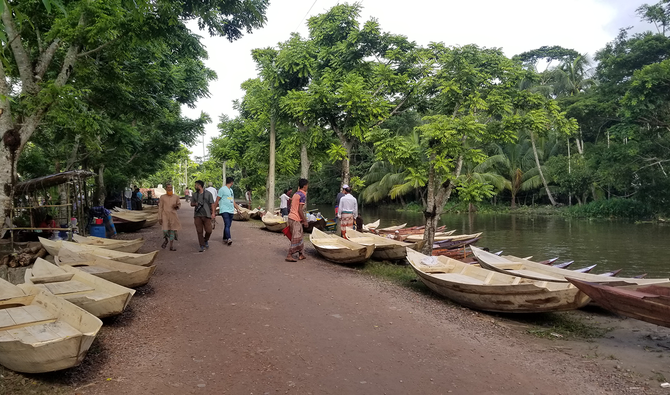
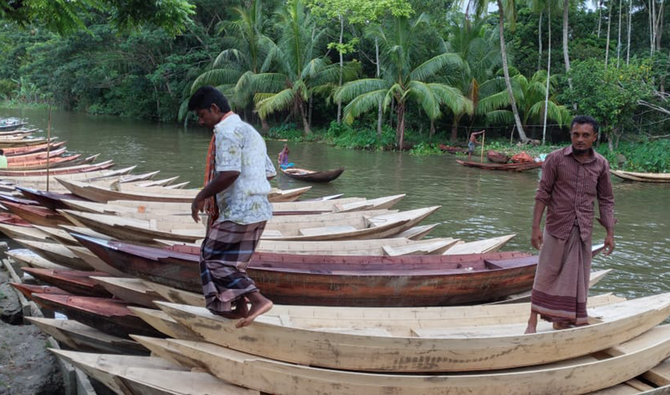
Several boats line a 100-year-old traditional market which is held every Friday in Bangladesh's southern district of Pirojpur. Located along the banks of the Sandhya river in Atghar, Pirojpur, the market caters to the demand of thousands of residents in the region. (AN Photo by Shehab Sumon)
2 / 4
Several boats line a 100-year-old traditional market which is held every Friday in Bangladesh's southern district of Pirojpur. Located along the banks of the Sandhya river in Atghar, Pirojpur, the market caters to the demand of thousands of residents in the region. (AN Photo by Shehab Sumon)
3 / 4
Several boats line a 100-year-old traditional market which is held every Friday in Bangladesh's southern district of Pirojpur. Located along the banks of the Sandhya river in Atghar, Pirojpur, the market caters to the demand of thousands of residents in the region. (AN Photo by Shehab Sumon)
4 / 4
Several boats line a 100-year-old traditional market which is held every Friday in Bangladesh's southern district of Pirojpur. Located along the banks of the Sandhya river in Atghar, Pirojpur, the market caters to the demand of thousands of residents in the region. (AN Photo by Shehab Sumon)
Short Url
Updated 23 August 2020
Follow

Bangladesh sees spike in boat sales as residents struggle to stay afloat

  • Incessant rains during monsoon season force many to flock to largest boat market in Pirojpur district
  • Average length of vessel between 7 to 8 feet, while price varies from $20 to $60

DHAKA: For a few hours every Friday, thousands of residents throng to a 100-year-old boat market in Bangladesh’s Pirojpur district, as the monsoon continues to inundate low-lying areas in the country and water levels rise from the incessant rain, forcing many to reimagine conveyance options.

The vessels at the Atghar boat market — the largest in the country and located along the banks of the Sandhya River in the Pirojpur district, nearly 264 km away from the capital Dhaka — serve as the only medium of travel for residents in the southern parts of the country, including in the Pirojpur, Jhalkathi and Barishal districts.

“The boat is part and parcel of our lives. Most of the houses in the low-lying areas go underwater during the rainy season, and boats are the only method of conveyance,” Mohammed Dalil Uddin, 72, told Arab News while scouring the Atghar boat market for a new vessel. 

Bangladesh is a riverine country, surrounded by the Padma, Jamuna, Dhaleswari, Ichhamati and Kaliganga rivers, which become problematic during the monsoon season when floodwaters disrupt life and communication for thousands of villagers.

And while each family buys at least one boat, others visit the market in keeping with tradition.

“I first visited this boat market with my grandfather when I was only 7 years old. Now, it’s become a tradition,” Dalil Uddin said.

Another buyer, Kamran Ahmed, from the Jhalkathi district, said he is in dire need of a new boat as “the existing one has become old and unusable.”

“I need to carry cattle feed from a long distance during monsoon season since the grazing fields in my village went under river water. Besides, I need to use this small boat for harvesting my guava from the orchard,” Ahmed, 59, told Arab News.

The boat market operates on goodwill; traders cater to the needs of the customers by crafting boats that are long-lasting and reasonably priced.

The average vessel length is between 7 to 8 feet, while the prices vary from $20 to $60, depending on the quality and size of the boats.

“We can provide the boats at a cheaper rate since wood is readily available in this part of the country. Besides, this wood tree has no other use, and we can’t use it for making furniture,” Ramesh Saha, 62, a trader at the boat market, told Arab News.

He added that for a majority of the traders, work involves managing a family business that has been passed down from one generation to another.

“My father used to sell boats in this market. Now I am running the family business, and my son is also assisting me,” Saha said. 

He is one of nearly 100 families from the nearby villages of Muktahar, Chami, Boldia, Inderhaat, Boitha Kata, Dubi and Kathali who specialize in the craft of boatmaking, which takes an average of “one to two days per vessel to make.”

“Sometimes, it takes a little longer, depending on how large the boat is,” Akbar Hossain, 54, a trader, told Arab News, adding that it is vital for these boats to be “very light” as it makes them easy to stay afloat. 

And while the traders usually sell around 100 to 200 boats every Friday, Hossain said the outbreak of the coronavirus disease (COVID-19) has impacted these numbers.

“People are not coming out of their homes unless it’s an emergency,” he said. 

The market also attracts several tourists from various parts of the country. 

 “It’s amazing to witness hundreds of boats kept in a row on the river water and streets, waiting to be sold,” Raihan Faruk, a private university student from Dhaka, told Arab News.  

“For me, it’s the experience of a lifetime. Once I return to Dhaka, I will tell my friends to visit this market too,” he added.


DR Congo’s amputees bear scars of years of conflict

Updated 2 sec ago
Follow

DR Congo’s amputees bear scars of years of conflict

GOMA: They survived the bombs and bullets, but many lost an arm or a leg when M23 fighters seized the city of Goma in the eastern Democratic Republic of Congo nearly a year ago.
Lying on a rug, David Muhire arduously lifted his thigh as a carer in a white uniform placed weights on it to increase the effort and work the muscles.
The 25-year-old’s leg was amputated at the knee — he’s one of the many whose bodies bear the scars of the Rwanda-backed M23’s violent offensive.
Muhire was grazing his cows in the village of Bwiza in Rutshuru territory, North Kivu province, when an explosive device went off.
He lost his right arm and right leg in the blast, which killed another farmer who was with him.
Fighting had flared at the time in a dramatic escalation of a decade-long conflict in the mineral-rich region that had seen the M23 seize swathes of land.
The anti-government M23 is one of a string of armed groups in the eastern DRC that has been plagued by internal and cross-border violence for three decades, partly traced back to the 1994 Rwanda genocide.
Early this year, clashes between M23 fighters and Congolese armed forces raged after the M23 launched a lightning offensive to capture two key provincial capitals.
The fighting reached outlying areas of Muhire’s village — within a few weeks, both cities of Goma and Bukavu had fallen to the M23 after a campaign which left thousands dead and wounded.
Despite the signing in Washington of a US-brokered peace deal between the leaders of Rwanda and the DRC on December 4, clashes have continued in the region.
Just days after the signing, the M23 group launched a new offensive, targeting the strategic city of Uvira on the border with the DRC’s military ally Burundi.
More than 800 people with wounds from weapons, mines or unexploded ordnance have been treated in centers supported by the International Committee of the Red Cross (ICRC) in the eastern DRC this year.
More than 400 of them were taken to the Shirika la Umoja center in Goma, which specializes in treating amputees, the ICRC said.
“We will be receiving prosthetics and we hope to resume a normal life soon,” Muhire, who is a patient at the center, told AFP.


- ‘Living with the war’ -


In a next-door room, other victims of the conflict, including children, pedalled bikes or passed around a ball.
Some limped on one foot, while others tried to get used to a new plastic leg.
“An amputation is never easy to accept,” ortho-prosthetist Wivine Mukata said.
The center was set up around 60 years ago by a Belgian Catholic association and has a workshop for producing prostheses, splints and braces.
Feet, hands, metal bars and pins — entire limbs are reconstructed.
Plastic sheets are softened in an oven before being shaped and cooled. But too often the center lacks the materials needed, as well as qualified technicians.
Each new flare-up in fighting sees patients pouring into the center, according to Sylvain Syahana, its administrative official.
“We’ve been living with the war for a long time,” he added.
Some 80 percent of the patients at the center now undergo amputation due to bullet wounds, compared to half around 20 years ago, he said.
“This clearly shows that the longer the war goes on, the more victims there are,” Syahana said.