Northern Cyprus set to reopen Cypriot ghost town on cease-fire lines

1 / 2
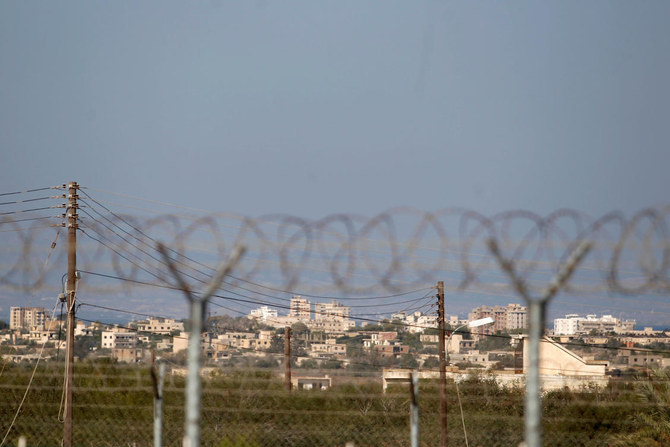
People gaze at Varosha, a former resort area fenced off by the Turkish military since the 1974 division of Cyprus, as they walk on a beach in Famagusta, August 5, 2019. (Reuters)
2 / 2
The fenced-off area of Varosha, restricted by the Turkish military, is seen from the Dherynia checkpoint, Cyprus, November 12, 2018. (Reuters)
Short Url
Updated 07 October 2020
Follow

Northern Cyprus set to reopen Cypriot ghost town on cease-fire lines

  • Turkish Cypriot PM Ersin Tatar said the revival of Varosha, now an eerie collection of derelict hotels, churches and residences, would bring trade and tourism benefits
  • The move is likely to anger Greek Cypriots, 39,000 of whom once lived in Varosha before fleeing advancing Turkish forces 46 years ago

ANKARA: Northern Cyprus is almost ready to begin reopening the town of Varosha, the breakaway state’s premier said on Friday, a former resort area fenced off and abandoned in no-man’s land since a 1974 Turkish invasion that split the island.
Turkish Cypriot Prime Minister Ersin Tatar said the revival of Varosha, now an eerie collection of derelict hotels, churches and residences, would bring trade and tourism benefits.
The move is likely to anger Greek Cypriots, 39,000 of whom once lived in Varosha before fleeing advancing Turkish forces 46 years ago, and stoke tensions between the two sides.
Varosha, a southern suburb of the city of Famagusta, has been a ghost town since the invasion, following a brief Greek-inspired coup, that partitioned the eastern Mediterranean island along cease-fire lines into Turkish and Greek Cypriot sides.
The former holiday resort has been off limits to all but the Turkish military since 1974.
Varosha has become a bargaining chip in the decades-long dispute between Greek and Turkish Cypriots. Ringed by a fence extending into the sea, the town is overrun by cacti and debris.
“Varosha is most definitely going to be opened. The tide has shifted, a new page has been turned,” Tatar said. (Northern Cyprus) will become stronger by opening Varosha to tourism.”
Tatar gave no specific time line for reopening Varosha.
“Varosha lies within TRNC territory,” he said, referring to Northern Cyprus, recognized as a state only by Turkey. “Nobody can take it from us. We are successfully continuing on our path. The inventory work is almost complete, we are in the opening phase.”
In February, Turkish and Turkish Cypriot officials visited Varosha, marking one of the most concrete steps by either side toward reviving the ghost town.
The island’s Greek Cypriots live mainly in the south, a republic that is in the European Union. Several peacemaking efforts have made no significant progress and the discovery of offshore energy resources has complicated the picture further.


WHO appeals for $1 bn for world’s worst health crises in 2026

Updated 4 sec ago
Follow

WHO appeals for $1 bn for world’s worst health crises in 2026

GENEVA: The World Health Organization on Tuesday appealed for $1 billion to tackle health crises this year across the world’s 36 most severe emergencies, including in Gaza, Sudan, Haiti and the Democratic Republic of Congo.
The UN health agency estimated 239 million people would need urgent humanitarian assistance this year and the money would keep essential health services going.
WHO health emergencies chief Chikwe Ihekweazu told reporters in Geneva: “A quarter of a billion people are living through humanitarian crises that strip away the most basic protections: safety, shelter and access to health care.
“In these settings, health needs are surging, whether due to injuries, disease outbreaks, malnutrition or untreated chronic diseases,” he warned.
“Yet access to care is shrinking.”
The agency’s emergency request was significantly lower than in recent years, given the global funding crunch for aid operations.
Washington, traditionally the UN health agency’s biggest donor, has slashed foreign aid spending under President Donald Trump, who on his first day back in office in January 2025 handed the WHO his country’s one-year withdrawal notice.
Last year, WHO had appealed for $1.5 billion but Ihekweazu said that only $900 million was ultimately made available.
Unfortunately, he said, the agency had been “recognizing ... that the appetite for resource mobilization is much smaller than it was in previous years.”
“That’s one of the reasons that we’ve calibrated our ask a little bit more toward what is available realistically, understanding the situation around the world, the constraints that many countries have,” he said.
The WHO said in 2026 it was “hyper-prioritising the highest-impact services and scaling back lower?impact activities to maximize lives saved.”
Last year, global funding cuts forced 6,700 health facilities across 22 humanitarian settings to either close or reduce services, “cutting 53 million people off from health care.” Ihekweazu said.
“Families living on the edge face impossible decisions, such as whether to buy food or medicine,” he added, stressing that “people should never have to make these choices.”
“This is why today we are appealing to the better sense of countries, and of people, and asking them to invest in a healthier, safer world.”