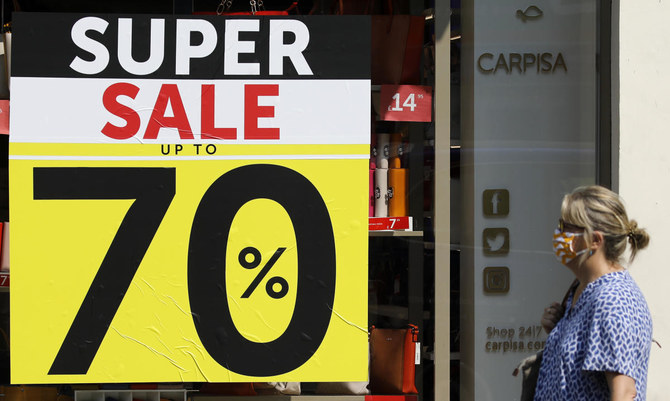
LONDON: British retail sales surged past their pre-coronavirus level in July, the first full month that shops selling non-essential goods were open since the country went into lockdown in March.
The unexpectedly robust figures show the strength of consumer demand even as other parts of the economy — and much of the retail sector itself — struggle to recover from recent hefty losses.
Retail sales volumes rose by 3.6 percent from June — above all forecasts in a Reuters poll of economists — and were 1.4 percent higher than in July 2019, the Office for National Statistics said, representing a sharp recovery from double-digit falls in April and May.
Compared with February, before Britain was broadly affected by the pandemic, sales were 3 percent higher.
Separately, official figures showed public sector net borrowing, excluding banks, totalled $35.33 billion in July, just above economists’ average $39.011 billion.
Britain’s retail sector has enjoyed a much faster bounce back than almost all other parts of the economy hit by the coronavirus lockdown.
But behind the headline figures there has been contrasting experiences for different types of retailer.
Supermarkets and other food shops have enjoyed year-on-year sales growth as British people eat at home more. Online sales have boomed, and household goods stores have seen strong demand.
But other areas — especially high-street clothing retailers — have suffered, with clothing and footwear sales still 25 percent down on a year ago.
Companies such as Marks & Spencer, Boots, John Lewis, Dixons Carphone and WH Smith have announced plans for thousands of job cuts.
Economists fear the broad retail recovery could prove temporary.
“July’s retail sales likely will represent this year’s peak,” said Samuel Tombs of consultancy Pantheon Macroeconomics.
Restaurants and bars began to reopen in July — giving people more options for their spending — and unemployment is forecast to rise sharply once a government job support scheme stops at the end of October. ($1 = 0.7549 pounds)


![]()

UK retail sales surge past pre-COVID peak in July
Short Url
https://arab.news/4t733
UK retail sales surge past pre-COVID peak in July
- Many fear the surge might be short lived as major retailers plan job cuts
- Supermarkets and other food shops have enjoyed year-on-year sales growth as British people eat at home more


Latest updates


© 2026 SAUDI RESEARCH & PUBLISHING COMPANY, All Rights Reserved And subject to Terms of Use Agreement.