

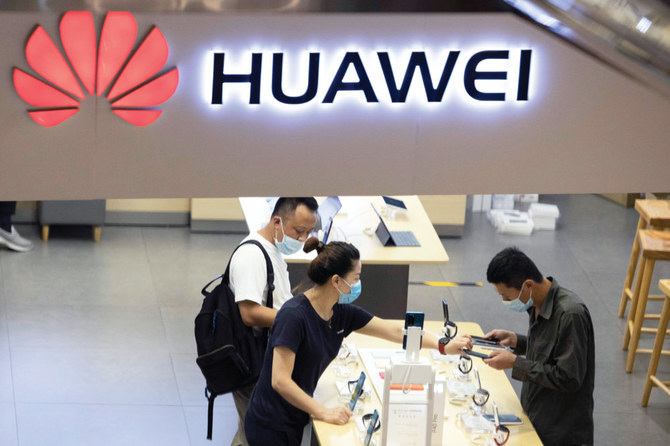

BEIJING: For nearly a decade, Huawei kept worldwide sales growing as Washington told US phone companies not to buy its network equipment and lobbied allies to reject China’s first global tech brand as a security threat.
Focusing on Europe, Asia, Africa and China’s booming market, Huawei became the biggest maker of switching gear and a major smartphone brand. As the White House cut off access to American components and Google’s popular music and other smartphone services, Huawei unveiled its own processor chips and app development. Last year’s sales rose 19 percent to $123 billion.
Now, Huawei is suffering as Washington intensifies a campaign to slam the door on access to foreign markets and components in its escalating feud with Beijing.
European and other phone carriers that bought Huawei gear are removing it from their networks. Huawei got a flicker of good news when it passed rivals Samsung and Apple as the No. 1 smartphone brand in June, but demand abroad is plunging.
“Huawei is losing market share quite dramatically outside China,” said industry analyst Paul Budde. “Their international position is most likely going to get worse rather than better.”
In the latest blow, the US Commerce Department this week confirmed rules announced in May that will bar non-American companies from using US technology to make processor chips and other components for Huawei without a government license.
The president of Huawei’s consumer business, Richard Yu, says it is running out of chips for smartphones. Yu said as of Sept. 15, contractors will be forced to stop making Kirin chips designed by Huawei’s engineers.
“This is a very big loss for us,” Yu said Aug. 8 at an industry conference, China Info 100.
Huawei heads a growing list of Chinese tech names the Trump administration is targeting as security risks in an initiative called Clean Networks. It wants countries to remove them as suppliers to telecom systems, undersea cables and app stores.
The White House has banned unspecified transactions with Chinese-owned platforms TikTok and WeChat, and is pressing TikTok’s owner to sell it. In June, the Pentagon added Huawei and surveillance firm HikVision to a list of companies it said were owned or controlled by the Communist Party’s (CCP) military wing. Last year, the Chinese owner of Grindr was ordered to sell the dating app.
Huawei is hardly finished. It says sales rose 13 percent to 454 billion yuan ($65 billion) in the first half of 2020. But after spending a decade and billions of dollars to become a leader in next-generation tech, the company faces the threat of being shut out of many major markets.
That is a setback for the CCP’s ambition to make China a global tech leader.
Western companies and consumers may also lose access to Huawei’s resources that can cost 30 percent less than that of rivals Ericsson and Nokia.
US, European and Japanese suppliers of processor chips and other technology stand to lose billions in sales to Huawei. “It doesn’t benefit any country to exclude Huawei,” said IDC’s Nikhil Batra.
Huawei, founded in 1987 by former military engineer Ren Zhengfei, denies it might help Beijing spy. Chinese officials complain Washington is whipping up phony security fears, without proof, to block a competitor to US tech companies.
The Trump administration is ramping up pressure on allies, including by threatening to withhold intelligence sharing if they allow Huawei into next-generation, or 5G, networks.
Huawei’s US market evaporated after the company and Chinese rival ZTE Corp. were declared security threats in 2012 by a congressional panel. Small, rural carriers still use Huawei’s lower-cost equipment, but Washington is prodding them to stop.
5G will expand networks supporting self-driving cars, factory robots, remote surgery and other futuristic applications. That makes 5G more intrusive and raises the cost of potential security breaches.
US officials say buying a 5G network from China is too risky because vendors need round-the-clock access for repairs and upgrades. Clean Networks cites Huawei as part of the CCP’s “surveillance state.”
“We call on all freedom-loving nations and companies to join the Clean Network,” said Secretary of State Mike Pompeo.
Last year, Huawei raced to remove American components from products after President Donald Trump blocked access to US processor chips and other tech, including Google services.
The CCP has fought back by threatening unspecified consequences against countries that block Huawei’s market access.
After the latest sanctions, the foreign ministry called on Washington to “stop suppressing” Chinese companies.
“The more hysterical the US suppression of Huawei and other Chinese companies, the more it proves the success of these companies,” said a ministry spokesman, Zhao Lijian.
In Europe, which supplied one-quarter of Huawei’s 2019 sales, Germany and France are deciding what role it can play in 5G. The UK agreed in January to a limited presence but changed course in July and banned Huawei from its mobile networks.
British mobile carriers BT and Vodaphone are also removing Huawei from European networks.
Vodafone has warned that rolling out 5G in Europe could be delayed by up to five years if other governments imposes similar limits.
“It would be hugely disruptive,” CEO Nick Read said in February.
Australia has banned Huawei from 5G networks, and Japan and Taiwan are limiting use of its technology. US officials, meanwhile, are promoting “trusted suppliers” like Ericsson and Nokia, and say they may help Brazil and others pay for Western equipment to avoid using Huawei.


