

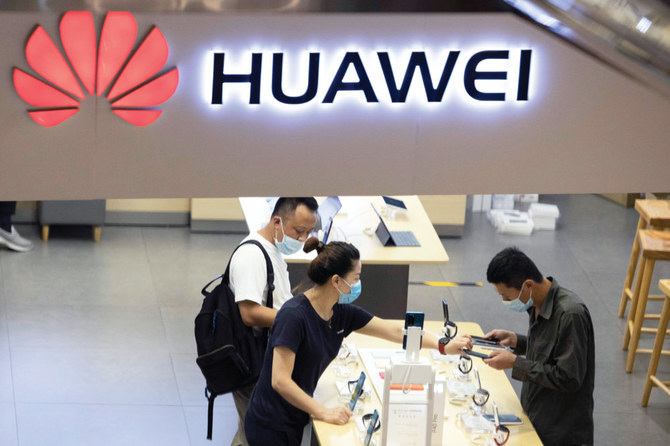
Huawei suffers under US pressure

Huawei is one of China’s biggest international success stories, but has come under heavy fire from the US over accusations of espionage. (AP)
Short Url
Updated 21 August 2020
Follow

Huawei suffers under US pressure

  • Telecommunications giant, now the world’s biggest smartphone company, is the subject of suspicion in Washington
  • 1987 Huawei was founded in 1987 by former military engineer Ren Zhengfei

BEIJING: For nearly a decade, Huawei kept worldwide sales growing as Washington told US phone companies not to buy its network equipment and lobbied allies to reject China’s first global tech brand as a security threat.

Focusing on Europe, Asia, Africa and China’s booming market, Huawei became the biggest maker of switching gear and a major smartphone brand. As the White House cut off access to American components and Google’s popular music and other smartphone services, Huawei unveiled its own processor chips and app development. Last year’s sales rose 19 percent to $123 billion.

Now, Huawei is suffering as Washington intensifies a campaign to slam the door on access to foreign markets and components in its escalating feud with Beijing.

European and other phone carriers that bought Huawei gear are removing it from their networks. Huawei got a flicker of good news when it passed rivals Samsung and Apple as the No. 1 smartphone brand in June, but demand abroad is plunging.

“Huawei is losing market share quite dramatically outside China,” said industry analyst Paul Budde. “Their international position is most likely going to get worse rather than better.”

In the latest blow, the US Commerce Department this week confirmed rules announced in May that will bar non-American companies from using US technology to make processor chips and other components for Huawei without a government license.

The president of Huawei’s consumer business, Richard Yu, says it is running out of chips for smartphones. Yu said as of Sept. 15, contractors will be forced to stop making Kirin chips designed by Huawei’s engineers.

“This is a very big loss for us,” Yu said Aug. 8 at an industry conference, China Info 100.

Huawei heads a growing list of Chinese tech names the Trump administration is targeting as security risks in an initiative called Clean Networks. It wants countries to remove them as suppliers to telecom systems, undersea cables and app stores.

The White House has banned unspecified transactions with Chinese-owned platforms TikTok and WeChat, and is pressing TikTok’s owner to sell it. In June, the Pentagon added Huawei and surveillance firm HikVision to a list of companies it said were owned or controlled by the Communist Party’s (CCP) military wing. Last year, the Chinese owner of Grindr was ordered to sell the dating app.

Huawei is hardly finished. It says sales rose 13 percent to 454 billion yuan ($65 billion) in the first half of 2020. But after spending a decade and billions of dollars to become a leader in next-generation tech, the company faces the threat of being shut out of many major markets.

That is a setback for the CCP’s ambition to make China a global tech leader.

Western companies and consumers may also lose access to Huawei’s resources that can cost 30 percent less than that of rivals Ericsson and Nokia.

US, European and Japanese suppliers of processor chips and other technology stand to lose billions in sales to Huawei. “It doesn’t benefit any country to exclude Huawei,” said IDC’s Nikhil Batra.

Huawei, founded in 1987 by former military engineer Ren Zhengfei, denies it might help Beijing spy. Chinese officials complain Washington is whipping up phony security fears, without proof, to block a competitor to US tech companies.

The Trump administration is ramping up pressure on allies, including by threatening to withhold intelligence sharing if they allow Huawei into next-generation, or 5G, networks.

Huawei’s US market evaporated after the company and Chinese rival ZTE Corp. were declared security threats in 2012 by a congressional panel. Small, rural carriers still use Huawei’s lower-cost equipment, but Washington is prodding them to stop.

5G will expand networks supporting self-driving cars, factory robots, remote surgery and other futuristic applications. That makes 5G more intrusive and raises the cost of potential security breaches.

US officials say buying a 5G network from China is too risky because vendors need round-the-clock access for repairs and upgrades. Clean Networks cites Huawei as part of the CCP’s “surveillance state.”

“We call on all freedom-loving nations and companies to join the Clean Network,” said Secretary of State Mike Pompeo.

Last year, Huawei raced to remove American components from products after President Donald Trump blocked access to US processor chips and other tech, including Google services. 

The CCP has fought back by threatening unspecified consequences against countries that block Huawei’s market access.

After the latest sanctions, the foreign ministry called on Washington to “stop suppressing” Chinese companies.

“The more hysterical the US suppression of Huawei and other Chinese companies, the more it proves the success of these companies,” said a ministry spokesman, Zhao Lijian.

In Europe, which supplied one-quarter of Huawei’s 2019 sales, Germany and France are deciding what role it can play in 5G. The UK agreed in January to a limited presence but changed course in July and banned Huawei from its mobile networks.

British mobile carriers BT and Vodaphone are also removing Huawei from European networks.

Vodafone has warned that rolling out 5G in Europe could be delayed by up to five years if other governments imposes similar limits.

“It would be hugely disruptive,” CEO Nick Read said in February.

Australia has banned Huawei from 5G networks, and Japan and Taiwan are limiting use of its technology. US officials, meanwhile, are promoting “trusted suppliers” like Ericsson and Nokia, and say they may help Brazil and others pay for Western equipment to avoid using Huawei.


Accelerating growth boosts investor confidence

Updated 06 December 2025
Follow

Accelerating growth boosts investor confidence

  • Startups attract fresh capital to scale AI, health tech, and infrastructure

RIYADH: Startups across the Middle East and North Africa are accelerating growth through strategic funding rounds, partnerships, and technological innovation. 

From agriculture tech and AI-led cybersecurity to digital health and home renovation, this week’s developments reflect the region’s expanding startup ecosystem and investor confidence across key verticals.  

Saudi agritech startup Nabt has raised $3.4 million in a seed extension round, bringing its total funding to $5 million.  

The round was led by SHG Group, with participation from Merak Capital and several angel investors, signaling strong investor confidence in the company’s long-term growth strategy.  

The funding announcement took place during a signing ceremony at the Sunbola program event under the Ministry of Environment, Water, and Agriculture.  

Founded to build both physical and digital infrastructure for the fresh-produce sector, Nabt connects farmers directly with commercial buyers through fulfillment centers that handle sorting, cold storage, and last-mile logistics.  

The company recently launched the Nabt Online Auction to support large-scale produce trading across the Kingdom, and Nabt Intel, which provides real-time pricing and market-demand data. 

CEO Abdullah Al-Otaibi said: “In just two years, Nabt has proven that building transparent and efficient infrastructure for fresh produce is not only possible but essential.”  

The new capital will support expansion into additional Saudi cities and further develop Nabt’s infrastructure and services to boost food security and farmer profitability across the country.   

COGNNA raises $9.2m 

COGNNA, a Saudi cybersecurity company founded in 2022, has closed a $9.2 million series A round led by Impact46 and co-led by BNVT Capital, with participation from Vision Ventures and Tali Ventures.  

The company offers AI-driven security operations tailored for enterprises and SMEs through its Agentic SOC platform.  

Combining AI automation with human oversight, COGNNA’s platform helps organizations simplify compliance and proactively defend against cyber threats. 

Chief Technology Officer Ziyad Al-Sheri stated: “Through our AI-led platform, we are building an Agentic SOC that doesn’t just respond to threats — it anticipates them.”  

The funding will be used to accelerate global expansion, enhance R&D in AI automation, and scale operational teams and infrastructure to meet growing demand. 

The company plans to allocate capital across product development, marketing, hiring, and international operations.  

Funch raises $500k 

Funch, a Dubai-based AI-native lunch subscription startup, has secured $500,000 in a pre-seed round led by Angelspark, with participation from investors including Mostafa Kandil, Mahesh Murthy, and Tushar F.  

Founded in 2025 by Ahmad Joehnny and Ghada Zanaty, the platform offers flexible, credit-based lunch subscriptions for 19 Emirati dirhams per day with no delivery fees. 

Founded in 2025 by Ahmad Joehnny and Ghada Zanaty, Funch offers flexible, credit-based lunch subscriptions with no delivery fees. (Supplied)

Funch replaces traditional meal plans with a system where users can pause, skip, or cancel orders while using credits only when meals are delivered.

“Our model is built around pre-planned orders, enabling us to operate with higher efficiency, reduce waste, and cut emissions with fewer trips,” said co-founder and chief operating officer Ghada Zanaty.  

The company leverages AI to forecast demand, optimize routes, rotate menus, and streamline logistics, and will use the funding to scale across Dubai and develop its AI systems further. 

Paymob teams up with Robusta 

Egyptian fintech Paymob and software development firm Robusta Technology Group have announced a strategic partnership to accelerate digital transformation across Egypt and the wider region.  

The collaboration will integrate Paymob’s digital payments infrastructure with Robusta’s AI-driven product development and analytics capabilities.  

The joint initiative aims to deliver intelligent digital experiences for SMEs and enterprises, supporting Egypt’s Vision 2030 goals. 

Both companies plan to expand regionally and develop future offerings combining automation, analytics, and seamless payment systems to improve operational efficiency for merchants and startups.  

Reno raises $4m

UAE-based renovation technology platform Reno has raised $4 million in a mix of equity and debt funding.  

The round included investments from Sanabil 500, Hub71, and Plus VC, as well as Zero 100 VC, FlyerOne Ventures,  and Sandstorm VC. AngelSpark and Swiss Founders Fund also invested.

Founded in 2024 by Marc Michel, Amr Hosny, and Farah Karabeg, Reno offers a tech-enabled, end-to-end solution for interior design and renovation services in both residential and commercial sectors.  

Reno aims to streamline the renovation process through a unified digital platform, allowing customers to manage projects from planning through execution.  

The company plans to use the new capital to expand across the GCC region, enhance its technological infrastructure, and further develop its customer experience. 

Glenwood PE and Mubadala invest in Korean desalination firm NanoH2O

Glenwood Private Equity and Abu Dhabi’s Mubadala Investment Company, along with co-investors, have completed a co-investment in NanoH2O, a Seoul-based reverse osmosis membrane manufacturer previously operating as LG Water Solutions under LG Chem.  

All closing conditions and regulatory approvals for the investment have been fulfilled.  

NanoH2O, which became an independent entity in 2024, supplies desalination and brackish water treatment solutions to municipal and industrial clients worldwide. More than 95 percent of its revenue is generated outside South Korea. 

“We have strong conviction in NanoH2O’s technology leadership and long-term growth potential,” said Mohamed Al-Badr, head of Asia at Mubadala.  

The firm aims to support NanoH2O’s global expansion, particularly in the MENA region, amid growing concerns over water security and decarbonization.