

Hundreds of Houthis killed in fighting in central Yemen, officials say

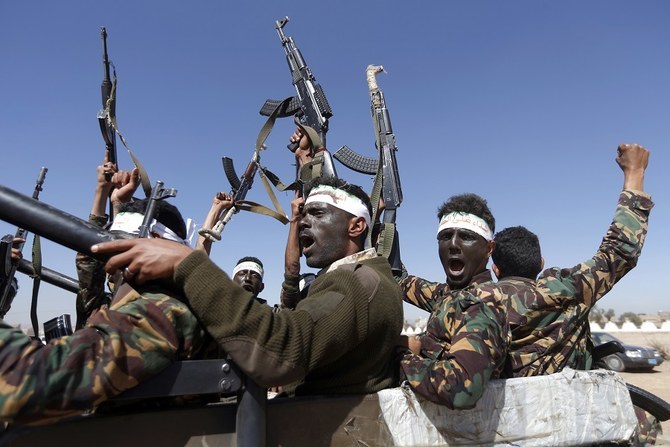
Houthi rebels have stepped up their attacks on Marib’s Serwah and Helan areas in an attempt to capture the oil- and gas-rich city of Marib. (AFP file photo)
Short Url
Updated 20 August 2020
Follow

Hundreds of Houthis killed in fighting in central Yemen, officials say

  • 35 fighters surrender to Yemeni troops in Serwah

AL-MUKALLA: Almost 1,000 Houthi fighters have been killed over the past four days in fierce clashes with government forces, which include allied tribesmen, in various contested areas of the central province of Marib, with hundreds more wounded or captured, local media and government officials said on Thursday. 

The Iran-backed Houthis have stepped up their attacks on Marib’s Serwah and Helan areas in an attempt to capture the oil- and gas-rich city of Marib.

“We have counted 966 Houthis, including senior officers, killed in the fighting in Marib over the last four days. Their bodies are still scattered on the battlefields,” an army officer in Marib, who asked to remain anonymous, told Arab News by telephone. Dozens of government troops and their tribal allies have also reportedly died in the fighting.

On Wednesday, at least 35 Houthi fighters surrendered when government forces attacked their location in Marib’s Serwah, local army commanders said. On the same day, senior army commanders in Marib attended the funeral of Brig. Mohammed Ali Alroken, the commander of 122 Infantry Brigade, who was killed in action in the northern province of Jawf.  

Local army commanders say that warplanes belonging to the Arab coalition have been targeting Houthi military locations and reinforcements. On Thursday, state television showed footage of thick smoke billowing from Houthi locations in mountainous areas of Serwah. 

Despite the heavy losses incurred during the Houthi offensive, Houthi official media outlets and Houthi supporters on social media claim the Iran-backed militia has made territorial gains in the province and is close to seizing control of Marib city.

The escalation in fighting comes as the United Nations Security Council and the UN Special Envoy for Yemen Martin Griffiths called upon warring factions to halt all military operations in Marib in order not to jeopardize peace in a city that is currently home to hundreds of thousands of internally displaced people who have taken shelter their over the last 5 years after fleeing their homes in the north.

Many local and international aid organizations have warned that Houthi attacks on the city have created panic among residents.

In neighboring Al-Bayda, Brig. Abdulrab Al-Asbahi, the commander of Al-Bayda Axis, said on Wednesday that at least 60 Houthis had been killed in heavy fighting with government forces in the district of Qania.

The Yemeni commander said air support and logistical support from the Saudi-led coalition and local tribesmen had enabled his troops to push back Houthi offensives in the area.

Lt. Gen. Sagheer bin Aziz, the army’s chief of staff, has renewed his pledge to defeat the Houthis on the battlefield and drive them out of areas under their control, including the capital, Sanaa.

Speaking to a gathering of army soldiers in Marib on Wednesday, Bin Aziz thanked the Saudi-led coalition for its support and stressed that the army and allied tribesmen are “determined to expel the Houthis from all Yemeni areas.”


Israeli court ordered prisons to give Palestinian detainees more food

Updated 54 min 44 sec ago
Follow

Israeli court ordered prisons to give Palestinian detainees more food

  • At least 101 Palestinians have died in Israeli custody since the start of the Gaza war

NABLUS: Five months after Israel’s Supreme Court ruled that its prisons were failing to provide enough food for Palestinian detainees and ordered conditions be improved, emaciated prisoners are still emerging with tales of extreme hunger and abuse.
Samer Khawaireh, 45, told Reuters that all he was given to eat in Israel’s Megiddo and Nafha prisons was ten thin pieces of bread over the course of a day, with a bit of hummus and tahini. Twice a week some ​tuna.
Videos saved on Khawaireh’s phone show him at normal weight before he was detained in the West Bank city of Nablus last April, and clearly emaciated upon his release. He says he lost 22 kg (49 pounds) during nine months in captivity, emerging a month ago covered in scabies sores and so gaunt and dishevelled his 9-year-old son Azadeen didn’t recognize him.
Reuters could not independently determine the total number of prisons where the scarcity of food prevailed, or the total number of inmates who experienced its toll.
Reuters could not independently verify Khawaireh’s diet during his captivity, the reasons for his extreme weight loss, or exactly how widespread such experience is among the 9,000 Palestinians held in Israeli jails.
But it was consistent with descriptions in some reports compiled by lawyers after prison visits. Reuters reviewed 13 such reports from December and January, in which 27 prisoners complained of a lack of food, with most saying provisions had not changed since the court order.
The Association for Civil Rights in Israel (ACRI), which was involved in last year’s landmark court case that led to the order for better treatment for prisoners, has accused the government of harboring a “policy of starvation” in prisons.
The Israel Prisons Service declined to comment on Khawaireh’s individual case but said it “rejects allegations of ‘starvation’ or systematic neglect. Nutrition and medical care are provided based on professional standards and operational procedures.”
The service “operates ‌in accordance with the ‌law and court rulings” and all complaints are investigated through official channels, a spokesperson said.
“Basic rights, including access to food, medical care, and adequate living ​conditions, ‌are provided ⁠in accordance ​with ⁠the law and applicable procedures, by professionally trained staff.”
Khawaireh, a journalist at a Nablus radio station who was held without charge, said he was never told why he was detained in a night raid on his house in April. Israel’s military declined to comment.
RIGHTS GROUP ASKS COURT TO HOLD PRISON SERVICE IN CONTEMPT
Independent verification of the treatment of detainees has become more difficult since the start of the Gaza War, when Israel barred prison visits by the International Committee of the Red Cross, a role the Geneva-based body has played in conflicts around the world for a century.
ACRI has petitioned Israel’s Supreme Court to allow Red Cross access to Palestinian detainees. It has also applied to court to have the prison service held in contempt for failing to comply with last September’s order that it improve conditions.
“All the indications that we’re getting are that not much has changed” since the court ruling, the group’s executive director Noa Sattath told Reuters.
“The prisoners are not getting more food if they ask for it. There hasn’t been any medical examination of the situation of the prisoners, and the prisoners are still hungry.”
The Supreme Court did not respond to a request for comment on the ⁠case.
BENEFITS AND INDULGENCES
The number of detainees held by Israel swelled after the Hamas-led attacks on October 7, 2023, with thousands swept up during Israel’s assault on ‌Gaza and a crackdown in the occupied West Bank, though hundreds were freed under a ceasefire last October.
Throughout the war in Gaza, Israel’s Security ‌Minister, Itamar Ben-Gvir, in charge of the prisons service, has compared Israel’s treatment of Palestinians with the abuse faced by Israeli hostages held in ​Gaza by Hamas, many of whom were released in a state of near starvation that shocked Israelis.
Hamas ‌denies starving hostages, saying they ate as well as their captors under Israeli restrictions on supplies to Gaza.
Sattath, of ACRI, said the treatment of hostages held by militants provides no justification for mistreating Palestinian detainees.
After returning ‌to office atop the most right-wing government in Israel’s history in late 2022, Prime Minister Benjamin Netanyahu put prisons in the hands of Ben-Gvir, a far-right settler activist known for keeping a portrait in his living room of a Jewish gunman who killed 29 Palestinian worshippers in a West Bank mosque.
Among Ben-Gvir’s first acts in office was to shut prison bakeries where Palestinian detainees had been allowed to make their own food, saying he aimed to cancel “benefits and indulgences.”
He has since publicly denounced courts for trying to force prisons to coddle Israel’s enemies. During last year’s court hearings, he called the case “crazy and delusional” in a post on X, mocked the judges for debating “whether the killers’ menu is balanced,” and said he was “here to make sure the ‌terrorists get the bare minimum.”
Ben-Gvir did not respond to a request for comment, including on whether the prison service is now in compliance with the court’s ruling, or whether any policies have been changed in response to it.
ACRI says the far-right’s criticism of judges amounts to a smear campaign intended to intimidate ⁠the judiciary. In 2024 the Supreme Court took the unusual ⁠step of complaining publicly over posters put up by right-wing activists, denouncing judges.
Hunger, more widely, has been an issue in the war in Gaza, where the United Nations says Israeli supply restrictions caused malnutrition among the more than 2 million Palestinian residents, reaching famine scale in mid-2025. Israel says the extent of hunger was exaggerated and blames Hamas fighters for stealing aid. Hamas denies diverting food, and a US analysis found no evidence that the militants did so systematically.
LAWYERS SAY TEEN DIED IN CUSTODY OF MALNUTRITION
At least 101 Palestinians have died in Israeli custody since the start of the Gaza war, according to the rights group Physicians for Human Rights Israel (PHRI).
Among them was Walid Ahmed, 17, who died in March last year after collapsing and hitting his head in prison, which his lawyers say was a result of illness due to malnutrition.
“His autopsy showed massive weight loss — loss of muscle mass, fat, weakened immune system. When he got an infection, his body couldn’t fight it,” said Ahmed’s lawyer Nadia Daqqa.
Ahmed’s autopsy, reviewed by Reuters, said he suffered from “prolonged malnutrition” and listed starvation, infection and dehydration as potential causes of death.
The prison service declined to comment on Ahmed’s treatment in custody or the cause of his death.
Naji Abbas, PHRI’s director of the prisoners and detainees department, says chronic hunger has made the overall detainee population dangerously susceptible to other ailments.
“When people are being starved, their immune system is weak. So every medical problem, even the simplest one, can become serious,” he said.
Amani Sarahneh, the director of media and documentation for the Palestinian Prisoners Society, who has reviewed hundreds of cases and is in continuous contact with detainees, said the physical consequences are only part of the impact of hunger.
“When you hear detainees describe food, you see how huge a space it takes ​in their minds, because the human desire to feel full is so basic. Israel uses this heavily: ​not only physically but psychologically,” she said.
Khawaireh, who has returned to work since his release on January 7, has put weight back on, though he still looks thin.
While in prison, he said he and other detainees sometimes would save up half their allotment of bread for Saturday, so that once a week they can feel full.
“We want to feel, one day, that we are full — even once a week, we want to feel full, we are never full.”