

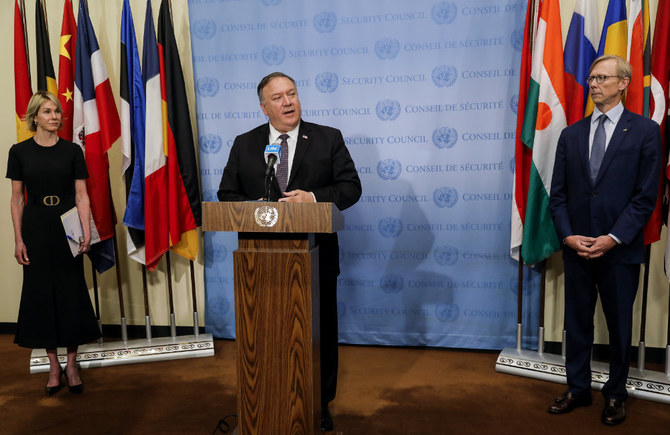


CHICAGO: US Secretary of State Michael Pompeo informed the United Nations Thursday that the US was restoring all UN sanctions on Iran that were lifted as a result of the Joint Comprehensive Plan of Action (JCPoA) approved under UN Security Council Resolution 2231 in 2015.
The resolution, which Pompeo called “one-sided” in favor of Iran, includes provisions that allow for the sanctions to be immediately re-imposed by the UN if Iran fails to live up to the agreement.
In letters to both UN Secretary-General Guterres and to the president of the UN Security Council, Pompeo said he is initiating the “snapback” process in the Resolution that would reimpose sanctions within 30 days.
“Our message is very, very simple. The United States will never allow the world’s largest state sponsor of terrorism to freely buy and sell planes, tanks, missiles, and other kinds of conventional weapons. These UN sanctions will continue the arms embargo,” Pompeo said at a press conference at the UN Thursday.
“These restored sanctions will also reimpose accountability for other forms of Iranian malign activity that the authors of the nuclear deal foolishly downplayed. Iran will be again prohibited from ballistic missile testing. Iran will be back under sanctions for ongoing nuclear activities — such as the enrichment of nuclear material — that could be applied to a nuclear weapons program.”
Pompeo accused Iran of refusing to allow the IAEA to insect Iranian sites formerly part of Iran’s nuclear program that are now suspected of re-engaging in undeclared nuclear activity.
Pompeo acknowledged that American allies including Germany, France and Britain privately support renewing the arms embargo, but declined to publicly support the “snapback” option. Pompeo accused them with “choosing to side with the ayatollahs,” calling it a “failure of leadership” and “appeasement.”
“Our friends in Germany, France, and the United Kingdom — the E3 — all told me privately that they don’t want the arms embargo lifted either’” Pompeo alleged.
“And yet today, in the end, they provided no alternatives, no options. No country but the United States had the courage and conviction to put forward a resolution. Instead, they chose to side with ayatollahs. Their actions endanger the people of Iraq, of Yemen, of Lebanon, of Syria — and indeed, their own citizens as well.”
Pompeo instead praised the members of the Gulf Cooperation Council (GCC) nations for “showing courage and unity” in confronting Iran’s terrorist policies.
“Two weeks ago, Bahrain, Kuwait, Oman, Qatar, Saudi Arabia, and the United Arab Emirates sent a letter to the Security Council urging a renewal of the arms embargo before it expired in October,” Pompeo said.
“As Iran’s neighbors, they know better than anyone else the havoc that Iran could create with these weapons. Look, the world — and especially our European friends on the Security Council — should have heeded their words.”
Pompeo urged the international community to join the US effort in re-imposing sanctions and “crafting a stronger deal that addresses the full range of Iran’s maligned behavior.”
He said a resolution requesting re-imposition of the sanctions will be introduced to the United Nations Security Council through the “snapback” provision of the original UN Security Council Resolution 2231.
Pompeo acknowledged that some UN members might oppose the move but said, “As for decisions that other nations make, they’re sovereign countries. They get to make their own choices. But make no mistake about it: It is an enormous mistake not to extend this arms embargo. It’s nuts, right? And I haven’t heard privately from any country that thinks it’s wise, except for perhaps from Iran.”
Pompeo said that since 1985 in Europe alone Iran has conducted “terrorist operations across Europe,” hijacked commercial jets, bombed and murdered “innocent Europeans,” assassinated dissidents in Europe, plotted to “blow up Jewish synagogues.”
“This is not a nation that is capable of or trustworthy to be able to buy and sell weapon systems. And so I just urge the whole world to unite. We have every capacity under 2231 to do this, and we’ll continue this effort. We’re going to make sure that this arms embargo doesn’t come back in place.
President Trump announced in May of 2018 that the United States would no longer comply with political commitments that were a part of the 2015 JCPoA agreement.
Pompeo said the US would back down if Iran were to “behave like a normal nation,” but said it was “unlikely” that Iran would.
“If we could get to a place where we got a full-on agreement with the Islamic Republic of Iran to behave like a normal nation and live up to the commitments we’ve asked for, we have been prepared to have that conversation for a long time,” Pompeo said.
“Were we able to achieve that, we would consider withdrawing this. I think it’s unlikely in the 31 days between here and there, but, as a diplomat, I always live in hope.”


