

US pressures UK on Iran sanctions at the UN

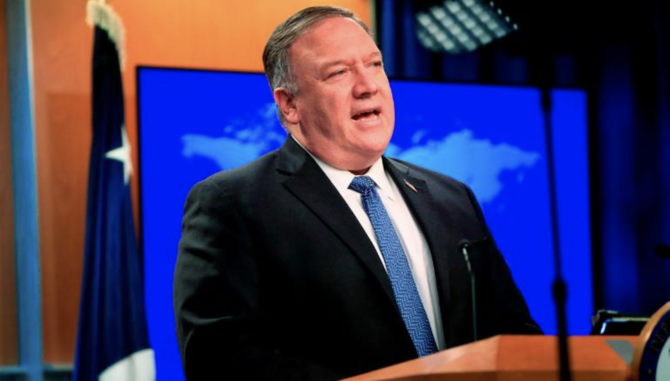
Secretary of State Mike Pompeo is set to trigger a “snapback” sanctions mechanism at Security Council, UK, France and Germany — the so-called “European 3” — all elected to abstain from a proposal by the US to bring back sanctions on Iran. (AFP/File Photo)
Short Url
Updated 20 August 2020
Follow

US pressures UK on Iran sanctions at the UN

  • Secretary of State Mike Pompeo set to trigger “snapback” mechanism at Security Council

LONDON: The US is putting pressure on the UK over the reimposition of UN sanctions on Iran, following London’s abstention on a crucial Security Council vote last week.

The UK, France and Germany — the so-called “European 3” — all elected to abstain from a proposal by the US to bring back sanctions on Iran previously eased as part of the 2015 Joint Comprehensive Plan of Action (JCPoA), commonly known as the “Iran Nuclear Deal” brokered by former US President Barack Obama.

The JCPoA includes the option for a 2007 UN arms embargo on Tehran to expire in October 2020, which Washington believes should remain in place, citing Iran’s failure to comply with terms agreed on its production of enriched uranium. Its arguments failed to convince the UN Security Council last week.

Opinion

This section contains relevant reference points, placed in (Opinion field)

The US, through its Secretary of State Mike Pompeo, is now attempting a “snapback” of sanctions eased under the JCPoA on Iran. However, US President Donald Trump withdrew from the JCPoA in 2018, calling it the “worst deal ever”. Iran and the EU argue that having left the agreement, Washington is no longer in a position to invoke such a mechanism. 

The US claims that as it was listed in the resolution confirming the JCPoA in 2015, it still has the power to invoke the “snapback”. There are also suggestions that, unlike the arms embargo, the JCPoA is not legally binding.

The UK’s impassivity has since garnered an angry response from Washington. Kelly Craft, the US ambassador to the UN, told the Times Newspaper: “The central question is whether or not Britain supports allowing the world’s largest state sponsor of terrorism to buy and sell weapons. Our administration has repeatedly stated that the US will never allow this to happen.”

******

READ MORE: National security experts urge US to introduce Iran ‘snapback’ sanctions


Pompeo says US expects to trigger snapback on Iran soon


******

Relations between the US and Iran have deteriorated since the election of Trump in 2016. Having withdrawn from the JCPoA in 2018, in January Washington ordered the assassination of the Iranian military commander Qassem Soleimani in an airstrike at Baghdad Airport in Iraq, in the aftermath of an attack on the US embassy in the Iraqi capital.

Last night, Trump pledged that Iran would “never” come into possession of or develop a nuclear weapon at a press conference at the White House.

A UK government spokesman said: “We share the US concern about Iranian proliferation and the impact this has on regional security.

“We have been clear that expiry of the Iran arms embargo would have serious negative implications for regional security and stability,” the spokesman said, adding: “The (arms embargo) resolution did not represent a basis for achieving consensus.”


Fresh clashes kill six in Iran cost-of-living protests

Updated 4 sec ago
Follow

Fresh clashes kill six in Iran cost-of-living protests

  • The protests began on Sunday in Tehran, where shopkeepers went on strike over high prices and economic stagnation
  • Earlier Thursday, state television reported that a member of Iran’s security forces was killed overnight during protests in the western city of Kouhdasht

TEHRAN: Protesters and security forces clashed in several Iranian cities on Thursday, with six reported killed, the first deaths since the cost-of-living demonstrations broke out.
The protests began on Sunday in Tehran, where shopkeepers went on strike over high prices and economic stagnation, and have since spread to other parts of the country.
On Thursday, Iran’s Fars news agency reported two people killed in clashes between security forces and protesters in the city of Lordegan, in the province of Chaharmahal and Bakhtiari, and three in Azna, in neighboring Lorestan province.
“Some protesters began throwing stones at the city’s administrative buildings, including the provincial governor’s office, the mosque, the Martyrs’ Foundation, the town hall and banks,” Fars said of Lordegan, adding that police responded with tear gas.
Fars reported that the buildings were “severely damaged” and that police arrested several people described as “ringleaders.”
In Azna, Fars said “rioters took advantage of a protest gathering... to attack a police commissariat.”
During previous protest movements, state media has labelled demonstrators “rioters.”
Earlier Thursday, state television reported that a member of Iran’s security forces was killed overnight during protests in the western city of Kouhdasht.
“A 21-year-old member of the Basij from the city of Kouhdasht was killed last night by rioters while defending public order,” the channel said, citing Said Pourali, the deputy governor of Lorestan Province.
The Basij are a volunteer paramilitary force linked to Iran’s Revolutionary Guards, the ideological branch of the Islamic republic’s army.
Pourali said that “during the demonstrations in Kouhdasht, 13 police officers and Basij members were injured by stone throwing.”
In the western city of Hamedan, protesters torched a motorbike in what the Tasnim news agency described as an unsuccessful attempt to burn down a mosque.
The same agency reported on Thursday that 30 people in a district of Tehran had been arrested the night before for alleged public order offenses in a “coordinated operation by the security and intelligence services.”

- ‘End up in hell’ -

The demonstrations are smaller than the last major outbreak of unrest in 2022, triggered by the death in custody of Mahsa Amini, who was arrested for allegedly violating Iran’s strict dress code for women.
Her death sparked a nationwide wave of anger that left several hundred people dead, including dozens of members of the security forces.
The latest protests began in the capital and spread after students from at least 10 universities joined in on Tuesday.
Iranian President Masoud Pezeshkian has sought to calm tensions, acknowledging protesters’ “legitimate demands,” and he urged the government Thursday to take action to improve the economic situation.
“From an Islamic perspective... if we do not resolve the issue of people’s livelihoods, we will end up in Hell,” Pezeshkian said at an event broadcast on state television.
Authorities, however, have also promised to take a “firm” stance, and have warned against exploiting the situation to sow chaos.
Local media coverage of the demonstrations has varied, with some outlets focusing on economic difficulties, and others on incidents caused by “troublemakers.”
Iran is in the middle of an extended weekend, with the authorities declaring Wednesday a bank holiday at the last minute, citing the need to save energy during the cold weather.
They made no official link to the protests.
The weekend in Iran begins on Thursday, and Saturday is a long-standing national holiday.
Iran’s prosecutor general said on Wednesday that peaceful economic protests were legitimate, but any attempt to create insecurity would be met with a “decisive response.”
“Any attempt to turn economic protests into a tool of insecurity, destruction of public property, or implementation of externally designed scenarios will inevitably be met with a legal, proportionate and decisive response.”

- Viral video -

Earlier this week, a video showing a person sitting in the middle of a Tehran street facing down motorcycle police went viral on social media, with some seeing it as a “Tiananmen moment” — a reference to the famous image of a Chinese protester defying a column of tanks during 1989 anti-government protests in Beijing.
On Thursday, state television alleged the footage had been staged to “create a symbol” and aired another video purportedly shot from another angle by a police officer’s camera.
Sitting cross-legged, the protester remains impassive, head bowed, before covering his head with his jacket as behind him a crowd flees clouds of tear gas.
On Wednesday evening, Tasnim reported the arrest of seven people it described as being affiliated with “groups hostile to the Islamic Republic based in the United States and Europe.”
It said they had been “tasked with turning the demonstrations into violence.” Tasnim did not say when they were arrested.
The national currency, the rial, has lost more than a third of its value against the US dollar over the past year, while double-digit hyperinflation has been undermining Iranians’ purchasing power for years.
The inflation rate in December was 52 percent year-on-year, according to the Statistical Center of Iran, an official body.