

Pakistani mango export to Arab countries at 41% as export target surpassed

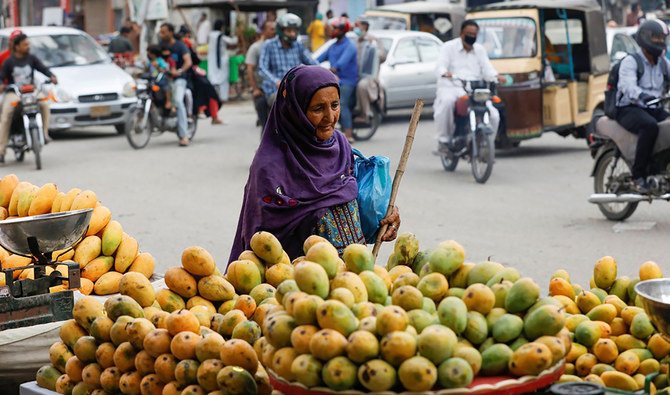
A woman walks past mango stalls at the retail market in Karachi on June 11, 2020. (REUTERS/File)
Short Url
Updated 21 August 2020
Follow

Pakistani mango export to Arab countries at 41% as export target surpassed

  • Despite the pandemic, the country exported 125,000 tons of mangoes worth $72 million against the season’s target of 80,000 tons
  • Pakistani exporters say they are confident the overall mango export would reach 150,000 tons in the next few weeks

KARACHI: Pakistan’s export of mangoes to Arab countries stood at 51,140 tons, or 41 percent of the country’s overall export of the fruit, during the current season, said exporters on Thursday, adding that the country sold more mangoes in the international market during the current season than expected and surpassed its target by 56 percent despite the COVID-19 constraints.
“During the current season, mango export increased by 45,000 tons to 125,000 tons mainly due to our aggressive marketing. The country has earned $72 million in revenue despite several challenges arising out of the COVID-19 pandemic,” Waheed Ahmed, patron-in-chief of the All Pakistan Fruit and Vegetable Exporters, Importers and Merchants Association (PFVA), told Arab News.


Pakistan’s de facto commerce minister, Abdul Razak Dawood, also commended the achievement, saying in a Twitter post: “I congratulate our mango exporters who have been able to achieve this remarkable result. A meeting is being arranged to strategize on a long term for exporting this great Pakistani product. Well done to all.”


Pakistani exporters had set a target of selling 80,000 tons of mangoes in the international market during the current season after the coronavirus outbreak that resulted in global lockdowns and travel suspensions. They are now confident, however, that the overall mango export would reach 150,000 tons since they are hoping to sell an additional 25,000 tons during the next one and a half months.
Mango season starts from May and lasts till the end of October, but Pakistani mangoes reached the Arab lands in June this year due to the coronavirus pandemic.
The 51,140 tons of mango or 41 percent of the country’s overall exports by August 14, 2020, was made to the Middle Eastern countries where, according to the PFVA data, the United Arab Emirates imported 33,019 tons, Oman 11,469 tons, Saudi Arabia 2,997 tons, Qatar 2,875 tons, Bahrain 1,685 tons, and Kuwait 580 tons.


Pakistani officials said that Arabs had developed the taste for Pakistani mangoes and the country was hoping to export even more of the fruit during the next season.
“Based on our promotional activities in the Gulf region, particularly Saudi Arabia, our exports are expected to increase by 30 to 40 percent if nothing unfavorable happens,” Ehtisham Farooq, trade development officer at the Embassy of Pakistan, told Arab News on the phone from Riyadh on Wednesday.
“This season was among the most difficult one for us,” Waheed Ahmed of the PFVA said. “However, we adopted aggressive and realistic marketing strategies and the government also supported us in this endeavor.”
“After the COVID-19 outbreak, Vitamin C became the most sought after food supplement and we made it part of our marketing strategy,” he added. “This worked particularly well in the Gulf region. We also got support from airline services that reduced freight charges by about 50 percent.”
Pakistan’s mango exports also benefitted from the country’s “mango diplomacy” that was carried out by the trade missions abroad that presented the fruit to officials and other high-profile individuals in foreign lands.
The Trade and Development Authority of Pakistan (TDAP) promoted mangoes in 24 cities across the world and sent the “gift of Pakistani mangoes” to 30 heads of states.
Pakistani exporters say they are optimistic they can take their country’s mango exports to 200,000 tons within three years. They also believe that the volume of the value-added mango products can be increased to $350 million within the same period. However, they are concerned about declining yield due to the changing climate which brought down the total production level from 1.8 million to 1.3 million tons last year, according to the PFVA. 


Pakistan’s flood-hit Sindh farmers’ group plans climate lawsuit against German firms

Updated 4 sec ago
Follow

Pakistan’s flood-hit Sindh farmers’ group plans climate lawsuit against German firms

  • Claim seeks $1.08 million in damages linked to devastating 2022 floods
  • Case targets energy, cement companies cited as major historical emitters

ISLAMABAD: A group of 43 farmers from Pakistan’s flood-ravaged Sindh province has decided to file a climate justice lawsuit against two German companies, accusing them of contributing to the global greenhouse gas emissions they say worsened the catastrophic floods of 2022, a rights activist and a claimant said on Friday.

The planned legal action targets energy company RWE and cement manufacturer Heidelberg Materials, following a legal notice issued in late October that gave the firms until December to reach a settlement over an estimated $1.08 million in damages. Environmental campaigners describe both companies as major historical contributors to global emissions.

Heidelberg Materials confirmed last month that it had received the legal notice and was reviewing the claim. RWE has not responded.

The case follows the devastating monsoon floods of 2022, which killed more than 1,700 people, displaced around 33 million and caused economic losses exceeding $30 billion across Pakistan. Sindh was the hardest-hit province, with districts such as Dadu, Larkana and Jacobabad submerged for months.

The legal move comes as communities in climate-vulnerable countries increasingly seek accountability from multinational corporations for climate-related losses, amid growing scientific evidence linking extreme weather events to global warming driven largely by industrialized economies.

“The farmers in Sindh, affected by environmental devastation, have now decided to pursue legal action against two German companies for climate justice, which is a historic decision,” Nasir Mansoor, general secretary of Pakistan’s National Trade Union Federation (NTUF), told Arab News.

Mansoor said climate change should be treated as a labor and livelihoods issue, arguing that repeated environmental shocks were eroding rural employment, food security and social stability in one of Pakistan’s poorest regions.

Abdul Khaliq Leghari, a landowner from Khairpur Nathan Shah and one of the 43 claimants, said the floods permanently damaged his farmland. He lost 40 acres of rice and wheat crops, and his yields have since fallen by half.

“We not only suffered large-scale losses to crops and livestock during the floods, but we are still suffering these losses even now. This is not our fault; rather, it is the fault of companies like the German ones,” Leghari told Arab News.

“Clouds rain all over the world, but here the clouds burst. What is our fault in this? Those who have brought the climate to this point are becoming richer and richer, while we are becoming poorer and poorer,” he said, adding that the farmers were seeking not only compensation but action by major polluters to prevent further environmental damage.

At a press conference at the Karachi Press Club on Thursday, farmers and activists said Pakistan, which contributes less than 1 percent of global greenhouse gas emissions, was paying a disproportionate price for industrial pollution generated elsewhere.

Mansoor said environmental degradation within Pakistan was accelerating, citing the rapid melting of 14,000 glaciers across three major mountain ranges and the loss of around 90 percent of the historic Indus Delta.

“The industrial model of capitalist development had brought the planet to the brink of destruction,” Mansoor said, adding that current generations had a narrowing window to prevent irreversible damage.

The litigation is being supported by the European Center for Constitutional and Human Rights (ECCHR) and the HANDS Welfare Foundation. Dr. Shaikh Tanveer Ahmed of HANDS told reporters that the 2022 floods were driven by global warming rather than being a purely natural disaster.

Lawyers involved in the case say it aims to link climate science with human rights law. While RWE and Heidelberg Materials have been identified in “carbon majors” research as significant historical emitters, neither company has accepted liability for the damages claimed in Sindh.

Miriam Saage-Maab, a German constitutional lawyer and a representative of the European Center for Constitutional and Human Rights (ECCHR), said the two firms were selected because they are among Germany’s major historical carbon dioxide emitters and are emblematic of the country’s fossil fuel-based economic model that has contributed to the climate crisis.

She said German civil law recognizes the principle of “joint and several liability,” under which it is legally permissible to hold one or more entities accountable for harm caused collectively by many contributors.

“If there are several people or several entities responsible for a harm, it is legitimate to only bring to court one or two of them, representing that the whole group of those have contributed to a harm,” Saage-Maab told Arab News.

She added that greenhouse gas emissions contribute to global warming regardless of where they are produced, intensifying extreme weather events worldwide.

“The CO2 emissions emitted in Germany, Europe or elsewhere have contributed to a warming climate, and this warming climate enabled the 2022 floods,” she said, describing this link as the core causal argument behind the lawsuit.