

In a first for Pakistan, Khyber Pakhtunkhwa province introduces universal health care

The building of Rehman Medical Institute (RMI), one of the biggest hospitals in Peshawar, Khyber Pakhtunkhwa is seen on Feb. 6, 2020. (AN/File)
Short Url
Updated 20 August 2020
Follow

In a first for Pakistan, Khyber Pakhtunkhwa province introduces universal health care

  • Every family in the province will be entitled to medical treatment of up to Rs1 million ($6,000) a year
  • Prime Minister Imran Khan expressed hope that other provinces will follow in Khyber Pakhtunkhwa's footsteps

ISLAMABAD: Northwestern Khyber Pakhtunkhwa province on Thursday launched the Sehat Sahulat program, becoming the first in Pakistan to introduce a health insurance program covering all residents.

Under the program, each family in the province, regardless of its financial status will be entitled to medical treatment of up to Rs1 million ($6,000) a year at over 250 government and private hospitals across the country.

Present during the launching ceremony, Prime Minister Imran Khan lauded the initiative and expressed hope that other provinces will follow in Khyber Pakhtunkhwa's footsteps. "Pressure will be now on other provinces to provide such facility to their citizens," he said, as quoted in a Twitter post by the ruling Pakistan Tehreek-e-Insaf (PTI).
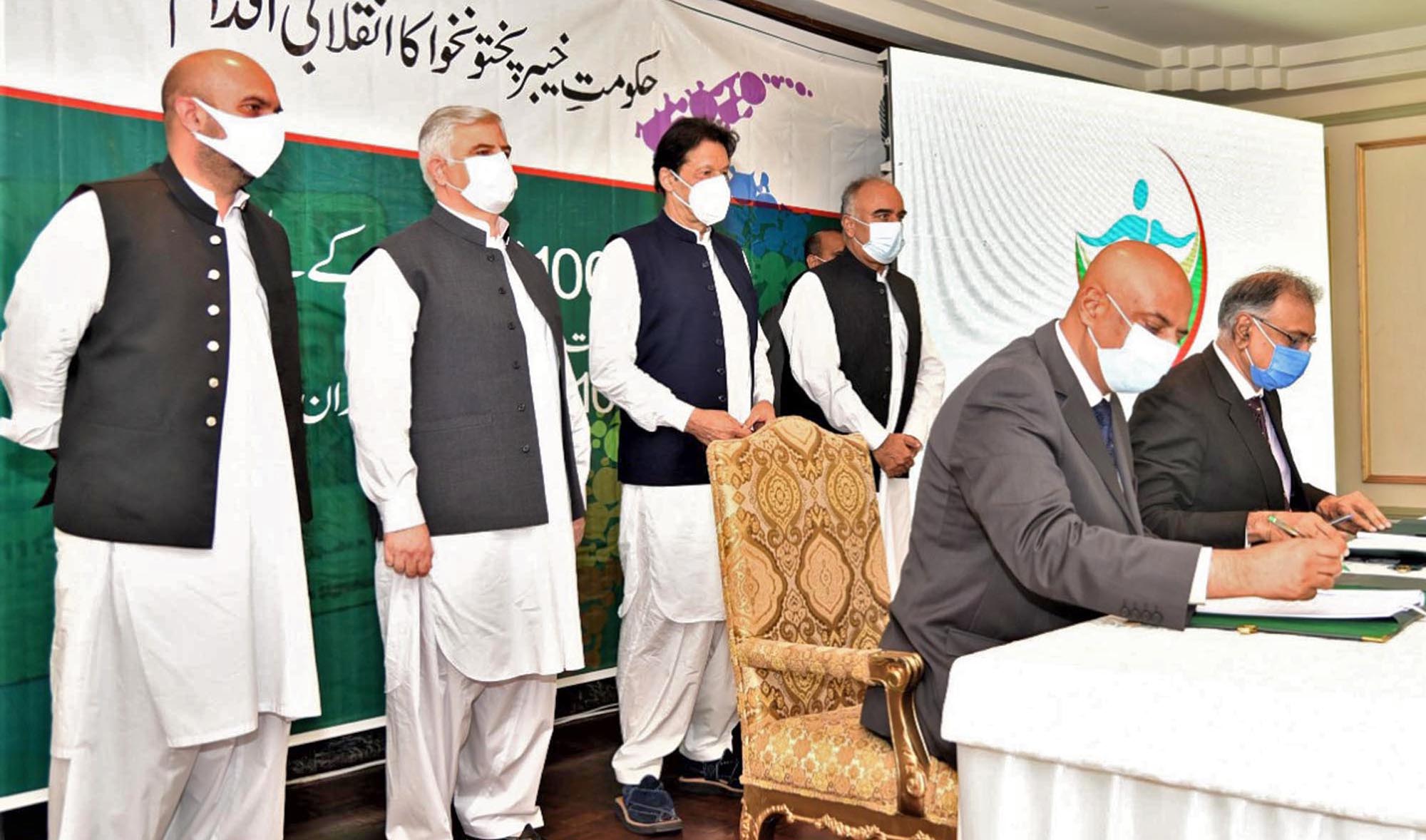


Pakistan Prime Minister Imran Khan, third left, witnesses MoU signing between Khyber Pakhtunkhwa government and State Life for universal coverage of Sehat Insaf Cards in KP provice, in a ceremony held at Islamabad on Aug. 20, 2020. (PID)

Local governments have been responsible for health care in Pakistan since the devolution of health to the provinces in 2011.

In Khyber Pakhtunkhwa, residents of Malakand division will start receiving the free services from October, followed by Hazara division in November, Mardan and Peshawar in December and Kohat, Bannu and Dera Ismail Khan in January.

The first phase of the program was launched in 2015 but covered only 100,000 families. By January, according to the provincial government, it is expected to cover over 6 million families — about 30 million people.

Data from Islamabad-based public policy think tank Tabadlab, shows that Pakistan ranks 154th out of 195 countries in terms of the quality and accessibility of its health care, which is far behind India (145th), Bangladesh (133rd), Bhutan (134th), and Sri Lanka (71st).

The national health infrastructure serving the country’s 220 million population comprises 1,279 hospitals, 5,527 basic health units, 686 rural health centers, 5,671 dispensaries, 747 maternal and child health center and 441 tuberculosis centers. The total availability of beds in these health facilities is estimated at only 145,124.


IMF hails Pakistan privatization drive, calls PIA sale a ‘milestone’

Updated 10 January 2026
Follow

IMF hails Pakistan privatization drive, calls PIA sale a ‘milestone’

  • Fund backs sale of national airline as key step in divesting loss-making state firms
  • IMF has long urged Islamabad to reduce fiscal burden posed by state-owned entities

KARACHI: The International Monetary Fund (IMF) on Saturday welcomed Pakistan’s privatization efforts, describing the sale of the country’s national airline to a private consortium last month as a milestone that could help advance the divestment of loss-making state-owned enterprises (SOEs).

The comments follow the government’s sale of a 75 percent stake in Pakistan International Airlines (PIA) to a consortium led by the Arif Habib Group for Rs 135 billion ($486 million) after several rounds of bidding in a competitive process, marking Islamabad’s second attempt to privatize the carrier after a failed effort a year earlier.

Between the two privatization attempts, PIA resumed flight operations to several international destinations after aviation authorities in the European Union and Britain lifted restrictions nearly five years after the airline was grounded following a deadly Airbus A320 crash in Karachi in 2020 that killed 97 people.

“We welcome the authorities’ privatization efforts and the completion of the PIA privatization process, which was a commitment under the EFF,” Mahir Binici, the IMF’s resident representative in Pakistan, said in response to an Arab News query, referring to the $7 billion Extended Fund Facility.

“This privatization represents a milestone within the authorities’ reform agenda, aimed at decreasing governmental involvement in commercial sectors and attracting investments to promote economic growth in Pakistan,” he added.

The IMF has long urged Islamabad to reduce the fiscal burden posed by loss-making state firms, which have weighed public finances for years and required repeated government bailouts. Beyond PIA, the government has signaled plans to restructure or sell stakes in additional SOEs as part of broader reforms under the IMF program.

Privatization also remains politically sensitive in Pakistan, with critics warning of job losses and concerns over national assets, while supporters argue private sector management could improve efficiency and service delivery in chronically underperforming entities.

Pakistan’s Cabinet Committee on State-Owned Enterprises said on Friday that SOEs recorded a net loss of Rs 122.9 billion ($442 million) in the 2024–25 fiscal year, compared with a net loss of Rs 30.6 billion ($110 million) in the previous year.