Israeli planes bomb Gaza as Egyptians seek to restore calm

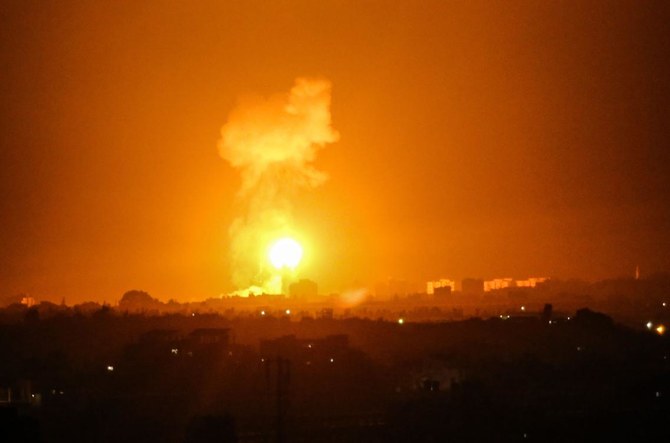
Smoke and flames rise after Israeli army war planes carried out airstrikes over Khan Yunis, Gaza Strip on August 16, 2020. (File/AFP)
Short Url
Updated 18 August 2020
Follow

Israeli planes bomb Gaza as Egyptians seek to restore calm

  • The strikes came as visiting Egyptian security officials strove to defuse the latest uptick in violence, a Hamas source said

GAZA CITY, Palestine: Israeli warplanes pounded Hamas-ruled Gaza early Tuesday in response to Palestinian fire balloons launched across the border, the Israeli army said.
The strikes came as visiting Egyptian security officials strove to defuse the latest uptick in violence, a Hamas source said.
“Fighter jets and (other) aircraft struck underground infrastructures belonging to the Hamas terror organization in the Gaza Strip,” an Israeli military statement said.
It linked the air strikes to “explosive and arson balloons launched from the Gaza Strip into Israel.”
The Hamas source told AFP the group had held talks with the Egyptian delegation in Gaza on Monday before it left the territory for meetings with the Israelis and the West Bank-based Palestinian Authority.
It was expected to return to Gaza after those talks were concluded, the source added.
Israel and Hamas have fought three wars since 2008.
Despite a truce last year backed by Egypt, the UN and Qatar, Hamas and Israel clash sporadically, with Palestinian incendiary balloons or rocket or mortar fire drawing retaliatory Israeli strikes and civil sanctions.
Israel has banned fishing off Gaza’s coast and closed the Kerem Shalom goods crossing, cutting off deliveries of fuel to the territory’s sole power plant.
The plant’s spokesman Mohammed Thabet announced its “complete shutdown” on Tuesday after its fuel ran out.
Power had been in short supply even before the shutdown, with consumers having access to mains electricity for only around eight hours a day.
That will now be cut to just four hours a day using power supplied from the Israeli grid.
For the rest of the time, those Gazans who can afford it rely on solar panels, or generators, which also need fuel.
The Hamas source said there were no casualties in the latest Israeli air raids.
“The occupation continued its aggression and carried out air strikes on Gaza after midnight,” he said, adding that the strikes were seen as a “negative response” to the truce feelers.
Gaza security sources and witnesses said the strikes hit Hamas lookout posts at Rafah in the south of the territory and Beit Lahia in the north.
Tensions have been rising for more than a week, with Hamas firing rockets and launching bundles of balloons across the border fitted with incendiary or explosive devices.
Israeli police said Tuesday that a balloon came down in the yard of a home in the town of Sderot, walking distance from the Gaza border and a frequent target for attack.
It caused some damage but no casualties, a police statement said.


As Iran conflict spills over, Iraq’s Kurds say ‘this war is not mine’

Updated 08 March 2026
Follow

As Iran conflict spills over, Iraq’s Kurds say ‘this war is not mine’

  • The Kurds, an ethnic minority with a distinct culture and language, are rooted in the mountainous region spread across Turkiye, Syria, Iraq and Iran
  • “This isn’t my war,” said 58-year-old Satar Barsirini

SORAN, Iraq: On a deserted road not too far from the border between Iran and Iraqi Kurdistan, Satar Barsirini looked up at the sky, now streaked with jets and drones.
Iraq’s Kurdish region has found itself caught in the crossfire of a regional war triggered by US and Israeli attacks on the Islamic republic.
Dressed like the Kurdish fighters he once served alongside, Barsirini still wears the khaki shalwar, fitted jacket and scarf wrapped around his waist.
Though recently retired, he refuses to give up his peshmerga uniform as he tills his small plot of land.
The rumble of jets and hum of drones “come from everywhere. Especially at night,” he told AFP in the hamlet of Barsirini, dozens of kilometers from the border.
He described the “shiver in our flesh” as the drones hit the ground outside.
“I feel bad for the people, because we have paid a lot in blood to liberate Kurdistan... We just want to live.”
Irbil, the autonomous region’s capital, and the valleys leading to the border have been targeted by Tehran and the Iraqi armed groups it supports.
American bases there have come under fire, as have positions held by Iranian Kurdish parties — the same ones US President Donald Trump said it would be “wonderful” to see storm Iran.
But Iran warned on Friday it would target facilities in Iraqi Kurdistan if fighters crossed into its territory.
“This isn’t my war,” said 58-year-old Barsirini.
He recalled the brutal repression and flight into the snowy mountains after the 1991 Kurdish uprising that followed the first Gulf War.

- ‘Dangerous people’ -

The uprising was repressed, leading to an exodus of two million Kurds to Iran and Turkiye.
“When we fled the cities for our lives, we went to Iran. They helped us, they gave us shelter and food,” he said.
The Kurds would not forget that, Barsirini stressed, adding that they could not just “turn against them” now to support the US and Israel.
“I don’t trust (Americans). They are dangerous people,” he said.
The Kurds, an ethnic minority with a distinct culture and language, are rooted in the mountainous region spread across Turkiye, Syria, Iraq and Iran.
They have long fought for their own homeland, but for decades suffered defeats on the battlefield and massacres in their hometowns.
They make up one of Iran’s most important non-Persian ethnic minority groups.
A week of war has gripped daily life in Iraqi Kurdistan, residents told AFP.
“People are afraid,” said Nasr Al-Din, a 42-year-old policeman who, as a child, lived through the 1991 exodus — “thrown on a donkey’s back with my sister.”
“This generation is different from the older ones” that have seen “seen fighting.”
Now, he said, you could be “sitting down in your home... and all of a sudden a drone hits your house.”
“We may have to go into town or somewhere safer,” said Issa Diayri, 31, a truck driver waiting in a roadside garage, his lorry idle for lack of deliveries from Iran.

- ‘Shouldn’t get involved’ -

Soran, a small town of 3,000 people about 65 kilometers (40 miles) from the border, was hit Thursday by a drone that fell in the middle of a street.
There, baker Yussef Ramazan, 42, and his three apprentices, hurriedly made bread before breaking their fast.
But, living so close to the Iranian border, he said “people are afraid to come and buy it.”
He told AFP he did not think it was a good idea “for the Kurdish region to get involved in this war.”
“We are not even an independent country yet. We would like to become one, but we are nothing for now, so we shouldn’t get involved in these situations.”
Across the street, Hajji watched from his empty dry cleaning shop as the road cleared.
Before the war, the town was crowded as evening fell, he said, declining to give his full name.
“But after the drone explosion, no one was here. In five minutes, everyone left the street and no one was out.”