

India's Congress party accuses Facebook of promoting hate speech

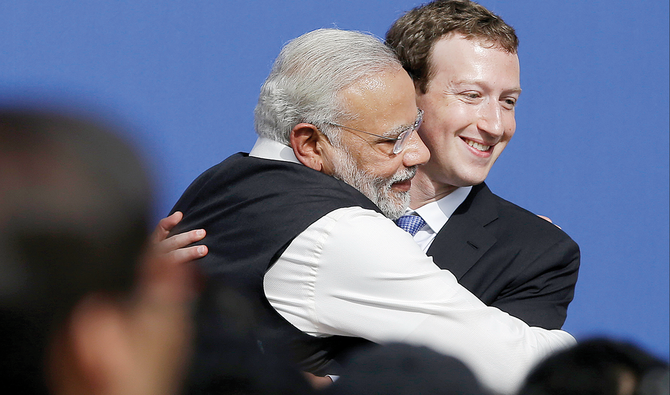
Facebook CEO Mark Zuckerberg, right, hugs Prime Minister of India Narendra Modi at Facebook offices in Menlo Park, Calif. Facebook India is under fire. (Files/AP)
Short Url
Updated 18 August 2020
Follow

India's Congress party accuses Facebook of promoting hate speech

  • Ruling party members posted incendiary messages, says Congress Party

NEW DELHI: Facebook was accused Monday of promoting hate speech and destabilizing democracy in India by the country’s main opposition Congress Party.

The social media giant has one of its biggest markets in India, with more than 340 million users.

But a report last week in the Wall Street Journal said the platform had ignored incendiary messages posted by members of the ruling Bharatiya Janata Party (BJP) to protect its business interests.

Facebook did not delete an anti-Muslim video posted by a southern Indian legislator, T. Raja Singh, in March until the newspaper challenged the social network about it.

It added that Facebook India’s public policy executive, Ankhi Das, opposed applying “hate speech rules to Singh and at least three other Hindu nationalist individuals and groups flagged internally for promoting or participating in the violence.”

Das, according to the paper’s report, told employees that “punishing violations by politicians from Modi’s party would damage the company’s business prospects in the country.”

“Across the world, in many countries, Facebook has removed pages citing ‘coordinated inauthentic behavior,’ but why has Facebook never done something similar with rumor-mongering and hate speeches in India?” Congress spokesperson Supriya Shrinate said at a press conference on Monday. “With all responsibility, I will say that Facebook’s inaction destabilizes our democracy. More often than not, Facebook takes no action and, even worse, allows objectionable content to continue despite being brought to notice.”

Facebook denied the accusations, saying that it did not favor any political party in India.

“We prohibit hate speech and content that incites violence, and we enforce these policies globally without regard to anyone’s political position or party affiliation,” it said in a statement to Arab News. “While we know there is more to do, we’re making progress on enforcement and conducting regular audits of our process to ensure fairness and accuracy.”

Congress wants a parliamentary committee inquiry into the issue.

“The Joint Parliamentary Committee (JPC) should examine how Facebook and WhatsApp are working to help the BJP in the elections and to create an atmosphere of hatred,” it said in a statement.

The BJP mocked the opposition’s demand and said the party should “look within itself.”

“It’s ridiculous,” BJP spokesperson Sudesh Verma told Arab News. “If the allegation itself is ludicrous, the demand for the JPC probe would come in the same category. You imagine something and then make a demand. The country does not work on this. If anything, they should approach Facebook. It has given clarifications already. The Congress leadership is frustrated.”

Experts said that the BJP had “weaponized” Facebook and WhatsApp and was using them as a strategy to “mold” public opinion.

“The top brass of Facebook in India are bending over backwards to placate the ruling BJP led by Prime Minister Narendra Modi,” New Delhi-based journalist Paranjoy G. Thakurta told Arab News.

Thakurta co-authored a book last year - “The Real Face of Facebook in India” - that explored how social media was propagating falsehoods in the country.

“Large numbers of Indians have been receiving fake, false, half-truth, inflammatory, incendiary information, and this influenced political preferences in the run-up to the election in 2019,” he said. “They weaponized WhatsApp, and it has become like an army for the rightwing group. Facebook and WhatsApp are not neutral. The playing field is not level. The Wall Street Journal article has highlighted how deep the nexus is between the top officials of Facebook and India’s ruling regime.”

Another New Delhi-based journalist, Urmilesh Urmil, said Facebook was “ideologically- oriented” and favored the ruling right-wing party.

“This is a matter of concern and affects the functioning of democracy in India,” he told Arab News.

In April, Facebook announced plans to invest $5 billion in Reliance Jio, the largest mobile and internet company in India. It is owned by the country’s richest person, Mukesh Ambani.

The deal is expected to give Facebook an even more significant foothold in India.

“The fact that this international global digital giant is tied up with India’s biggest telecommunication provider Reliance Jio means that global monopoly and the local bigwig have come together,” Thakurta added. “I worry how much control and influence these large conglomerates will have in influencing what people read and watch, thereby influencing attitudes and preferences, including their political behavior.”


Japan prepares to restart world’s biggest nuclear plant, 15 years after Fukushima

Updated 7 sec ago
Follow

Japan prepares to restart world’s biggest nuclear plant, 15 years after Fukushima

NIIGATA: Japan took the final step to allow the world’s largest nuclear power plant to ​resume operations with a regional vote on Monday, a watershed moment in the country’s return to nuclear energy nearly 15 years after the Fukushima disaster. Kashiwazaki-Kariwa, located about 220 km (136 miles) northwest of Tokyo, was among 54 reactors shut after the 2011 earthquake and tsunami crippled the Fukushima Daiichi plant in the worst nuclear disaster since Chernobyl.
Since then, Japan has restarted 14 of the 33 that remain operable, as it tries to wean itself off imported fossil fuels. Kashiwazaki-Kariwa will be the first operated by Tokyo Electric Power Co. (TEPCO), which ran the doomed Fukushima plant. On Monday, Niigata prefecture’s assembly passed a vote of confidence on Niigata Governor Hideyo Hanazumi, who backed the restart last month, effectively allowing for the plant to begin operations again.
“This is a milestone, but this is not the end,” Hanazumi told reporters after the vote. “There is no end in terms of ensuring the safety of Niigata residents.”
While lawmakers voted in support of Hanazumi, the assembly session, the ‌last for the year, ‌exposed the community’s divisions over the restart, despite new jobs and potentially lower electricity bills.
“This is nothing ‌other ⁠than ​a political settlement ‌that does not take into account the will of the Niigata residents,” an assembly member opposed to the restart told fellow lawmakers as the vote was about to begin.
Outside, around 300 protesters stood in the cold holding banners reading ‘No Nukes’, ‘We oppose the restart of Kashiwazaki-Kariwa’ and ‘Support Fukushima’. “I am truly angry from the bottom of my heart,” Kenichiro Ishiyama, a 77-year-old protester from Niigata city, told Reuters after the vote. “If something was to happen at the plant, we would be the ones to suffer the consequences.”
TEPCO is considering reactivating the first of seven reactors at the plant on January 20, public broadcaster NHK reported.
Kashiwazaki-Kariwa’s total capacity is 8.2 GW, enough to power a few million homes. The pending restart would bring one 1.36 GW unit online next year and start another one with the same capacity around 2030.
“We remain firmly committed to never ⁠repeating such an accident and ensuring Niigata residents never experience anything similar,” said TEPCO spokesperson Masakatsu Takata. Takata declined to comment on timing. TEPCO shares closed up 2 percent in afternoon trade in Tokyo, higher than the wider ‌Nikkei index, which was up 1.8 percent.

RELUCTANT RESIDENTS WARY OF RESTART
TEPCO earlier this year pledged to ‍inject 100 billion yen ($641 million) into the prefecture over the next ‍10 years as it sought to win the support of Niigata residents.
But a survey published by the prefecture in October found 60 percent of residents did ‍not think conditions for the restart had been met. Nearly 70 percent were worried about TEPCO operating the plant.
Ayako Oga, 52, settled in Niigata after fleeing the area around the Fukushima plant in 2011 with 160,000 other evacuees. Her old home was inside the 20 km irradiated exclusion zone.
The farmer and anti-nuclear activist has joined the Niigata protests.
“We know firsthand the risk of a nuclear accident and cannot dismiss it,” said Oga, adding that she still struggles with post-traumatic stress-like symptoms from what happened at Fukushima.
Even Niigata Governor Hanazumi ​hopes that Japan will eventually be able to reduce its reliance on nuclear power. “I want to see an era where we don’t have to rely on energy sources that cause anxiety,” he said last month.

STRENGTHENING ENERGY SECURITY
The Monday vote was seen as the ⁠final hurdle before TEPCO restarts the first reactor, which alone could boost electricity supply to the Tokyo area by 2 percent, Japan’s trade ministry has estimated. Prime Minister Sanae Takaichi, who took office two months ago, has backed nuclear restarts to strengthen energy security and to counter the cost of imported fossil fuels, which account for 60 percent to 70 percent of Japan’s electricity generation.
Japan spent 10.7 trillion yen ($68 billion) last year on imported liquefied natural gas and coal, a tenth of its total import costs.
Despite its shrinking population, Japan expects energy demand to rise over the coming decade due to a boom in power-hungry AI data centers. To meet those needs, and its decarbonization commitments, it has set a target of doubling the share of nuclear power in its electricity mix to 20 percent by 2040.
Joshua Ngu, vice chairman for Asia Pacific at consultancy Wood Mackenzie, said public acceptance of the restart of Kashiwazaki-Kariwa would represent “a critical milestone” toward reaching those goals. In July, Kansai Electric Power, Japan’s top nuclear power operator, said it would begin conducting surveys for a reactor in western Japan, the first new unit since the Fukushima disaster.
But for Oga, who was in the crowd outside the assembly on Monday chanting ‘Never forget Fukushima’s lessons!’, the nuclear revival is a terrifying reminder of the potential risks. “At the time (2011), I never thought that TEPCO would operate a nuclear power ‌plant again,” she said.
“As a victim of the Fukushima nuclear accident, I wish that no one, whether in Japan or anywhere in the world, ever again suffers the damage of a nuclear accident.”