

German group first to climb Pakistan peak after COVID-19 restrictions eased

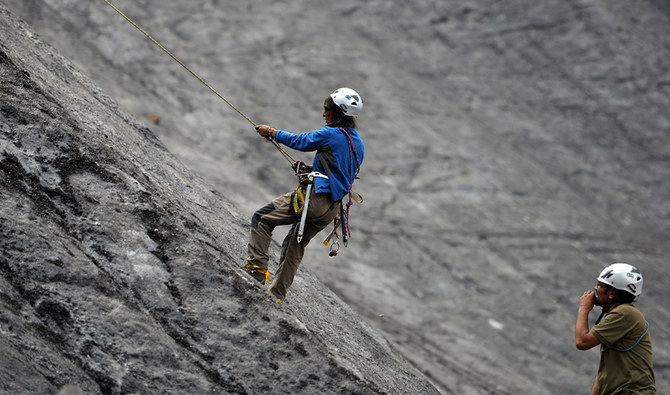
In this photograph taken on August 4, 2014, a Pakistani student from the Shimshal Mountaineering School climbs a slope on a glacier as trainer Niamat Karim (R) looks on near the Shimshal village in the northern Hunza valley. (AFP)
Short Url
Updated 17 August 2020
Follow

German group first to climb Pakistan peak after COVID-19 restrictions eased

  • Five-member team begins trek of 6,500mts mountain in Shimshal Valley
  • Follows Pakistan lifting its anti-virus lockdown on August 10 

ISLAMABAD: A group of five Germans will be the first foreigners to climb the over 6,500-meter-high peak in Shimshal Valley of Gilgit-Baltistan, after Pakistan lifted its anti-coronavirus restrictions last week and reopened its mountains for the trekking season. 

“A five-member German team led by climber Felix Berg arrived in Pakistan as the country has seen a significant drop in COVID-19 cases and is gradually returning to normalcy,” Karrar Haidri, Secretary Alpine Club of Pakistan told Arab News on Monday. 

Home to five of the world’s 14 tallest mountains, Pakistan had shut down its tourism sector in March this year to limit the spread of the coronavirus outbreak, which has killed 6,175 and infected 289,214 people thus far, out of a population of 220 million. 

Khyber Pakhtunkhwa and Gilgit-Baltistan, the two main hubs for domestic and international tourism, were the worst affected by the lockdown imposed five months ago.

Haidri said that while nearly 40 expeditions had been conducted and more than 100 foreign climbers and trekking groups had visited the country last year, the pandemic had dealt a severe blow to the tourism sector this year. He was, however, hopeful that the trend would pick up soon. 

“More foreigners are expected to arrive in the country in the coming days,” he said, without divulging more details. 


JazzCash signs deal with Binance in UAE to explore regulated crypto adoption in Pakistan

Updated 24 min 59 sec ago
Follow

JazzCash signs deal with Binance in UAE to explore regulated crypto adoption in Pakistan

  • MoU focuses on awareness and development of compliant virtual-asset solutions in Pakistan
  • Pakistan introducing licensing regime for crypto firms as it formalizes digital-asset oversight

ISLAMABAD: Pakistani financial-technology platform JazzCash has signed a memorandum of understanding with global cryptocurrency exchange Binance in the United Arab Emirates to explore cooperation on virtual-asset use and education in Pakistan, the company said on Wednesday.

The agreement sets a framework for discussions on awareness campaigns and future digital-asset products that would comply with Pakistan’s emerging crypto regulations. The move signals growing engagement between global blockchain companies and Pakistani fintechs as authorities shift toward formal licensing of the sector.

Pakistan has spent the past year drafting rules to regulate the fast-expanding market for digital coins and tokens, requiring virtual-asset service providers to obtain government approval. Officials say the transition is aimed at curbing money-laundering and terror financing risks, boosting transparency and encouraging responsible innovation.

“JazzCash has always championed technologies that expand financial access while promoting secure and inclusive participation in the digital economy," JazzCash Chief Executive Officer Murtaza Ali said. 

“By entering into this exploratory MoU with Binance, we are advancing our efforts to understand how global digital-asset trends can support Pakistan’s evolving regulatory landscape. We aim to engage responsibly, support regulatory progress, and advance opportunities that build trust, transparency and innovation for our customers.”

The MoU does not establish a commercial partnership, but marks one of the most high-profile engagements between Pakistan’s fintech sector and a global crypto exchange as the country moves toward regulated digital-asset adoption.

Binance welcomed the cooperation, framing it as part of Pakistan’s shift toward regulated digital-asset activity.

"With regulatory frameworks like [Pakistan Virtual Assets Regulatory Authority] PVARA paving the way, this collaboration represents a significant step toward expanding financial inclusion and empowering more people to access the benefits of blockchain technology in a secure and compliant environment," Binance Chief Marketing Officer Rachel Conlan said.

Earlier this month, Binance executives met Pakistani finance officials to discuss digital-payments reform, blockchain-skills training and the potential for Web3-linked jobs. Pakistan also set up the Pakistan Crypto Council and formed PVARA this year to license and supervise crypto-asset service providers.