

Qatar versus Red Bull — a Champions League semifinal for the 21st century

1 / 2
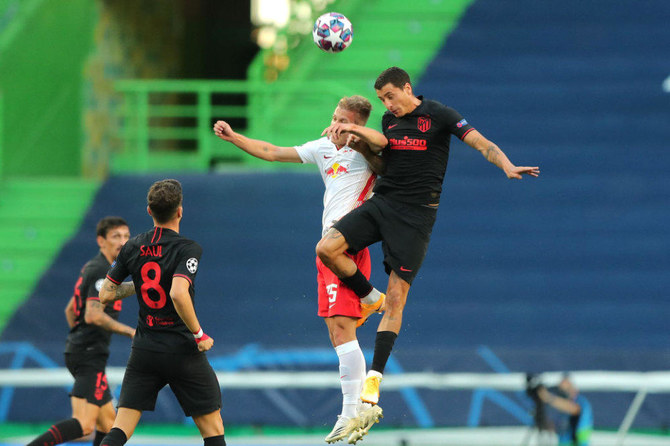
Leipzig's Spanish midfielder Dani Olmo (L) jumps for the ball with Atletico Madrid's Uruguayan defender Jose Gimenez during the UEFA Champions League quarter-final football match between Leipzig and Atletico Madrid at the Jose Alvalade stadium in Lisbon on August 13, 2020. (AFP / POOL / Miguel A. Lopes)
2 / 2
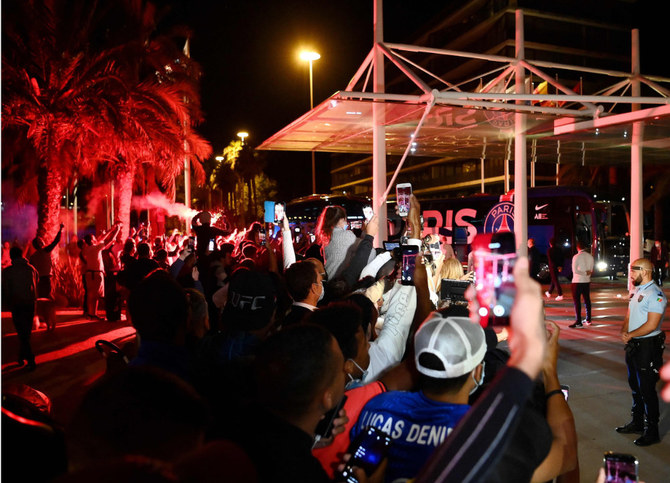
Fans gather as Paris Saint-Germain players arrives at the hotel in Lisbon on August 12, 2020. (AFP / POOL / FRANCK FIFE)
Short Url
Updated 17 August 2020
Follow

Qatar versus Red Bull — a Champions League semifinal for the 21st century

  • After being bought by state-funded Qatar Sports Investments in 2011, PSG went on to trample over the competition in France
  • Energy drinks giant Red Bull created RS Leipzig after buying the license of SSV Markranstadt

LISBON: Either Paris Saint-Germain or RB Leipzig will reach the Champions League final for the first time this midweek but the prospect of these hugely ambitious clubs clashing in the last four in Lisbon may be a turn-off for many football fans.
When UEFA president Aleksander Ceferin spoke to AFP last week about the future of elite European football, he observed that the sport had become “a different thing to what it was 10 years ago, let alone 20 years ago.”
Ceferin was speaking specifically about the need to change the Financial Fair Play rules after Manchester City’s successful appeal against a two-year Champions League ban.
But his point was about much more than that.
Ten years ago Inter Milan won the Champions League, beating Bayern Munich in the final. Bayern had defeated Lyon in the last four.
Those teams meet again in the semis on Wednesday after Lyon’s unexpected success against City, who have not yet made the Champions League final 12 years on from the Abu Dhabi takeover of the club.
Also in 2010, PSG won the French Cup but finished 13th in Ligue 1. They were going nowhere fast. Leipzig, meanwhile, had just made their way up to the fourth tier of German football.
In 2011, PSG were bought by the state-funded Qatar Sports Investments and have gone on to trample over the competition in France, winning Ligue 1 in seven of the last eight years.

Costly transfers
They paid the two biggest transfer fees in history to sign Neymar and Kylian Mbappe in 2017 and it is a wonder it has taken them this long to reach a Champions League semifinal again, 25 years after their first and last appearance.
“It is very special. It is the first time we have made it to the semifinals. It is history for the club,” said PSG president Nasser Al-Khelaifi after their quarter-final win over Atalanta, a remark that gave the impression it was a different club that lost to AC Milan in the 1995 semis.
In most ways it was. PSG are now the fifth richest club in world football, according to Deloitte’s Football Money League. Their revenue in 2018/19 was 635.9 million euros ($753 million).
Fans of other clubs sometimes laugh about PSG lacking tradition, given they were only founded in 1970. But they are veritable old-timers compared to Leipzig.

Hated by club supporters
The German club was only founded in 2009 when energy drinks giant Red Bull bought the license of fifth-division minnows SSV Markranstadt, creating RasenBallsport Leipzig.
’RasenBallsport’ is a fabricated German word, a way of getting around Red Bull’s problem that, under German Football League (DFL) rules, a team may not carry a sponsor’s name.
They also navigated their way around the DFL’s so-called ‘50+1’ rule in place to prevent any individual having a controlling stake in a club.
Red Bull, founded by Austrian billionaire Dietrich Mateschitz, owns 49 percent, with the remaining 51 percent owned by company employees.
Even before they first appeared in the Bundesliga in 2016, Leipzig were hated by supporters of other clubs.
Dynamo Dresden fans threw a severed bull’s head onto the pitch during a game between the teams. Borussia Dortmund fans have boycotted matches against Leipzig in protest at the club’s ownership structure.
Unlike PSG, Leipzig’s footballing model places the emphasis on signing and developing talented youngsters.
Nevertheless, cult German football magazine 11Freunde responded to Leipzig’s quarter-final win over Atletico Madrid by saying it would not cover their semifinal.
“RB Leipzig is a pure marketing project. Created solely to strengthen the Red Bull brand,” it wrote, calling the club “an imitation.”
The Red Bull stable also owns Salzburg, who also appeared in this season’s Champions League, New York Red Bulls, and Red Bull Bragantino, who have just reached Brazil’s top flight.
In Leipzig, RB have at least revived a tradition of footballing success — Lokomotiv Leipzig, a leading club in the old East Germany, were UEFA Cup semifinalists in 1974 and Cup Winners’ Cup runners-up in 1987.
Both PSG and RB Leipzig are now within touching distance of the Champions League final, but neutral support could be thin on the ground.

Middle East war puts Asian Football Confederation in a tricky situation

Updated 59 min 5 sec ago
Follow

Middle East war puts Asian Football Confederation in a tricky situation

  • Asian football has long been structured around regions, with competitions split between East and West
  • With conflict in the Middle East escalating on Feb. 28, the AFC was forced into emergency mode as the knockout stages of its club competitions approach

DAMMAM: Football in Asia has never been an easy task to manage. Long flights, numerous time zones, conflicting calendars, vastly different football cultures and — perhaps more than any other confederation in the world — politics.
While the war in the Middle East falls under the AFC’s umbrella, its direct effects have so far been limited to the clubs in West Asia. Asian football has long been structured around regions, with competitions split between East and West, although for a period, the second-tier AFC Cup operated in five separate regions.
As a result, AFC club competitions in East Asia continued uninterrupted in the first week of March. A crowd of 31,225 watched Johor Darul Ta’zim’s historic 3-1 victory over Sanfrecce Hiroshima in the AFC Champions League Elite round of 16. Bangkok United defeated Tampines Rovers in the AFC Champions League Two quarter-final, and an all-Cambodian clash between Phnom Penh Crown and PKR Svay Rieng in the AFC Challenge League ended in a 4-1 victory for the visitors.
The situation in West Asia, however, is vastly different.
With the conflict in the Middle East escalating on Feb. 28, the AFC was forced into emergency mode as the knockout stages of its club competitions approach.
Within 24 hours, the confederation announced that all first-leg matches involving West Asian clubs in AFC competitions would be rescheduled until further notice. The same decision was taken for the second-leg matches fixtures just 48 hours later.
Domestic football has also been heavily disrupted. Leagues in Qatar, Bahrain, Kuwait and Lebanon have been postponed indefinitely, with matches continuing behind closed doors in Jordan.
Leagues in Saudi Arabia, Oman, Iraq and Syria continue to operate, but flights in the region are limited.
With the season already compressed by the FIFA Arab Cup, FIFA Intercontinental playoffs and the upcoming FIFA World Cup, member associations throughout the Middle East now find themselves scrambling alongside the AFC to solve a problem that ultimately lies outside their control.
Another issue looms on the horizon. The AFC Champions League final stage will be hosted in Saudi Arabia next month for the second year in a row. While football has not halted in the Kingdom and the security situation is stable, it remains to be seen whether East Asian clubs will be willing to travel if the conflict continues.
What is the real solution, fans ask?
One proposal that has been circulated is to centralize the knockout rounds from the Round of 16 stage instead of the quarter-finals. That option, however, presents its own challenges. East Asian clubs have already begun their journey in the round of 16, and the idea of centralized hosting has historically not been popular across the continent.
When Saudi Arabia and Qatar were selected to host the AFC World Cup Qualifiers fourth round last year, the decision sparked backlash from Indonesia, Iraq, Oman and the UAE. More recently, journalist Ali Al-Marshoud claimed on Saudi sports program “In the 90” that the UAE’s Al-Wasl rejected a proposal for their AFC Champions League Two quarter-final against Al-Nassr as a single-leg match in Jeddah.
The AFC therefore finds itself in a difficult position. It cannot control regional geopolitics, nor can it influence government policies. At the same time, there is no guarantee that East Asian clubs will travel to the region, or that West Asian clubs will agree to surrender their right to play matches at home.
The conflict has also begun to affect international football.
With the FIFA World Cup intercontinental playoffs scheduled for later this month and Iraq facing a crucial qualifier in Mexico on March 31, uncertainty continues to grow.
In a statement released by the Iraqi Football Association, officials confirmed they were in constant contact with FIFA and the AFC regarding potential travel complications.
Head coach Graham Arnold is currently unable to leave the UAE, while several players and staff have struggled to obtain visas to Mexico due to embassy closures. All the while flights through Iraqi airspace have been suspended.
Political complications are not new to Asian football. For years, Saudi and Iranian clubs played each other at neutral grounds. Conflicts in Syria, Palestine, Iraq and Lebanon also forced the AFC to adopt special arrangements at various times. And of course, the COVID-19 pandemic, which fundamentally reshaped the state of football in Asia.
Yet the current situation presents a different scale of challenge.
For the first time in modern history, the AFC must navigate a regional conflict that touches nearly every part of the confederation. With the season entering its decisive stages and the largest World Cup in history approaching, solutions must be found quickly, or Asian football risks a crisis that could reshape the continental game.