

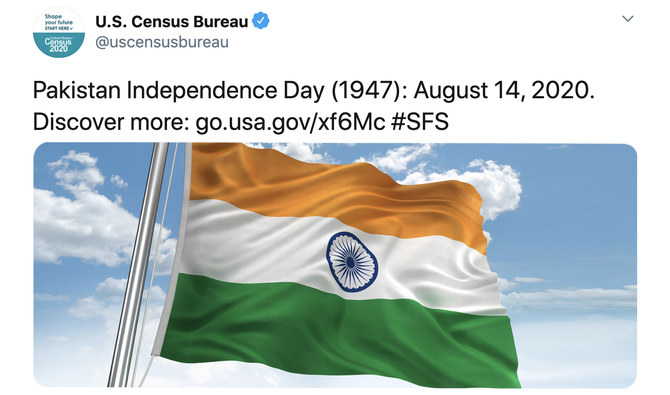

RAWALPINDI: “Discover more,” the US Census Bureau tweeted on Friday, before directing users to a website for more information on Pakistan’s Independence Day.
Except that there was one problem – the image used to accompany the tweet was that of an Indian flag.
The post has since been deleted, but not before it was retweeted and liked by several users of the social media platform, with some calling out the US government body for its “ignorance,” including Michael Kugelman, Deputy Director of the Asia Program at the Wilson Center, who tweeted about the faux pas to his more than 120,000 followers.
“All I can say is that the US Census Bureau does not appear to support the Two Nation Theory,” Kugelman said in his message.
All I can say is that the US Census Bureau does not appear to support the Two Nation Theory. pic.twitter.com/Kniofc0nDh
— Michael Kugelman (@MichaelKugelman) August 15, 2020
His post has since received more than 1,300 likes and hundreds of retweets, with former Senator Sehar Kamran seeking an apology from the US Census Bureau for its “deliberate” tweet.
“Very sad & unfortunate, strongly condemn this ignorance, [sic] deliberate act or negligence,” she tweeted to the US Census Bureau.
“It has definitely hurt the feelings of millions of Pakistanis across the globe. Just deleting the tweet is not enough, we need an apology,” Kamran, who also tagged the US Embassy of Islamabad and the White House in her tweet, added.
Very sad & unfortunate, strongly condemn this ignorance, dilebrate act or negligence by the @uscensusbureau
It has definitely hurt the feelings of millions of Pakistanis across the globe.
Just deleting the tweet is not enough, we need an apology.@usembislamabad @WhiteHouse https://t.co/oHtBE6aCI3— Senator Sehar Kamran T.I. (@SeharKamran) August 15, 2020
Meanwhile, several users from India and Pakistan locked horns in the comments’ section of Kugelman’s tweet as well.
Amin Gani, who tweets under his name, replied that both Pakistanis and Indians were missing the joke in the tweet, before suggesting that the error might have been a mixup by a South Asian employee at the bureau.
“As a Pakistani, I find this goof up hilarious...or perhaps it was Kumar who uploads photos for the US Census bureau who goofed up!,” he said.
Meanwhile, Saima Khan who tweets under the handle “zephyr010,” also traced it to ignorance writing: “Because to group all brown people as one is quite convenient!“
Because to group all brown people as one is quite convenient !
— Saima Khan (@zephyr010) August 15, 2020
Others blamed the “collective” US ignorance for the move.
“That’s bad,” wrote a Twitter user under the handle “Gym-bot,” “Americans ignorance of the rest of the world was never a secret but Trump has sent the US into a nosedive from which I don’t see it recovering any time soon.”
That's bad
Americans ignorance of the rest of the world was never a secret but Trump has sent the US into a nosedive from which I don't see it recovering any time soon— Gym-Bot (@FAhmaduk) August 15, 2020
Another user, “Zerodarknerdy,” wrote, “Some [sic] americans cant point to Canada on the map, so no surprise here.”
Some americans cant point to Canada on the map, so no surprise here.
— Zerodarknerdy (@Zerodarknerdy1) August 15, 2020
The US Census Bureau has yet to acknowledge or apologize for the error.


