Turkish strikes kill three Kurds in Iraq

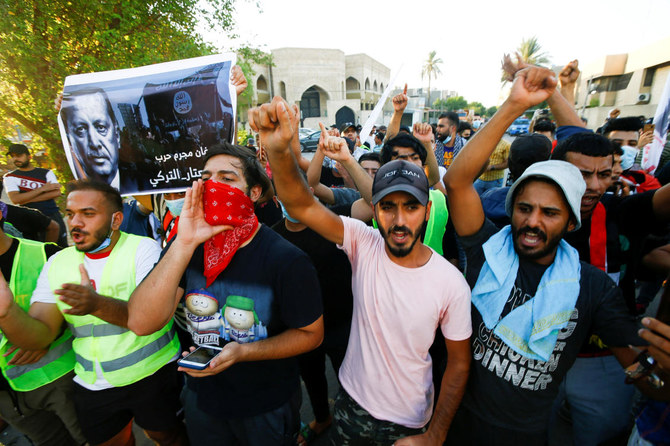
Demonstrators gather in front of the Turkish Embassy protesting against the killing of Iraqi boarder guards by a Turkish airstrike, in Baghdad, Iraq August 13, 2020. (File/Reuters)
Updated 14 August 2020
Follow

Turkish strikes kill three Kurds in Iraq

  • Turkey launched a cross-border operation in mid-June against Kurdistan Workers’ Party (PKK) rebels in northern Iraq
  • The men were killed when they stopped outside a grocery store

ERBIL, Iraq: Turkish bombardment killed three Kurdish fighters in northern Iraq, a local official said Friday, as Baghdad seeks to rally support to end Ankara’s offensive on its soil.
Turkey launched a cross-border ground and air operation in mid-June against Kurdistan Workers’ Party (PKK) rebels in the mountainous terrain of northern Iraq.
“A Turkish bombardment targeted a car in the village of Rashanki, in Dohuk province, killing three PKK fighters, and injuring a fourth who fled,” said Mushir Bashir, the local mayor, of the bombardment late Thursday.
The men, who were traveling in an off-road vehicle, were killed when they stopped outside a grocery store, he added.
The attack comes as Iraq tries to drum up support from its Arab neighbors to form a united front against Ankara’s offensive.
Turkey defends its right to bomb the PKK, which it considers to be a “terrorist” organization, and accuses Baghdad and Iraqi Kurdistan of not stopping the group.
Earlier this week, two senior Iraqi officers and their driver were killed in a Turkish drone strike, prompting Iraq to summon the Turkish ambassador in Baghdad for the third time in two months.
On Friday, Iraqi Foreign Minister Fuad Hussein contacted his Bahraini and Emirati counterparts, after calling the day before the Egyptian, Jordanian, Saudi and Kuwaiti foreign ministers, as well as Arab League chief Ahmed Aboul Gheit.
Hussein pleaded for “a united position, forcing Turkey to withdraw its forces that have infiltrated Iraqi territory.”
Achieving that is a major challenge, analysts say.
Turkey, a major trading partner of Iraq and a regional heavyweight, has had several military posts in Iraqi Kurdistan for the past 25 years.
Now it is expanding its bases, Kurdish sources say.
The PKK has waged an insurgency against the Turkish state since 1984. It has long used the rugged terrain of northern Iraq as a rear base to wage attacks on Turkey, which in turn had set up military positions inside Iraqi territory to fight them.
Since Turkey launched its offensive in mid-June, at least five civilians have been killed.
Ankara says at least seven of its men have been killed, and the PKK and its allies have lost 14 fighters.


Israel plans large camp for Palestinians in southern Gaza, retired general says

Updated 7 sec ago
Follow

Israel plans large camp for Palestinians in southern Gaza, retired general says

  • Avivi said the camp would be used to house Palestinians who wish to leave Gaza and cross into Egypt as well as those who wish to stay

JERUSALEM, Jan 27 : Israel has cleared land in southern Gaza for the construction of a camp for Palestinians potentially equipped with surveillance and facial recognition technology at its entrance, a retired Israeli general who advises the military said on Tuesday.
Retired reservist Brig.-General Amir Avivi told Reuters in ​an interview that the camp would be built in an area of Rafah cleared of tunnels built by Hamas, with entry and exit tracked by Israeli personnel.
Avivi is founder of the influential Israel Defense and Security Forum, a group representing thousands of Israeli military reservists. He does not speak on behalf of Israel’s military, which declined to comment. The Israeli prime minister’s office did not immediately provide comment on any plans to build a camp in Rafah.
Avivi said the camp would be used to house Palestinians who wish to leave Gaza and cross into Egypt as well as those who wish to stay.
His comments come as Israel prepares for a “limited reopening” of Gaza’s Rafah border crossing with Egypt, a key requirement under US President Donald Trump’s plan to end the Gaza war.
Sources told Reuters this month that Israel wants to ensure more Palestinians leave ‌Gaza than are allowed ‌in. Israeli officials have spoken in the past about encouraging Gazans to emigrate, though they deny ‌intending ⁠to ​transfer the ‌population out by force — a highly sensitive issue for Palestinians.
“There are no Gazans, almost at all, in Rafah,” Avivi said. The area fell under complete Israeli military control following an October Israel-Hamas ceasefire, and most Palestinians fled for areas held by Hamas.
“You need to build infrastructure in Rafah that can host them, and then they can choose if they want to go or not,” Avivi said. He said the structure would likely be “a big, organized camp” capable of hosting hundreds of thousands of people that could enforce ID checks including facial recognition.
In July, Israel’s Defense Minister Israel Katz told Israeli media that he had ordered troops to prepare a camp in Rafah to house Gaza’s population. Officials have not spoken publicly about such plans since then.
Ismail Al-Thawabta, head ⁠of the Hamas-run Gaza government media office, told Reuters in a statement that the idea amounted to cover for “forced displacement.”

POTENTIAL RETURN TO WAR
Palestinians in Gaza, shattered by two years of Israeli attacks ‌in the enclave, have long faced restrictions on their movement and monitoring of their ‍online activity and phone calls by Israeli surveillance agencies.
Nearly all of Gaza’s ‍2 million people have been forced into a narrow coastal strip from which Israeli forces withdrew under the ceasefire and where Hamas ‍has retained control.
Trump’s plan for Gaza, now in its second phase, calls for Gaza’s reconstruction to start in Rafah and for Hamas to lay down its arms in exchange for further Israeli troop withdrawals from the territory.
Avivi said Israel’s military was preparing for a new offensive against Hamas if it refuses to give up its weapons. This could include relaunching attacks on Gaza City, the enclave’s largest.
The camp in Gaza could be used to house Palestinians fleeing a renewed Israeli ​assault, Avivi said.
“Plans are set. The army is ready to get the command from the government, from the cabinet to renew its maneuvers in Gaza,” Avivi said.
Israel’s military says it has continued to carry out operations in Gaza since ⁠the ceasefire to thwart what it describes as planned attacks by militants and destroy Hamas’ tunnel network under Gaza.
Israeli attacks since the ceasefire have killed more than 480 Palestinians in Gaza, health authorities there say, while the military says four soldiers have been killed in militant attacks.
Avi Dichter, a minister in Israeli Prime Minister Benjamin Netanyahu’s cabinet and former head of Israel’s domestic intelligence service, said disputes over disarmament could lead Israel back into war in Gaza.
“We have to get prepared for the war in Gaza,” Dichter told Reuters, adding that the disarmament issue “will have to be solved by Israeli troops, the hard way.”

DEMILITARIZATION GOAL
Hamas has publicly refused to lay down its weapons. Two Hamas officials told Reuters this week that neither Washington nor the mediators had presented the group with any detailed or concrete disarmament proposal.
According to a document shared by the White House last week, the Trump administration wants to see heavy weapons decommissioned immediately, with “personal arms registered and decommissioned by sector” as the police under an interim technocratic administration in Gaza “become capable of guaranteeing personal security.”
Trump has repeatedly warned Hamas that it would have “hell to pay” if it does not lay down its weapons.
A US official said on Tuesday that disarmament ‌could come along with some sort of amnesty for Hamas members.
Speaking to Israel’s parliament on Monday night, Netanyahu said the next phase of the ceasefire would not include reconstruction of Gaza.
“The next phase is demilitarization of the Strip and disarming Hamas,” Netanyahu said.