

Kashmiris reject India’s militant rehab plan

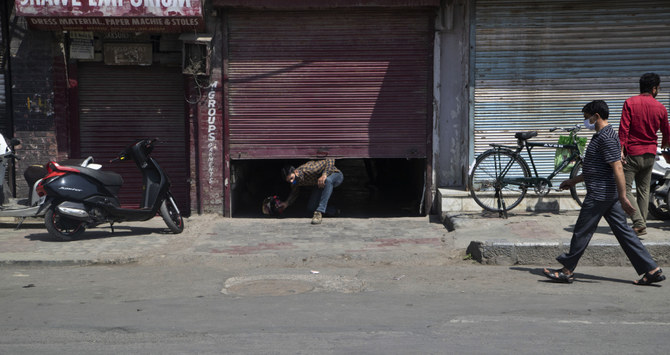
India has tried similar rehabilitation programs in the past. (AP)
Short Url
Updated 14 August 2020
Follow

Kashmiris reject India’s militant rehab plan

  • India’s rehabilitation policy will be “futile” unless it addresses the source of the problem: expert

NEW DELHI: An Indian military plan to end militancy in the region by resettling young Kashmiri fighters has been described as “meaningless” by both analysts and former fighters.
The rehabiliation program will fail unless the roots of unrest in the region — violence, alienation and betrayal — are addressed by New Delhi, they say.
India’s military commander in the Kashmir Valley, Lt. Gen. B.S. Raju, announced the rehabilitation program on Wednesday, saying advanced plans had been submitted to Indian Prime Minister Narendra Modi.
Referring to the Kashmiri fighters as “young boys who need to be taken care of,” Raju said the policy “will help and give confidence to those who are opting to surrender.”
India has tried similar rehabilitation programs in the past, but some who took part have told Arab News they now regret their experience.
“They offered us jobs, some money, rehabilitation and training, but in the last 6 years I have received nothing,” former fighter Sanullah Dar, 44, said.
Dar  returned to Indian-administered Kashmir from Pakistan in 2014 when he was offered a place in rehabilitation scheme by the-then Kashmiri government. His Pakistani wife accompanied him.
“Even after 6 years my wife doesn’t have an Indian passport. My children are also denied passports. I was leading a peaceful life in Lahore, earning a living, doing some work. But here we are without hope.”
Dar left Kashmir in 1990 at the height of militant uprising in the valley, settled down in Lahore and married a Pakistani woman. After 24 years he decided to return to his homeland after the rehabilitation policy was announced.
Javed Ahmed, who returned from Karachi in 2007, also regrets his decision to respond to the Kashmir government’s call.
“There is no empathy or sympathy for us. No promise has been honored. My wife and I somehow survive eking out a living, but there are more that 400 families who are struggling to feed themselves,” Ahmed, who now works as bus driver, told Arab News.

FASTFACT

Former fighters say previous amnesty ‘left us with nothing.’

“My wife is still treated as a foreigner, she cannot have an Indian passport. Legally, a foreign wife should become a legal citizen of the husband’s country within four or five years, but my wife and several women are living like stateless persons.”
Ahmed’s wife, Saira, said she is unable to return to Pakistan because she has no documents.
“My father is sick, but I cannot visit him because I don’t have a passport.”
Ahmed is worried about the future of his four children.
“My younger children get angry when they see our humiliation, and it is because of this humiliation that many in Kashmir pick up guns,”
he said.
“I am worried that they might become rebels when they grow up. Can you stop them?“
A Kashmir expert, retired Air Vice Marshal Kapil Kak, told Arab News that India’s rehabilitation policy will be “futile” unless it addresses the source of the problem, which is “alienation, anger, hatred and a sense of betrayal.”
The issue was exacerbated by the decision to revoke Kashmir’s autonomy, he said.
On Aug. 5 last year, New Delhi annulled Article 370 of India’s constitution, which had guaranteed Kashmir’s autonomy. Amid a military lockdown thousands of local political leaders and activists were detained, some of whom remain under arrest.
“These militants are not criminals. They are coming out to express dissent and protest at the way they have been treated by India for the past 30 years,” Kak said.
In the past seven months at least 135 fighters have been killed in the region. The Indian military says that about 200 militants are still active in the Kashmir Valley.
“There is a monetary reward for killing militants, which is an incentive for extrajudicial killings, and also leads to fake encounters in which civilians are killed and branded as militants,” said Khurram Parvez, a Kashmiri human
rights activist.
“If the government really wants to show change of approach, it must stop financial rewards for killing militants. The rehabilitation policies have been a disaster.” 
Zaffar Choudhary, a Srinagar-based political analyst and editor of online news magazine The Dispatch, told Arab News: “Militancy is never a mechanical process where the isolation of a few elements can change the course of a project.
“Militancy is in the mind,” he said. “A few become more visible as militants when they pick guns. So you have to deal not just with the militants but also wider society. It is the society that needs rehabilitation through political outreach.”
Despite repeated attempts by Arab News, Lt. Gen. B.S. Raju, who announced the rehabilitation policy, was unavailable for comment.


Rubio plans to visit Israel next week as US-Iran tensions remain high after latest talks

Updated 5 sec ago
Follow

Rubio plans to visit Israel next week as US-Iran tensions remain high after latest talks

TEL AVIV, Israel: US Secretary of State Marco Rubio will make a quick trip to Israel early next week, the State Department said, as tensions between the United States and Iran remain high after their latest nuclear talks and American forces gather in the region.
The US Embassy in Israel had earlier urged staff who want to leave to depart, joining other nations in encouraging people to leave the region and signaling that US military action might be imminent. The announcement of Rubio’s visit could indicate a longer timeline for any potential strike.
A confidential report from the UN nuclear watchdog meanwhile confirmed that Iran has not offered inspectors access to sensitive nuclear sites since they were heavily bombed during the 12-day war launched by Israel last June. As a result, it said it could not confirm Iran’s claims that it stopped uranium enrichment after the US and Israeli strikes.
The report was circulated to member countries and seen by The Associated Press.
US President Donald Trump has threatened military action if Iran does not agree to a far-reaching deal on its nuclear program. Iran insists it has the right to enrich uranium for peaceful purposes and denies seeking a nuclear weapon.
Those wishing to leave ‘should do so TODAY’
The State Department said in a statement that Rubio would visit Israel on Monday and Tuesday to “discuss a range of regional priorities including Iran, Lebanon, and ongoing efforts to implement President Trump’s 20-Point Peace Plan for Gaza.” It offered no other details.
Israeli Prime Minister Benjamin Netanyahu has long urged tougher US action against Iran, and has warned that Israel will respond to any Iranian attack.
The announcement of Rubio’s visit came just hours after the US Embassy in Jerusalem implemented “authorized departure” status for non-essential personnel and family members, which means that eligible staffers can leave the country voluntarily at government expense.
In an email, US Ambassador Mike Huckabee urged staff considering departure to do so quickly, advising them to focus initially on getting any flight out of Israel and to then make their way to Washington.
“Those wishing to take AD should do so TODAY,” Huckabee wrote, using an acronym for “authorized departure.”
“While there may be outbound flights over the coming days, there may not be,” he added, in an email that was recounted to The Associated Press by someone involved with the US mission who wasn’t authorized to share details.
On a town hall meeting Friday after the email was sent, Huckabee told staff that he was encouraging airlines to keep flying.
Vance to meet with mediator
Iran and the United States on Thursday walked away from another round of nuclear negotiations in Geneva without a deal. Technical discussions are scheduled to take place in Vienna next week.
US Vice President JD Vance was to meet later on Friday in Washington with Oman’s foreign minister, Badr Al-Busaidi, who has been mediating the talks, according to a person with knowledge of the meeting who spoke on condition of anonymity because the meeting is private.
Earlier, Al-Busaidi said that there had been significant progress made on Thursday, though officials from Iran and the United States haven’t announced steps forward.
Iranian Foreign Minister Abbas Araghchi on Thursday said “what needs to happen has been clearly spelled out from our side,” without offering specifics. Iran has long demanded relief from heavy international sanctions in return for taking steps to limit but not end its nuclear program.
The UN chief meanwhile urged Iran and the US “to focus on the diplomatic track” even as tensions rise and a potential for a US strike remains very possible.
“We’re seeing both positive messages coming out of the diplomatic tracts, which we’re continuing to encourage,” UN Secretary-General António Guterres said, according to his spokesperson Stephane Dujarric. “We’re also seeing very worrying military movements. throughout the region, which is extremely concerning as well.”
Flights suspended as people are urged to leave

The US has gathered a massive fleet of aircraft and warships in the Middle East, with one aircraft carrier already in place and another heading to the region. Iran says it will respond to any US attack by targeting American forces in the region, potentially including those stationed in US bases in allied Arab countries.
Airlines such as Netherlands-based KLM have already announced plans to suspend flights out of Tel Aviv’s Ben Gurion International Airport, and other embassies have also made plans for authorized departures from Israel and neighboring countries.
Britain’s Foreign Office said that “due to the security situation, UK staff have been temporarily withdrawn from Iran.” It said the embassy was operating remotely.
In Israel, the UK said Friday it moved some diplomatic staff and their families from Tel Aviv to another, unspecified location in Israel “as a precautionary measure.” In an update to its travel advice, the Foreign Office added that the country’s embassy in Tel Aviv is operating as normal but that the situation “could escalate quickly and poses significant risks.”
British Prime Minister Keir Starmer said Thursday the UK was focused on “supporting the political process” between Washington and Tehran.
Australia on Wednesday “directed the departure of all dependents of Australian officials posted to Israel in response to the deteriorating security situation in the Middle East.” China, India and several European countries with missions in Iran have advised citizens to avoid travel to the country.
China’s Foreign Ministry also advised its citizens already in Iran to leave, according to a statement reported by Chinese state media.