

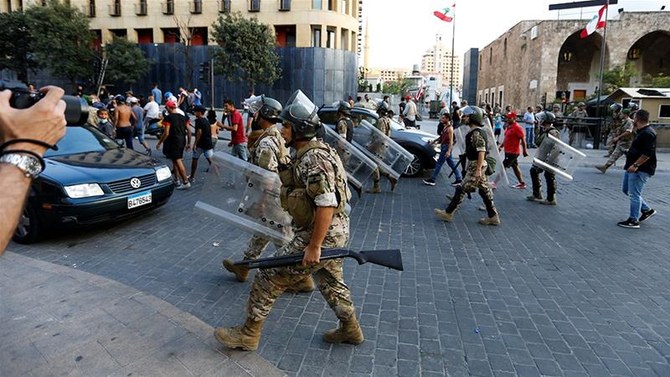
Beirut emergency law sparks fears of army crackdown
In its first meeting since the blast, Lebanon’s parliament on Thursday backed legislation allowing the army to ban gatherings deemed threats to national security
Human rights groups warned that the emergency law will give the Lebanese military extensive powers to quell protests and leave activists at the mercy of military courts
Updated 13 August 2020
NAJIA HOUSSARI
BEIRUT: Lebanon’s parliament has approved a two-week state of emergency in Beirut that gives sweeping powers to the army, prompting warnings of a crackdown on protests in the city.
The green light for the tough new measures comes 10 days after a deadly explosion in the capital killed more than 170 people, wounded 6,500 others and forced the Cabinet to step down.
In its first meeting since the blast, Lebanon’s parliament on Thursday backed legislation allowing the army to ban gatherings deemed threats to national security and expanding the jurisdiction of military courts over civilians.
Human rights groups warned that the emergency law will give the Lebanese military extensive powers to quell protests and leave activists at the mercy of military courts.
The Lebanese parliament met in Beirut’s Unesco Palace complex after its headquarters were heavily damaged in the explosion.
Opinion
This section contains relevant reference points, placed in (Opinion field)
A decree imposing a state of emergency was issued by Prime Minister Hassan Diab’s government the day after the explosion.
The government resigned five days later amid angry protests demanding “revenge” for the blast, which has been widely blamed on negligence by the authorities.
Sources told Arab News that the Lebanese judiciary is waiting on a report by French experts who joined rescue efforts and investigated the site of the explosion to determine its causes.
The Lebanese judiciary concluded that “according to investigations with officials under arrest and witnesses, the incident was due to negligence that allowed the storing of 2,750 tons of ammonium nitrate in a warehouse in the port for seven years without taking precautionary measures.”
A source said that “the investigator in charge of the case has listened to the testimony of security officials.”
Investigators will also interview former public works ministers Ghazi Aridi, Ghazi Zaiter and Youssef Fenianos along with former justice and finance ministers, including Salim Jreissati and Maj. Gen. Ashraf Rifi.
Meanwhile, complications surround the appointment of a judicial investigator.
Arab News has been told that the Higher Judicial Council considered appointing judge Tareq Al-Bitar, who was proposed by the caretaker justice minister. However, Al-Bitar declined the role.
Sources said that “Al-Bitar later was pressured by two Free Patriotic Movement ministers to retrieve his resignation, which led to the Higher Judicial Council expressing reservations over his nomination.”
Eight MPs — Nadim Gemayel, Paula Yacoubian, Sami Gemayel, Elias Hankach, Michel Moawad, Neemat Frem, Henry Helou, and Marwan Hmadeh — have resigned following the explosion. The parliament session was boycotted by members of the Lebanese Forces bloc.
Protesters gathered near the Unesco Palace during the parliamentary session, chanting slogans and waving Lebanese flags.
Parliamentary Speaker Nabih Berri accused MPs who resigned of neglecting their duties while “the country is dying right in front of us.”
He called for the prompt formation of a new government “with a primary goal of fighting corruption and restoring Lebanese unity.”
The parliamentary session lasted for only 40 minutes but brought divisions between those calling for a parliamentary investigative committee and others demanding an international inquiry.
MP Usama Saad warned that the state of emergency will hinder public freedom.
“At this time we want the army and security forces to be a support to the people rather than being coercive agencies,” he said.
The White Shirts medical group, which treats people injured during protests, claimed that security forces had used lethal “shredded” bullets — an explosive projectile that causes massive internal injuries — against protesters in recent days.
The volunteer group held a press conference to show X-rays detailing shocking injuries among protesters taken to hospital.
Former health minister Mohammed Jawad Khalifeh was among the first to warn on Twitter against use of the bullets.
Hundreds of volunteers gathered in Martyrs’ Square to help remove rubble and broken glass from houses, office blocks and shops throughout the devastated city.
More than 180 aircraft had carried emergency aid to Lebanon by Thursday. The relief operation is being coordinated by the Lebanese army, which is storing and distributing material including food, tents and medical supplies.
After arriving in Beirut on Thursday, David Hale, US state undersecretary for political affairs, said in a statement: “Economic and fiscal reforms are needed, and an end to dysfunctional governments and empty promises.
“All Lebanese want to see a Lebanon guided by the Lebanese people that fulfills their ambitions and needs, not those of others.
“The US is ready to support a Lebanese government that reflects and responds to the will of the people, and genuinely commits and acts for real change."
Hale said that the FBI will join Lebanese and international investigators at the invitation of the Lebanese "in order to help answer questions that I know everyone has about the circumstances that led up to this explosion and to work with Lebanon in this regard.”
Florence Parly, France’s armed forces minister, also arrived in the capital, while Mohammad Jawad Zarif, Iran’s foreign minister, is due to arrive on Friday.
LONDON: As the conflict between Israel and Iran intensifies, attention is turning once again to the Strait of Hormuz — the narrow, 33-km-wide stretch of water separating Oman and Iran, through which a fifth of the world’s daily oil supply flows.
During the 12-day war in June last year, when Israel and the US attacked Iranian military and nuclear facilities, the mere suggestion that Iran might try to close the waterway sent oil prices soaring.
And, on Sunday morning, fears that shipping through the globally vital but vulnerable bottleneck was once again in peril were realized when the Oman Maritime Security Centre reported that the Skylight, a Palau-flagged tanker, had been hit some 5 nautical miles north of Musandam’s Khasab port.
It was not immediately clear what had struck the vessel, injuring four crew members. Oman said the 20 crew members, including 15 Indians and five Iranians, had been evacuated safely.
In December, the Skylight was one of several ships sanctioned by the US Treasury, accused of being part of “Iran’s sanctions-evading shadow fleet … which exports Iranian petroleum and petroleum products through deceptive shipping practices.”
Following the launch of joint US-Israel attacks on Iran on Saturday, Iranian drone and missile attacks have struck commercial ports including Jebel Ali in Dubai and the Port of Duqm in Oman, and the US Navy base in Bahrain.
On Saturday, Lloyd’s List, which provides a wide range of services to the global shipping industry, from insurance and live ship tracking to risk evaluation and threat assessments, reported that Iranian forces have been hailing individual ships to warn that they pass through the Strait of Hormuz at their own risk.
Lloyd’s, which has reviewed the messages, says they are regarded as “credible threats” by tanker and security officials, and that “major trading houses are halting shipments through the Strait of Hormuz.”
This picture provided by the Iranian Army office on December 31, 2022, shows Iranian troops during a military drill in Makran beach on the Gulf of Oman, near the Hormuz Strait. (Handout via AFP)
On Sunday at 10:42 GMT, the UK Maritime Trade Operations Center issued an advisory notice to mariners in the region, warning of “the potential for elevated electronic interference, including disruption to AIS and other navigational or communication systems.”
It added that while “no official closure of the Strait of Hormuz has been formally communicated to the maritime industry through recognized maritime safety channels … claims regarding the closure … continue to circulate via open source and VHF communications.”
It advised mariners in the Arabian Gulf, Gulf of Oman, North Arabian Sea and the Strait of Hormuz to maintain a continuous listening watch on the universal maritime radio communications Channel 16, to “strictly adhere to recognised transit corridors,” expect potential “hailing from military units and be prepared to respond professionally” and to “immediately report unusual activity, suspicious approaches, electronic interference or incidents to UKMTO.”
Ships, various industry sources reported, were expected to “stay put for several days.” Satellite imagery shows vessels have halted at various ports, including Fujairah in the UAE, which is on the Gulf of Oman, and were not sailing through Hormuz.
But the situation remains murky. On Saturday, Lloyd’s List’s automatic identification system, SeaOrbis, showed that while many vessels, including tankers and containerships, were making U-turns in the Gulf and the Gulf of Oman, others were continuing to pass through the Strait of Hormuz.
Lloyd’s also cautioned that “it was not immediately clear if any tankers were transiting the Strait of Hormuz with their AIS switched off.”
A family sits against the backdrop of a dockyard off coast city of Fujairah, in the Strait of Hormuz in northern UAE on February 25, 2026. (AFP)
On Saturday, about 750 vessels of various types appeared to be stalled in the Gulf.
Skytek, a provider of intelligence services to marine insurance firms, said in a post on X that “over 100 containerships, 450 oil & gas tankers, and 200 bulk carriers are currently inside the Strait of Hormuz — exposed to potential blockage or entrapment.”
Skytek’s live monitoring showed “one-way flow OUT of the Gulf. No vessels are entering the Strait.”
Despite the buildup of US Navy power in the region in the run-up to Saturday’s attacks on Iran, tanker and bulk-carrier traffic had “surged last month, amplifying risk if the Strait is disrupted.”
In this photo taken on November 26, 2023, the US Navy's aircraft carrier USS Dwight D. Eisenhower is seen transiting the Strait of Hormuz. The Eisenhower is the centerpiece of one of two carrier strike groups currently deployed in the Middle East. (US Department of Defense / via AFP)
Speaking to Lloyd’s, shipping data company Linerlytica said approximately 170 container ships, with a capacity equal to 1.4 percent of global capacity, were “inside the strait and facing restrictions on exiting.”
The disruption is not limited to passage in and out of the Gulf, nor to oil and gas tankers. Fears are rising that global trade in goods, as well as oil and gas, could be seriously affected as shipping companies weigh the risk posed by transiting the Red Sea and Suez Canal.
Lloyd’s reported that on Saturday that “a tanker was observed making a U-turn near the Bab el-Mandeb” — the bottleneck entrance to the Red Sea between Yemen and Djibouti — “amid fears of Houthi attacks on commercial shipping.”
From October 2023 until last November, in response to Israel’s assault on Gaza, the Iran-backed Houthis had attacked more than 170 ships, sinking four and killing a dozen crew members.
Now, according to maritime industry site gCaptain, the terrorist group has indicated that it intends to resume missile and drone attacks on commercial shipping in the Red Sea.
Citing “two senior Houthi officials, speaking anonymously,” gCaptain said they indicated that “renewed attacks could begin imminently,” potentially signaling “the end of roughly three and a half months of relative calm in one of the world’s most critical trade corridors.”
On Saturday, French company CMA-CGM, the world’s third-largest shipping container line, ordered all vessels bound to or from the Gulf to “take shelter” and suspended all transits through the Red Sea and Suez Canal until further notice.
Hapag-Lloyd has also suspended all transits through the Strait of Hormuz, “until further notice.”
In a message to customers, the company said: “The safety and security of our crews, vessels, and your cargo remain our highest priority.
“This measure is therefore not discretionary but a necessary response to the current conditions and regulatory restrictions.”
As a result, it added, “services calling ports in the Arabian Gulf may experience delays, rerouting, or schedule adjustments. We are working to minimize disruption and will communicate any material changes to affected shipments as soon as possible.”
According to the US Energy Information Administration, 20 million barrels of oil — 20 percent of global consumption — pass through the Strait of Hormuz every day, along with one-fifth of the world’s liquefied natural gas trade, primarily from Qatar.
The oil lane is so vital because no real alternatives exist. Most Gulf oil cannot be rerouted without massive delays. It is the only deep-water route capable of handling the world’s largest crude tankers.
The EIA has estimated that 84 percent of Gulf crude flows to Asia, with China, India, Japan and South Korea as top buyers.
When geopolitical tensions spiked over in June last year after Iranian retaliatory strikes on Israel, Brent crude surged from $69 to $74 per barrel in a single day — even though no ships were blocked.
The knock-on effects of a blockade now could be extremely widespread.
Experts say high oil prices would confront central banks worldwide with a dilemma over whether to lower or raise interest rates. Insurance prices would rise, contributing to inflation, and it would also cause disruptions in supply chains across several countries.
In 2024, Saudi Arabia, the world’s largest oil exporter, moved 5.5 million barrels per day through Hormuz. That is 38 percent of total crude flows in the strait, according to tanker tracking data produced by the London-based real-time insights firm, Vortexa.
While the Kingdom has contingency pipelines, they are not a perfect solution. The East-West Pipeline, with a capacity of 7 million barrels per day, can divert crude to the Red Sea, but it is already running near full capacity due to recent Houthi attacks on shipping.
The UAE’s Fujairah Pipeline, with 1.8 million barrels per day capacity, is also heavily used, leaving little to spare.
Iran’s Goreh-Jask Pipeline, designed for 300,000 barrels per day, is barely operational, having handled just 70,000 barrels per day before shutting down in late 2024.
If the Strait of Hormuz were blocked, the EIA has said that Saudi Arabia and the UAE could only reroute about 2.6 million barrels per day — far less than the 20 million that normally passes through.
Given that the economies of most Gulf countries, particularly Saudi Arabia, rely heavily on oil exports, a closure of the strait would deal a severe blow to their economic stability, according to experts. The extent of the financial damage would hinge on how long the strait remains blocked, with prolonged disruptions likely triggering budget deficits across the region.
For energy-hungry Asian economies, a blockade would be catastrophic.
China relies on the Strait of Hormuz for nearly half its crude imports. India, Japan, and South Korea would face severe shortages, forcing emergency releases from strategic reserves. Global shipping costs would explode as tankers would need to take longer routes around Africa.
The first Asian economy to be affected by any closure of the Strait of Hormuz would be China. If the repercussions of the strait’s closure spill over into multiple economies, it could lead to a global recession — posing another challenge in terms of how to revive the global economy.
The US is less vulnerable, importing only half a million barrels per day from the Gulf, equivalent to 7 percent of total US imports. But it would still suffer from skyrocketing global prices.
The crisis, of course, is not merely about oil: It is about the fragile balance that keeps markets stable and societies moving.
Iran has historically threatened to close the Strait of Hormuz but has never done so. In an op-ed for Arab News in June 2024, Abdulaziz Sager, founder and chair of the Gulf Research Center, said a full closure “would harm Iran’s own economy given that it relies on the waterway for its oil exports.”
But with Iran seemingly now backed into a corner, there is every chance it could take this final leap. The country is already economically crippled by sanctions and, following the killing of Supreme Leader Ali Khamenei, the regime is facing an existential reality.
Past incidents have shown the global impact of regional events. In 2019, attacks on Saudi tankers near Fujairah and the Abqaiq drone strikes briefly cut 5 percent of the global oil supply. World powers, therefore, have a major interest in keeping the strait open.