

Netanyahu’s uneasy alliance seems headed toward collapse

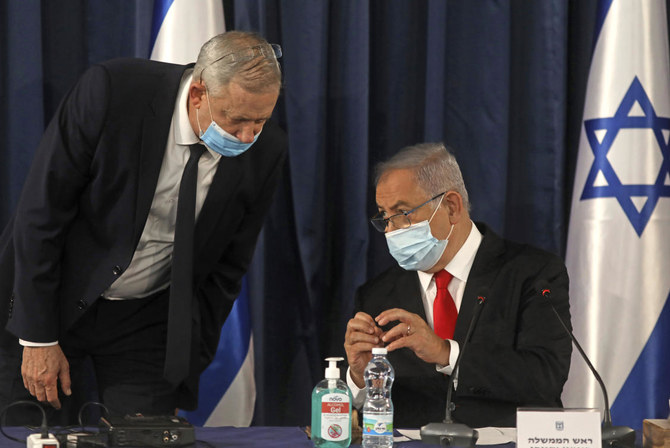
Israeli Prime Minister Benjamin Netanyahu, right, and Defense Minister Benny Gantz during the weekly cabinet meeting in Jerusalem, June 7, 2020. (AP Photo)
Short Url
Updated 11 August 2020
Follow

Netanyahu’s uneasy alliance seems headed toward collapse

  • Fractious coalition government could be headed toward collapse as Israel grapples with a raging coronavirus outbreak, an economic calamity and a wave of public protests
  • With little common ground and a severe lack of trust, the uneasy alliance now has just two weeks to reach a budget deal or plunge the nation into its fourth election since last year

JERUSALEM: When Prime Minister Benjamin Netanyahu and his rival, Benny Gantz, agreed to form an “emergency” government in May after three bitter and deadlocked election campaigns, the goal was to stabilize Israeli politics in the face of a global pandemic.
But less than 100 days later, their fractious coalition government could be headed toward collapse as Israel grapples with a raging coronavirus outbreak, an economic calamity and a wave of public protests. With little common ground and a severe lack of trust, the uneasy alliance now has just two weeks to reach a budget deal or plunge the nation into its fourth election since last year.
The differences run so deep that this week’s Cabinet meeting was canceled. Parliament is expected on Wednesday to approve an extension beyond the Aug. 25 deadline to allow the sides more time to reach a compromise. But even if there is a deal, few expect the partnership to last much longer because of the bad blood and many clashes.
“What is clear is that even if elections have been deferred, this is just a matter of time. In another two months a new excuse will be found, and we will once again find ourselves in the same deep crisis,” argued columnist Sima Kadmon in the Yediot Ahronot daily. “Netanyahu has been given time to conceive of his next tricks and shticks.”
Critics say that Netanyahu is focused on his ongoing corruption trial and resistant to ceding the premiership to Gantz next year, as called for by their coalition agreement. Netanyahu has reportedly tried to lure in defectors from Gantz’s party to secure a thin parliamentary majority and avert another election.
Netanyahu has seen his support drop dramatically in the face of the wave of demonstrations sweeping the country against his perceived failure to respond to the virus and its resulting economic crisis. He’s repeatedly said he opposes another election, saying that with unemployment over 20% now is the time to focus on getting the Israeli economy back on track.
But opponents believe he is angling for a crisis that would trigger a new election. Despite the dip in support, polls suggest Netanyahu’s Likud maintains a sizable lead over all other parties.
The election of a more favorable government could enable Netanyahu to pre-empt what is expected to be a a new legal challenge against his fitness to serve. Opponents are expected to file the challenge when the evidentiary stage of the trial begins in January. During that phase, he will be required to sit in court three times a week.

Opinion

This section contains relevant reference points, placed in (Opinion field)

In another twist, opposition leader Yair Lapid, who this week accused both Netanyahu and Gantz of playing “pathetic petty politics at the expense of the public,” intends to introduce a bill that will bar anyone indicted of a crime from seeking the premiership. Without Gantz’s support, it is unlikely to pass.
The showdown ostensibly revolves around the state’s budget. The government is required by law to pass one by Aug. 25 or else elections are automatically called.
The coalition agreement calls for a two-year budget. But Netanyahu, citing the economic crisis, is pushing for a 2020 budget alone. Gantz says that a short-term budget halfway through the year would be meaningless and violate their deal.
Netanyahu appears to be driven in part by political considerations.
Under their power-sharing deal, a failure to reach a budget deal is the only situation that allows Netanyahu to dissolve the partnership without yielding power to Gantz.
If a long-term budget deal is reached, it would all but guarantee that Gantz will take over as prime minister in September 2021, as specified in the deal.
Netanyahu desperately wants to stay in office throughout his trial, which is expected to drag on for several years.
At a tour of an air force base Tuesday, he tried to explain his motivations as that of responsible leadership.
“I don’t deal in ultimatums. I think we need to pass a budget immediately, for the needs of our security and for the needs of the state,” Netanyahu said.
Defense Minister Gantz, whose Blue and White faction has also seen its support drop, says he doesn’t want to go to elections and accuses Netanyahu of having “personal reasons” for leading to it.
“Whoever loves the state of Israel doesn’t take it to elections at this time,” Gantz said Monday.
He and Netanyahu have repeatedly clashed throughout their brief alliance over various pieces of legislation and policy proposals. Ever since Gantz’s faction broke ranks with coalition discipline two weeks ago to pass a pro-gay rights bill, Netanyahu’s allies have been threatening disbandment.
They’ve also differed in their approach to the widescale protests drawing thousands to the streets several times a week. While Gantz has sympathized with the demonstrators, Netanyahu has denounced them as radicals and anarchists who were waging an incitement campaign against him and his family.
Netanyahu has come under withering criticism for remaining in office while on trial for corruption, pushing for seemingly anti-democratic measures under the guise of combating the virus and generally mismanaging the crisis. The size of his bloated government, a minister’s comment dismissing the public’s pain, and his own efforts to secure himself a sizable tax break have created a sense that the 70-year-old Netanyahu is detached from the troubles of his angry electorate. His family’s perceived hedonism and zest for power have further alienated those who are struggling.
Netanyahu is on trial for a series of cases in which he allegedly received lavish gifts from billionaire associates and traded regulatory favors with media moguls for more favorable coverage of himself and his family. The prime minister has denied any wrongdoing and accuses the media and law enforcement of a witch hunt to oust him from office.


Uganda’s presidential election experiences hours of delays at some polling stations

Updated 7 sec ago
Follow

Uganda’s presidential election experiences hours of delays at some polling stations

  • Some polling stations remained closed for up to four hours after the scheduled 7 a.m. start time due to “technical challenges“
  • The East African country of roughly 45 million people has 21.6 million registered voters

KAMPALA, Uganda: Uganda’s presidential election was plagued by widespread delays Thursday in addition to a days-long Internet shutdown that has been criticized as an anti-democratic tactic in a country where the president has held office since 1986.
Some polling stations remained closed for up to four hours after the scheduled 7 a.m. start time due to “technical challenges,” according to the nation’s electoral commission, which asked polling officers to use paper registration records to ensure the difficulties did not “disenfranchise any voter.”
President Yoweri Museveni, 81, faces seven other candidates, including Robert Kyagulanyi, a musician-turned-politician best known as Bobi Wine, who is calling for political change.
The East African country of roughly 45 million people has 21.6 million registered voters. Polls are expected to close at 4 p.m. Thursday, according to the electoral commission. Results are constitutionally required to be announced in 48 hours.
Impatient crowds gathered outside polling stations expressing concerns over the delays Thursday morning. Umaru Mutyaba, a polling agent for a parliamentary candidate, said it was “frustrating” to be waiting outside a station in the capital Kampala.
“We can’t be standing here waiting to vote as if we have nothing else to do,” he said.
Wine alleged there was electoral fraud occurring, noting that biometric voter identification machines were not working at polling places and claiming there was “ballot stuffing.”
“Our leaders, including Deputy President for Western Region, arrested. Many of our polling agents and supervisors abducted, and others chased off polling stations,” Wine wrote in a post on social media platform X.
Museveni told journalists he was notfied biometric machines were inoperable at some stations and he supported the electoral body’s decision to revert to paper registration records. He did not comment on the allegation of fraud.
Ssemujju Nganda, a prominent opposition figure and lawmaker seeking reelection in Kira municipality, told The Associated Press he had been waiting in line to vote for three hours.
Nganda also noted biometric machines were malfunctioning, in addition to the late arrival of balloting materials, and predicted the delays likely would lead to apathy and low turnout in urban areas where the opposition has substantial support.
“It’s going to be chaos,” he said Thursday morning.
Nicholas Sengoba, an independent analyst and newspaper columnist, said delays to the start of voting in urban, opposition areas favored the ruling party.
Museveni serving Africa’s third-longest presidential term
Uganda has not witnessed a peaceful transfer of presidential power since independence from British colonial rule six decades ago.
Museveni has served the third-longest term of any African leader and is seeking to extend his rule into a fifth decade. Some critics say removing him through elections remains difficult, but the aging president’s authority has become increasingly dependent on the military led by his son, Muhoozi Kainerugaba.
Museveni and Wine are reprising their rivalry from the previous election in 2021, when Wine appealed to mostly young people in urban areas. With voter turnout of 59 percent, Wine secured 35 percent of the ballots against Museveni’s 58 percent, the president’s smallest vote share since his first electoral campaign three decades ago.
The lead-up to Thursday’s election produced concerns about transparency, the possibility of hereditary rule, military interference and opposition strategies to prevent vote tampering at polling stations.
Uganda’s Internet was shut down Tuesday by the government communications agency, which cited misinformation, electoral fraud and incitement of violence. The shutdown has affected the public and disrupted critical sectors such as banking.
Heavy security deployed
There has been heavy security leading up to voting, including military units deployed on the streets this week.
Amnesty International said security forces are engaging in a “brutal campaign of repression,” citing a Nov. 28 opposition rally in eastern Uganda where the military blocked exits and opened fire on supporters, killing one person.
Museveni urged voters to come out in large numbers during his final rally Tuesday.
“You go and vote, anybody who tries to interfere with your freedom will be crushed. I am telling you this. We are ready to put an end to this indiscipline,” he said.
The national electoral commission chairperson, Simon Byabakama, urged tolerance among Ugandans as they vote.
“Let us keep the peace that we have,” Byabakama said late Wednesday. “Let us be civil. Let us be courteous. Let’s be tolerant. Even if you know that this person does not support (your) candidate, please give him or her room or opportunity to go and exercise his or her constitutional right.”
Authorities also suspended the activities of several civic groups during the campaign season. That Group, a prominent media watchdog, closed its office Wednesday after the interior ministry alleged in a letter that the group was involved in activities “prejudicial to the security and laws of Uganda.”
Veteran opposition figure Kizza Besigye, a four-time presidential candidate, remains in prison after he was charged with treason in February 2025.