

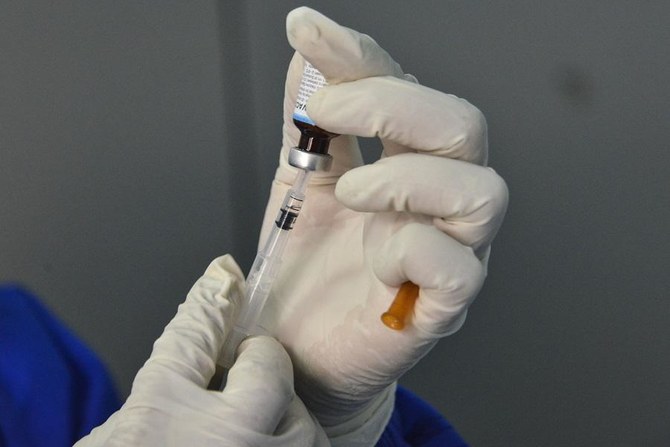
Indonesia begins human trials of anti-virus vaccine

Indonesia, the world’s fourth most populous country, has been struggling to contain its mounting virus cases. (AFP)
Short Url
Updated 12 August 2020
Follow

Indonesia begins human trials of anti-virus vaccine

  • The third phase of the clinical trials of the vaccine — which is manufactured by China’s Sinovac Biotech in collaboration with its Indonesian pharma counterpart, Bio Farma — began on Tuesday
  • The third phase is a must before the vaccine, known as CoronaVac, goes into the production stage and is a prerequisite for all pharmaceutical products, including medicines and vaccines

JAKARTA: Indonesia is stepping up efforts to find a COVID-19 vaccine by launching human trials of a potentially effective drug amid criticism of its lacklustre handling of the pandemic and concerns about its plummeting economy.

The third phase of the clinical trials of the vaccine — which is manufactured by China’s Sinovac Biotech in collaboration with its Indonesian pharma counterpart, Bio Farma — began on Tuesday and is being conducted by the Padjadjaran University School of Medicine at six locations in Bandung, West Java province, where the university and the state-owned pharma company are based.

“The first day of the trial went well, with 20 volunteers in each of the six locations injected with the potential vaccine. We have no complaints so far, and we are preparing the second injection batch on Aug 14,” Iwan Setiawan, a spokesman for Bio Farma, told Arab News on Wednesday.

He added that the six-month trial would require the participation of 1,620 volunteers who were “in good health and had not tested positive” for the disease.

Ridwan Kamil, governor of West Java, Indonesia’s most populated province, is among the volunteers who have signed up for the trial.

The third phase is a must before the vaccine, known as CoronaVac, goes into the production stage and is a prerequisite for all pharmaceutical products, including medicines and vaccines.

“The potential vaccine had gone through three trials; the pre-clinical, the clinical trial first phase and the second phase in China,” Bio Farma CEO Honesti Basyir said in a statement.

According to Basyir, Sinovac is one of the few institutions that have progressed to the third phase of the clinical trial from among hundreds of research institutions around the world that are developing the COVID-19 vaccine.

According to Oxford Business Group’s COVID-10 Economic Impact Assessment, there are more than 150 different vaccines that international researchers are working on. However, only 26 have reached the human trial stage so far.

Once the trials are concluded, Bio Farma will register the vaccine with the Food and Drug Supervisory Agency so that it can begin mass-production of the drug.

“We have prepared a production facility for the COVID-19 vaccine with a maximum capacity of 100 million dosages, and by the end of December this year we will have an increased production capacity to produce an additional 150 million dosages,” Basyir said.

President Joko Widodo oversaw the first injections to the batch of volunteers in one of the six locations and also toured Bio Farma’s production facility. 

“We hope this clinical trial would conclude in six months and so we can start producing the vaccine in January and vaccinate our people soon,” Widodo said.

State-Owned Enterprise Minister Erick Thohir, who is also the head of the COVID-19 mitigation and national economic recovery committee, said that Bio Farma was a well-established vaccine producer whose products were halal-compliant and used in 150 countries, including in the Middle East.

The collaboration with Sinovac is one of three vaccine-development projects that Indonesia is engaging in with foreign parties as it grapples with a surge in infections. At the same time, social restrictions and economic activities were eased. The other two projects are with South Korea’s Genexine and Norway’s Coalition for Epidemic, Preparedness and Innovation.

As of Wednesday, Indonesia had reported 130,718 infections with 1,942 new cases, 85,798 recoveries and 5,903 deaths, although experts suggest that the numbers could be higher due to the country’s low testing capacity.

Cases also surged in the capital Jakarta with workplaces emerging as the new infection clusters after thousands of employees returned to work recently.


Ukraine to give revised peace plans to US as Kyiv readies for more talks with its coalition partners

Updated 8 sec ago
Follow

Ukraine to give revised peace plans to US as Kyiv readies for more talks with its coalition partners

  • Ukraine’s European allies are backing Zelensky’s effort to ensure that any settlement is fair and deters future Russian attacks.
  • The French government said Ukraine’s allies — dubbed the “Coalition of the Willing” — will discuss the negotiations Thursday by video

KYIV: Ukraine is expected to hand its latest peace proposals to US negotiators Wednesday, President Volodymyr Zelensky said, a day ahead of his urgent talks with leaders and officials from about 30 other countries supporting Kyiv’s effort to end the war with Russia on acceptable terms.
As tension builds around US President Donald Trump’s push for a settlement and calls for an election in Ukraine, Zelensky said his country would be ready for such a vote within three months if partners can guarantee safe balloting during wartime and if its electoral law can be altered.
Washington’s goal of a swift compromise to stop the fighting that followed Russia’s all-out invasion in February 2022 is reducing Kyiv’s room for maneuvering. Zelensky is walking a tightrope between defending Ukrainian interests and showing Trump he is willing to make some compromises.
Ukraine’s European allies are backing Zelensky’s effort to ensure that any settlement is fair and deters future Russian attacks.
The French government said Ukraine’s allies — dubbed the “Coalition of the Willing” — will discuss the negotiations Thursday by video. Zelensky said it would include those countries’ leaders.
“We need to bring together 30 colleagues very quickly. And it’s not easy, but nevertheless we will do it,” he said late Tuesday.
Zelensky’s openness to an election was a response to comments by Trump in which he questioned Ukraine’s democracy and suggested the Ukrainian leader was using the war as an excuse not to stand before voters. Those comments echo similar remarks often made by Russian President Vladimir Putin.
Zelensky told reporters late Tuesday he is “ready” for an election but would need help from the US and possibly Europe to ensure its security. He suggested Ukraine could be ready to hold balloting in 60 to 90 days if that proviso is met.
“To hold elections, two issues must be addressed: primarily, security — how to conduct them, how to do it under strikes, under missile attacks; and a question regarding our military — how they would vote,” Zelensky said.
“And the second issue is the legislative framework required to ensure the legitimacy of elections,” he said.
Previously, Zelensky had pointed out that a ballot can’t legally take place while martial law — imposed due to Russia’s invasion — is in place. He has also asked how a vote could happen when civilian areas of Ukraine are being bombarded by Russia and almost 20 percent of the country is under Moscow’s occupation.
Zelensky said he has asked lawmakers from his party to draw up legislative proposals allowing for an election while Ukraine is under martial law.
Ukrainians have on the whole supported Zelensky’s arguments, and have not clamored for an election. Under the law that is in force, Zelensky’s rule is legitimate.
Putin has repeatedly complained that Zelensky can’t legitimately negotiate a peace settlement because his five-year term that began in 2019 has expired.
US seeks closer ties with Russia
A new US national security strategy released Dec. 5 made it clear that Trump wants to improve Washington’s relationship with Moscow and “reestablish strategic stability with Russia.”
The document also portrays European allies as weak.
Russian Foreign Minister Sergey Lavrov praised Trump’s role in the Ukraine peace effort, saying in a speech to the upper house of parliament that Moscow appreciates his “commitment to dialogue.” Trump, Lavrov said, is “the only Western leader” who shows “an understanding of the reasons that made war in Ukraine inevitable.”
Trump’s peace efforts have run into sharply conflicting demands from Moscow and Kyiv.
The initial US proposal was heavily slanted toward Russia’s demands. To counter that, Zelensky has turned to his European supporters.
Zelensky met this week with the leaders of Britain, Germany and France in London, the heads of NATO and the European Union in Brussels, and then to Rome to meet the Italian premier and Pope Leo XIV.
Zelensky said three documents were being discussed with American and European partners — a 20-point framework document that is constantly changing, a document on security guarantees, and a document about Ukraine’s recovery.
Military aid for Ukraine declines
Europe’s support is uneven, however, and that has meant a decrease in military aid since the Trump administration this year cut off supplies to Kyiv unless they were paid for by other NATO countries.
Foreign military help for Ukraine fell sharply over the summer, and that trend continued through September and October, a German body that tracks international help for Ukraine said Wednesday.
Average annual aid, mostly provided by the US and Europe, was about 41.6 euros billion ($48.4 billion) between 2022–24. But so far this year Ukraine has received just 32.5 billion euros ($37.8 billion), the Kiel Institute said.
“If this slower pace continues in the remaining months (of the year), 2025 will become the year with the lowest level of new aid allocations” since the war began, it said.
This year, Denmark, Finland, Norway and Sweden have substantially increased their help for Ukraine, while Germany nearly tripled its average monthly allocations and France and the UK both more than doubled their contributions, the Kiel Institute said.
On the other hand, it said, Spain recorded no new military aid for Kyiv in 2025 while Italy reduced its low contributions by 15 percent compared with 2022–2024.