



LAHORE: Pakistan has lifted almost all of its coronavirus restrictions after reporting a decline in active cases and deaths in over a month.
The government has allowed restaurants, beauty parlors, shopping malls, cinemas, parks, museums and the tourism sector to reopen from Monday with strict social distancing rules.
However, wedding halls remain closed till mid-September and a final decision to open schools will be made on September 7, announced Asad Umar, the minister for planning, development and special initiatives, who also heads the central decision-making body for coronavirus in Pakistan, in a press briefing last week.
The confinement measures have been in place since late March, a month after Pakistan detected its first case of the deadly disease. But in early April, the government began rolling back restrictions in a phased manner.
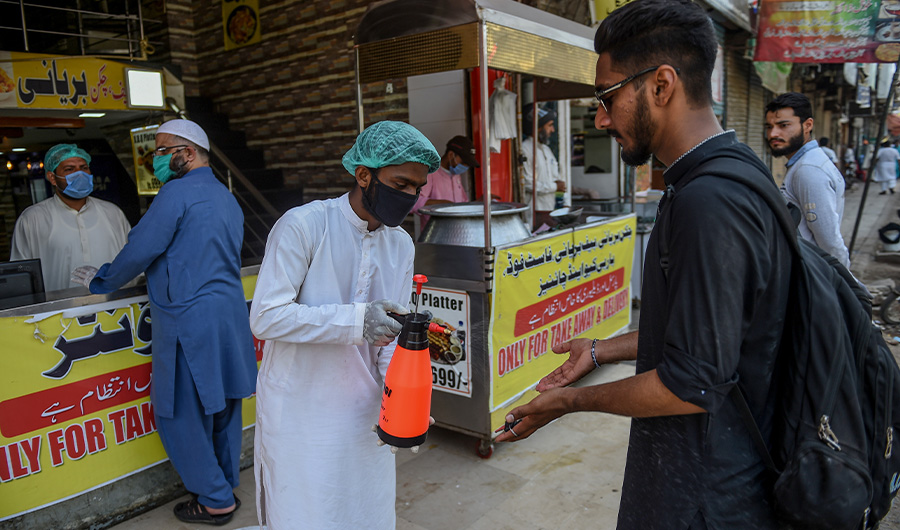
An employee (C) sanitizes the hands of a customer outside a restaurant open for takeaway and delivery services during a government-imposed nationwide lockdown as a preventive measure against the COVID-19 coronavirus, in Karachi on April 18, 2020. (AFP)
On Sunday, Pakistan recorded 539 new cases of the virus and 15 deaths in a single day, down from its highest tally of over 6,000 cases and 153 deaths on June 19. Separately, it has also dropped from the 11th most-impacted country globally in July to 14th position in August, as per a tally by the US-based Johns Hopkins University.
Still, fearing a spike in infections as people resume social contact, the government has outlined new health guidelines for the reopening.
In Punjab, Pakistan’s most populous province, which has recorded the second-highest Covid-19 caseload in the country, restaurants must keep dining rooms half-empty.
Under the new rules, customers will have to wear masks, handshakes and hugs will not be allowed, and the menu will not be distributed, states a notification dated August 7 by Punjab’s primary and secondary health care department.
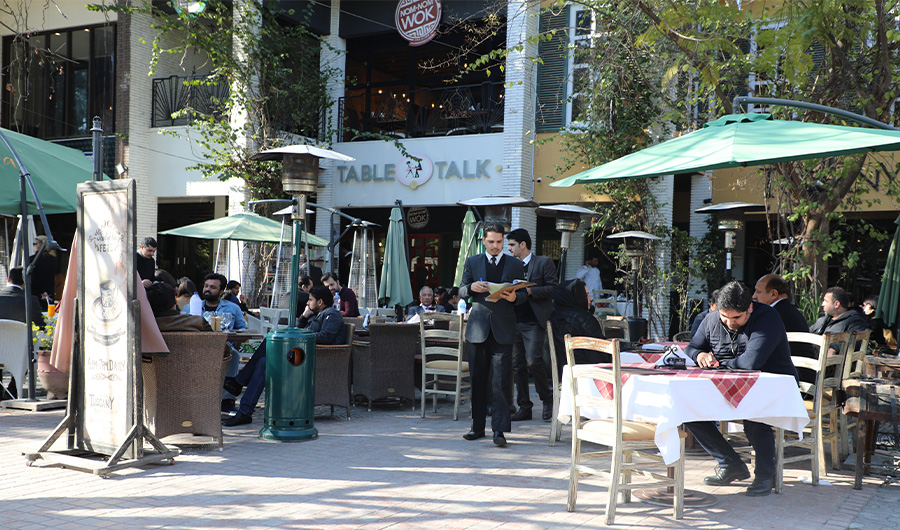
People enjoy their coffee at Kohsar Market, one of Islamabad's favorite meetup areas, Jan. 22, 2020. (AN photo)
Customers must sit on alternative chairs, leaving one chair vacant. The empty chair must be marked with a red cross, ribbon or a “no seating” card, adds the notification.
In order to check that dine-in restaurants do not violate health precautions, the Punjab Food Authority, which regulates food safety and hygiene in the province, will send its team regularly to inspect eateries, a senior health official, who asked not to be named, told Arab News.
However, Amir Rafiq Qureshi, who heads the Restaurants Unity Association, in Punjab’s capital city Lahore, is certain restaurants will follow all health guidelines. But owners, he added, need some “breathing space” to implement new rules.
“I also do hope the administration does not abuse its powers and harass restaurant staff,” Qureshi said, “We have instructed all restaurants in Lahore to keep pictures of inspection teams so we can be sure there is no mishap.”
Even though sit-down dinners have been allowed to open from today, a significant number of eateries did not survive the Covid-19 lockdown.
“Of the 1,000 plus restaurants in Lahore alone, 30 to 40 percent have shut down permanently and will not be resuming business,” he told Arab News, “As a result thousands of people are now unemployed.”
As for the tourism sector in Punjab, the standard operating procedures (SOPs) to reopen include limiting occupancy of a hotel or guest house to 60 percent, encouraging guests to book online and restricting tourist groups to 10 people, among other measures.


