

Starvation looms for Morocco’s horses as tourism collapses

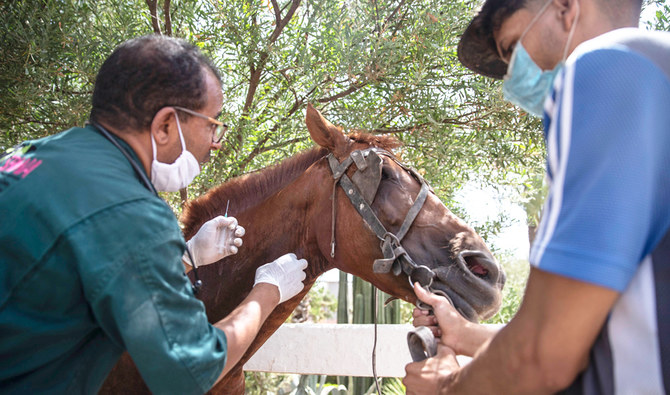
A doctor inspects a sick horse at the SPANA shelter in Marrakech. (AP)
Short Url
Updated 10 August 2020
Follow

Starvation looms for Morocco’s horses as tourism collapses

  • SPANA helped carriage owners provide the basics for their horses when the COVID-19 pandemic reached Morocco

MARRAKECH: Abdenabi Nouidi sold his favorite horse for $150 to help feed the others on the team that pulls tourists in carriages through the buzzing streets of Marrakech, and he is still scared about the future for the others. The prospect of starvation looms for carriage horses and other animals normally used in Morocco’s tourist mecca., since visitors have vanished during the coronavirus pandemic.
The Society for the Protection of Animals Abroad, or SPANA, says hundreds of Morocco’s carriage horses and donkeys are threatened amid the collapsing tourism industry. They are among the estimated 200 million horses, donkeys, camels and elephants worldwide providing various livelihoods for over a half-billion people.
The North African kingdom closed its doors to outsiders after the first virus case was confirmed March 2. It also recently issued a ban on domestic travel to eight cities, including Marrakech.
Thousands of people in the city depend on the carriage horses for their livelihood. A single horse carriage in Marrakech supports four to five families, including owners, drivers and stable boys, driver Abdeljalil Belghaoute said.
He spoke from his carriage, waiting in a line near the famed Jemaa El-Fnaa Square, hoping that someone would want a ride.
‘If you have a shop, you can close it. If you sell goods, you store them. But imagine having ... horses who need to eat, drink and get medical care,” said Abdeljalil Nouidi.
For two decades, the four Nouidi brothers have taken tourists on sightseeing jaunts in horse-drawn carriages. Now they have empty pockets and mouths to feed, both at home and at the rundown complex outside Marrakech where drivers stable their horses.
The brothers were forced to sell seven of their horses in July. Abdenabi Nouidi’s favorite, Cocotte, was among them.
“This is not something I can easily forgive myself for,” he said, recalling a promise he made to Cocotte 15 years ago to keep him forever.
The Nouidi brothers say their horses are visibly nervous and know an abrupt change in their lives may be coming. With no carriage work, the horses’ routine has been disrupted, feed is running low and stablemates are leaving for good.
SPANA helped carriage owners provide the basics for their horses when the COVID-19 pandemic reached Morocco. It delivered three months’ worth of feed to almost 600 horses in the city and the neighboring town of Aït Ourir during the country’s lockdown.
“It became very clear to us when the lockdown was first imposed that many of Marrakech’s working animals would need our help or face a dire outcome,” said the head veterinarian at SPANA’s Marrakech center, Hassan Lamrini.

NUMBER

200m horses, donkeys, camels and elephants worldwide are providing various livelihoods for over a half-billion people.

The center, in a working-class neighborhood, is a mecca for the city’s thousands of working animals. Since 1988, the team of vets and technicians have cared for donkeys, mules and horses free of charge.
Lamrini said the center has treated an increasing number of cases of colic, an abdominal pain that causes complications in the digestive system, often due to malnutrition. Colic can be fatal.
“There is not much in the world that matters to me more than caring for these animals. They are my entire life,” said Boujamaa Ninich, who has dedicated 50 years to working with SPANA. He spends weeks on end sleeping in a little room at the center to ensure the animals are cared for after dark.
“They give so much to their owners. There is so little that we can give back,’ he said.
Marrakech was nearly at a standstill on a recent visit. The Jamma El Fnaa Square, a vast area with hawkers, food vendors and snake-dancers, was nearly deserted.
“Only tourism can save us from this catastrophe we’re facing,” said Belghaoute, the carriage driver hoping for a fare.
The Moroccan government earlier this year launched a social media campaign to encourage citizens to explore their country, but spiking numbers of COVID-19 cases led to the travel ban for eight of the country’s top tourist cities.
Authorities counted 28,500 infections and 435 deaths as of Thursday, but experts say all counts in all countries understate the true toll of the pandemic, due to limited testing, missed mild cases and other factors.
“The longer this goes on, horses and families will struggle to survive. We’re really scared by how bad this can get,” Belghaoute said.


Lebanon approves financial gap draft law despite opposition from Hezbollah and Lebanese Forces

Lebanon's Prime Minister Nawaf Salam speaking during a press conference after a cabinet session in Beirut on December 26, 2025.
Updated 26 December 2025
Follow

Lebanon approves financial gap draft law despite opposition from Hezbollah and Lebanese Forces

  • Legislation aims to address the fate of billions of dollars in deposits that have been inaccessible to Lebanese citizens during the country’s financial meltdown

BEIRUT: Lebanon’s Cabinet on Friday approved a controversial draft law to regulate financial recovery and return frozen bank deposits to citizens. The move is seen as a key step in long-delayed economic reforms demanded by the International Monetary Fund.

The decision, which passed with 13 ministers voting in favor and nine against, came after marathon discussions over the so-called “financial gap” or deposit recovery bill, stalled for years since the banking crisis erupted in 2019. The ministers of culture and foreign affairs were absent from the session.

The legislation aims to address the fate of billions of dollars in deposits that have been inaccessible to Lebanese citizens during the country’s financial meltdown.

The vote was opposed by three ministers from the Lebanese Forces Party, three ministers from Hezbollah and the Amal Movement, as well as the minister of youth and sports, Nora Bayrakdarian, the minister of communications, Charles Al-Hajj, and the minister of justice, Adel Nassar.

Finance Minister Yassin Jaber broke ranks with his Hezbollah and Amal allies, voting in favor of the bill. He described his decision as being in line with “Lebanon’s supreme financial interest and its obligations to the IMF and the international community.”

The draft law triggered fierce backlash from depositors who reject any suggestion they shoulder responsibility for the financial collapse. It has also drawn strong criticism from the Association of Banks and parliamentary blocs, fueling fears the law will face intense political wrangling in Parliament ahead of elections scheduled in six months.

Prime Minister Nawaf Salam confirmed the Cabinet had approved the bill and referred it to Parliament for debate and amendments before final ratification. Addressing public concerns, he emphasized that the law includes provisions for forensic auditing and accountability.

“Depositors with accounts under $100,000 will be repaid in full with interest and without any deductions,” Salam said. “Large depositors will also receive their first $100,000 in full, and the remainder will be issued as negotiable bonds backed by the assets of the Central Bank, valued at around $50 billion.”

He said further that bondholders will receive an initial 2 percent payout after the first tranche of repayments is completed.

The law also includes a clause requiring criminal accountability. “Anyone who smuggled funds abroad or benefited from unjustified profits will be fined 30 percent,” Salam said.

He emphasized that Lebanon’s gold reserves will remain untouched. “A clear provision reaffirms the 1986 law barring the sale or mortgaging of gold without parliamentary approval,” he said, dismissing speculation about using the reserves to cover financial losses.

Salam admitted that the law was not perfect but called it “a fair step toward restoring rights.”

“The banking sector’s credibility has been severely damaged. This law aims to revive it by valuing assets, recapitalizing banks, and ending Lebanon’s dangerous reliance on a cash economy,” he said. “Each day of delay further erodes people’s rights.”

While the Association of Banks did not release an immediate response after the vote, it previously argued during discussions that the law would destroy remaining deposits. Bank representatives said lenders would struggle to secure more than $20 billion to cover the initial repayment tier and accused the state of absolving itself of responsibility while effectively granting amnesty for decades of financial mismanagement and corruption.

The law’s fate now rests with Parliament, where political competition ahead of the 2025 elections could complicate or delay its passage.

Lebanon’s banking sector has been at the heart of the country’s economic collapse, with informal capital controls locking depositors out of their savings and trust in state institutions plunging. International donors, including the IMF, have made reforms to the sector a key condition for any financial assistance.